12. Meteorites, Asteroids, Minor Planets & Comets#
Learning objectives: By the end of this lecture, you will be able to classify meteorites and use isotopic chronometers to date the early solar system, describe the dynamics and populations of the asteroid belt and trans-Neptunian region, explain the origin and structure of comets, and use small bodies as formation fossils that record the solar system’s dynamical and chemical history.
See also
Slides: Download Lecture 12 (PDF)
The previous lectures have followed the planets one by one: rocky worlds in Lecture 9 and Lecture 10, gas and ice giants in Lecture 11. This lecture is about everything that did not become a planet. Small bodies are the leftover pieces of the planet-building process: asteroids and meteorites in the inner solar system, comets and Kuiper Belt objects (KBOs) in the outer solar system, dwarf planets like Ceres and Pluto in between, and the Oort cloud at the gravitational edge of the Sun’s domain. Most of them are physically tiny. Together they carry far more information about how the solar system formed than the eight planets do, because they have been processed much less.
We follow the same descriptive-first structure as in the planet lectures. Part 1 introduces meteorites, the only solar-system samples we can study in a laboratory and the source of every absolute age in this course. Part 2 surveys the dynamical populations: asteroid belt, near-Earth asteroids, Kuiper Belt, scattered disk, dwarf planets, and the inferred Oort cloud. Part 3 covers the messengers and visitors: in-situ space missions, sample-return missions, planetary defence, and the new and remarkable category of interstellar interlopers. Pluto is treated here as the largest known KBO, not as a planet. Fig. 12.1 collects the small bodies visited by spacecraft to set the scale for the rest of the lecture.
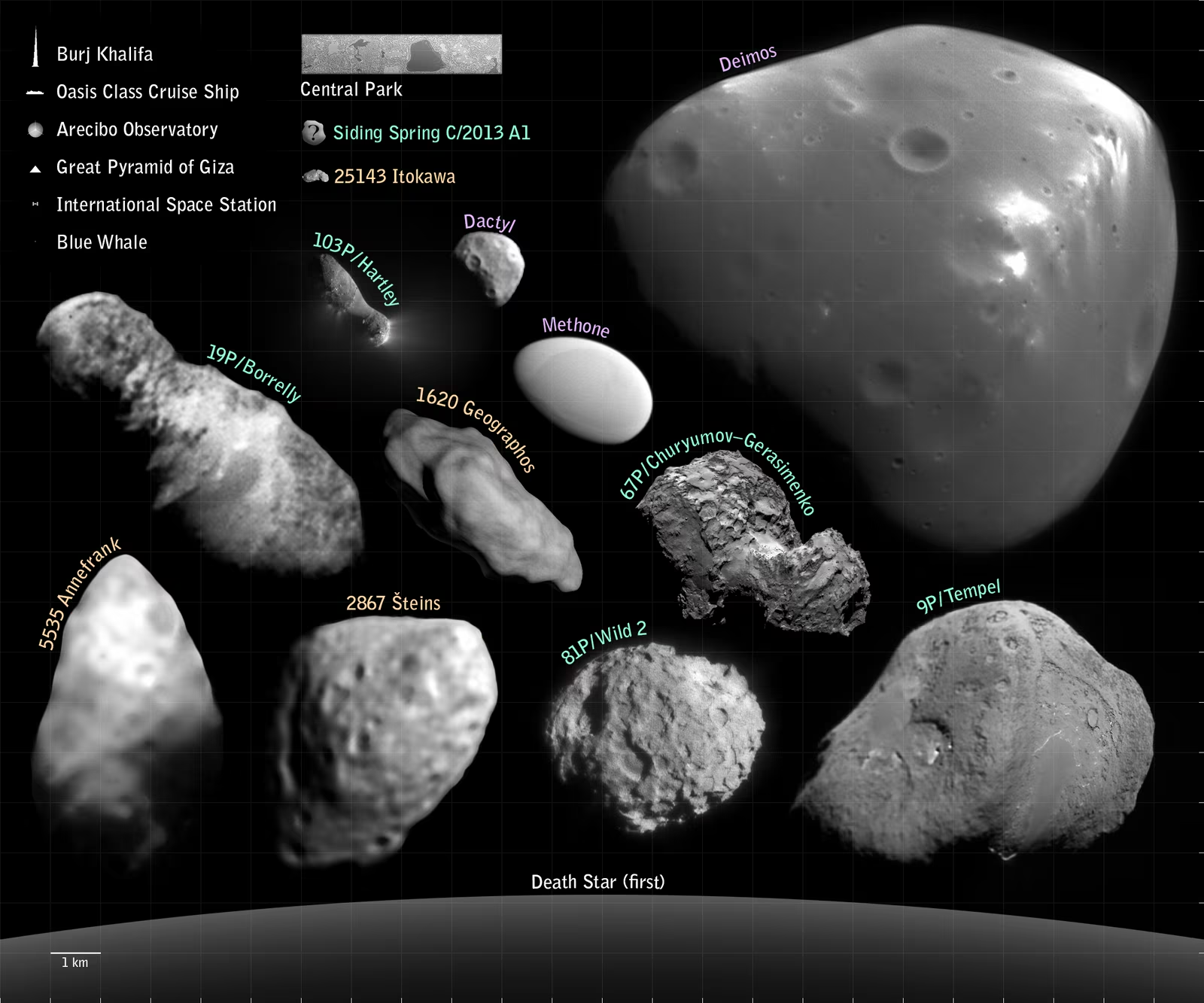
Fig. 12.1 Size comparison of representative small bodies visited by spacecraft, scaled against terrestrial landmarks for reference. Comet and asteroid nuclei span a range from sub-kilometre fragments to several hundred kilometres for the largest main-belt asteroids and dwarf planets. The major dynamical reservoirs from which these bodies are drawn (main belt asteroids and Trojans, asteroids that share Jupiter’s orbit while librating around its leading and trailing Lagrange points, inside Jupiter’s orbit; the Kuiper Belt and scattered disk just beyond Neptune; and the Oort cloud at \(10^4\)-\(10^5\) AU) are surveyed in the rest of this lecture. Image credit: NASA/JPL-Caltech, public domain.#
12.1. Part 1: Meteorites, samples of the early solar system#
12.1.1. Why meteorites matter#
A meteorite is a rocky or metallic fragment from interplanetary space that has survived atmospheric passage to reach the ground. Its parent body is the object, usually an asteroid, that produced the fragment. Meteorites are catalogued either as falls, recovered shortly after a witnessed fireball, or finds, collected after weathering on Earth [Krot et al., 2014]. The majority are recovered from Antarctica and deserts, where dark stones are easy to find against pale sand or ice and chemical weathering is slow.
Meteorites provide the oldest rocks available to terrestrial laboratories. Earth’s geological record begins around \(4.0\) Gyr ago and lunar rocks postdate Moon formation by hundreds of Myr, but primitive meteorites preserve grains that condensed directly from the protoplanetary disk. Some primitive meteorites contain presolar grains, mineral grains older than the Sun that condensed in the ejecta of dying stars [Zinner, 2014].
The oldest known solar system solids yield an absolute age of \(4567.30 \pm 0.16\) Myr [Connelly et al., 2012]. This date defines time zero (\(t = 0\)) against which to date planetesimal differentiation, core formation, and the giant impact that formed the Moon.
12.1.2. A taxonomy of stones from space#
Chondrites are primitive meteorites directly inherited from the protoplanetary disk. Their defining components are chondrules: millimetre-scale silicate spheres crystallised from molten droplets in the disk.
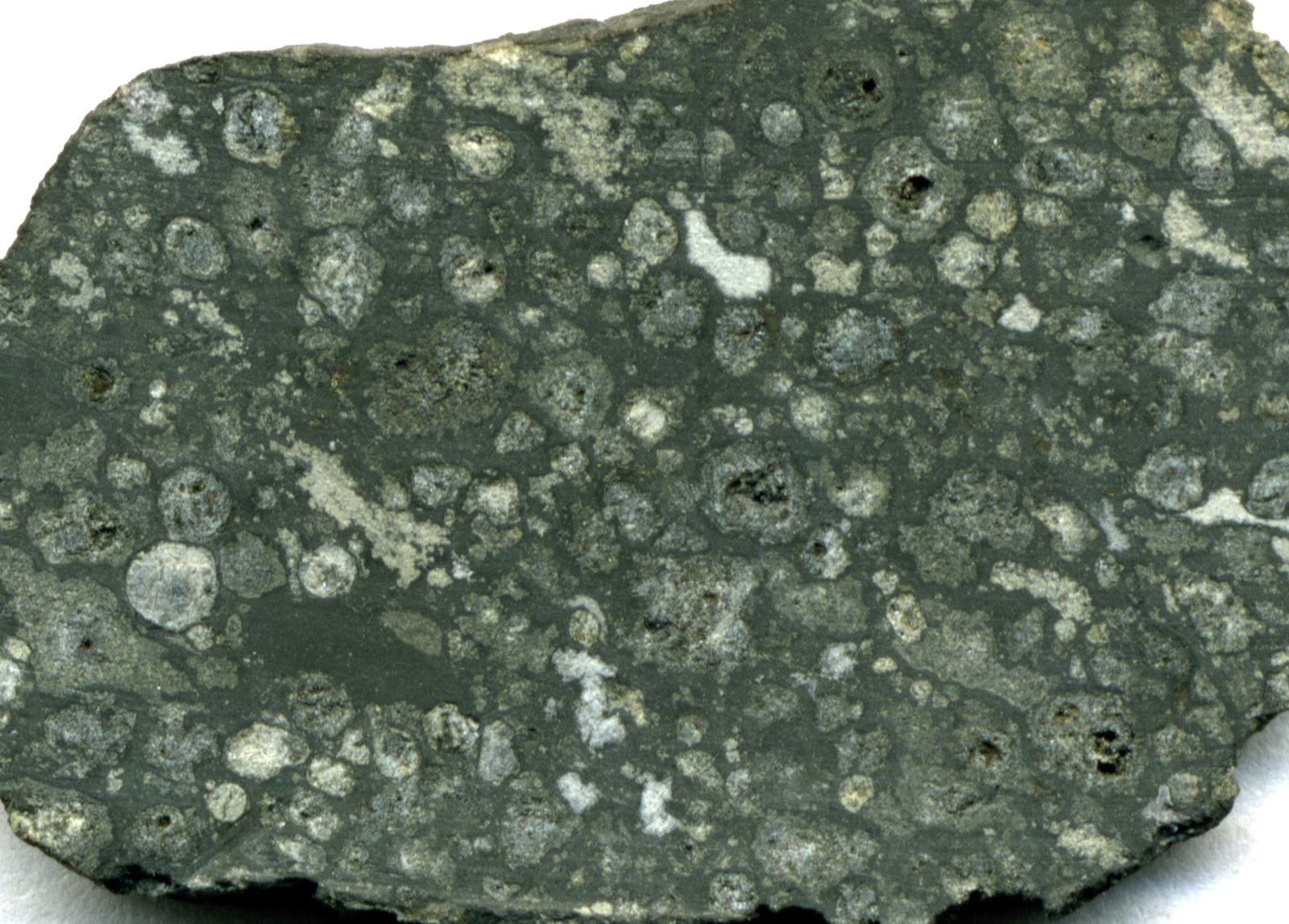
Fig. 12.2 A polished slab of the Allende carbonaceous chondrite (CV3), which fell in Mexico on 8 February 1969. Allende is rich in millimetre-scale chondrules (round, lighter inclusions) and bright Calcium-Aluminium-rich Inclusions (CAIs), the oldest known solids in the solar system. The matrix is dark, fine-grained, water-bearing material. Image credit: James St. John, CC BY 2.0 (Wikimedia Commons).#
Other meteorites are differentiated meteorites that melted and segregated into crusts and mantles (achondrites), metallic cores (iron meteorites), and mixed silicate-metal boundaries (stony irons).
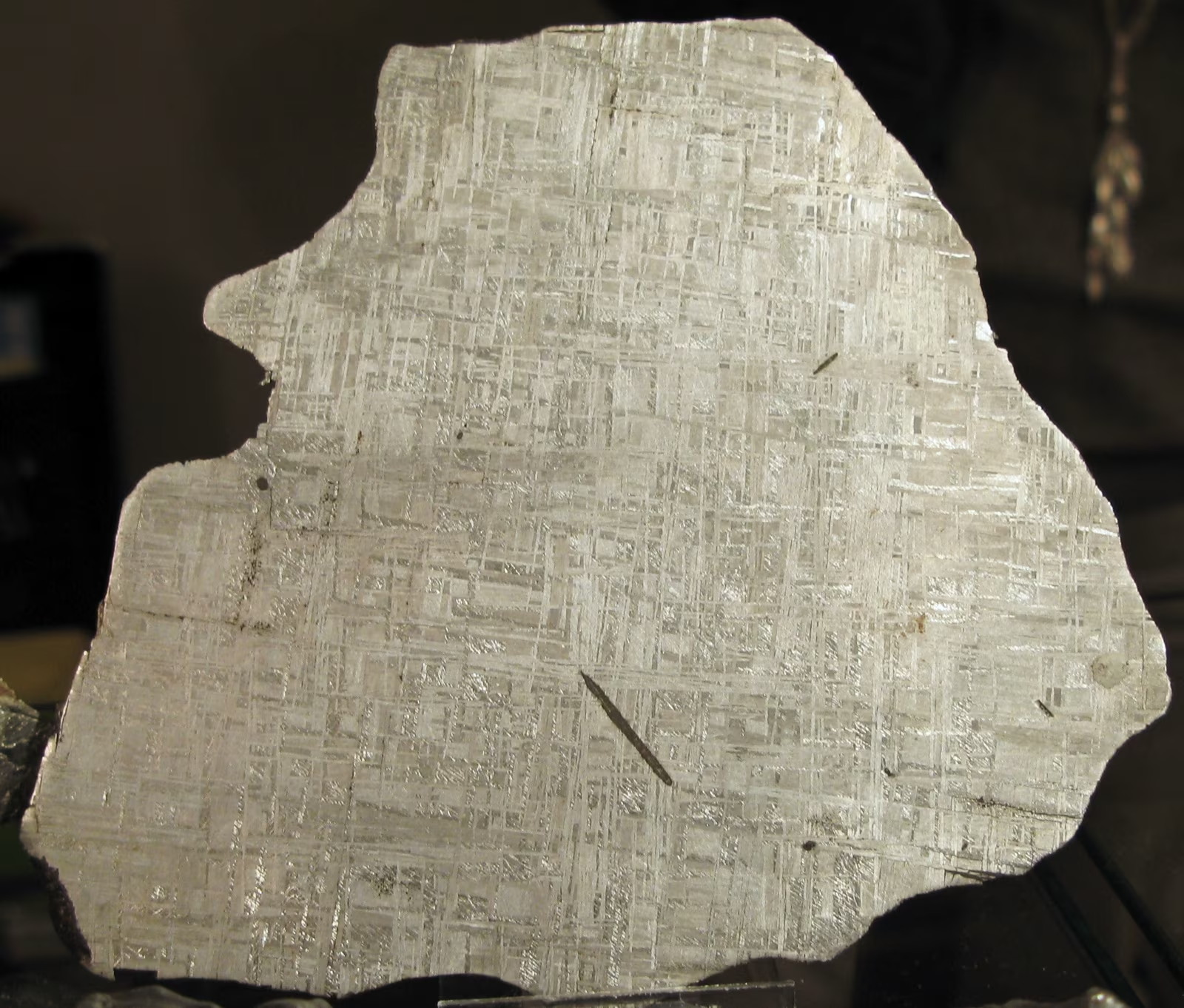
Fig. 12.3 Polished and acid-etched surface of an iron meteorite displaying the Widmanstätten pattern: an interlocking lattice of kamacite and taenite, two Fe-Ni phases. The pattern can only form if the solid metal cools at a rate slower than \(\sim 100\) K per million years inside the metallic core of a parent body of asteroid size or larger. Image credit: H. Raab, CC BY-SA 3.0 (Wikimedia Commons).#
The Widmanstätten pattern (Fig. 12.3) forms as Fe-Ni phases unmix during slow cooling (\(< 100\) K per million years) in metallic cores, indicating parent bodies tens to hundreds of kilometres in radius [Goldstein et al., 2009].
Pallasites (Fig. 12.4) are stony irons sampling the core-mantle boundary of a differentiated parent body.
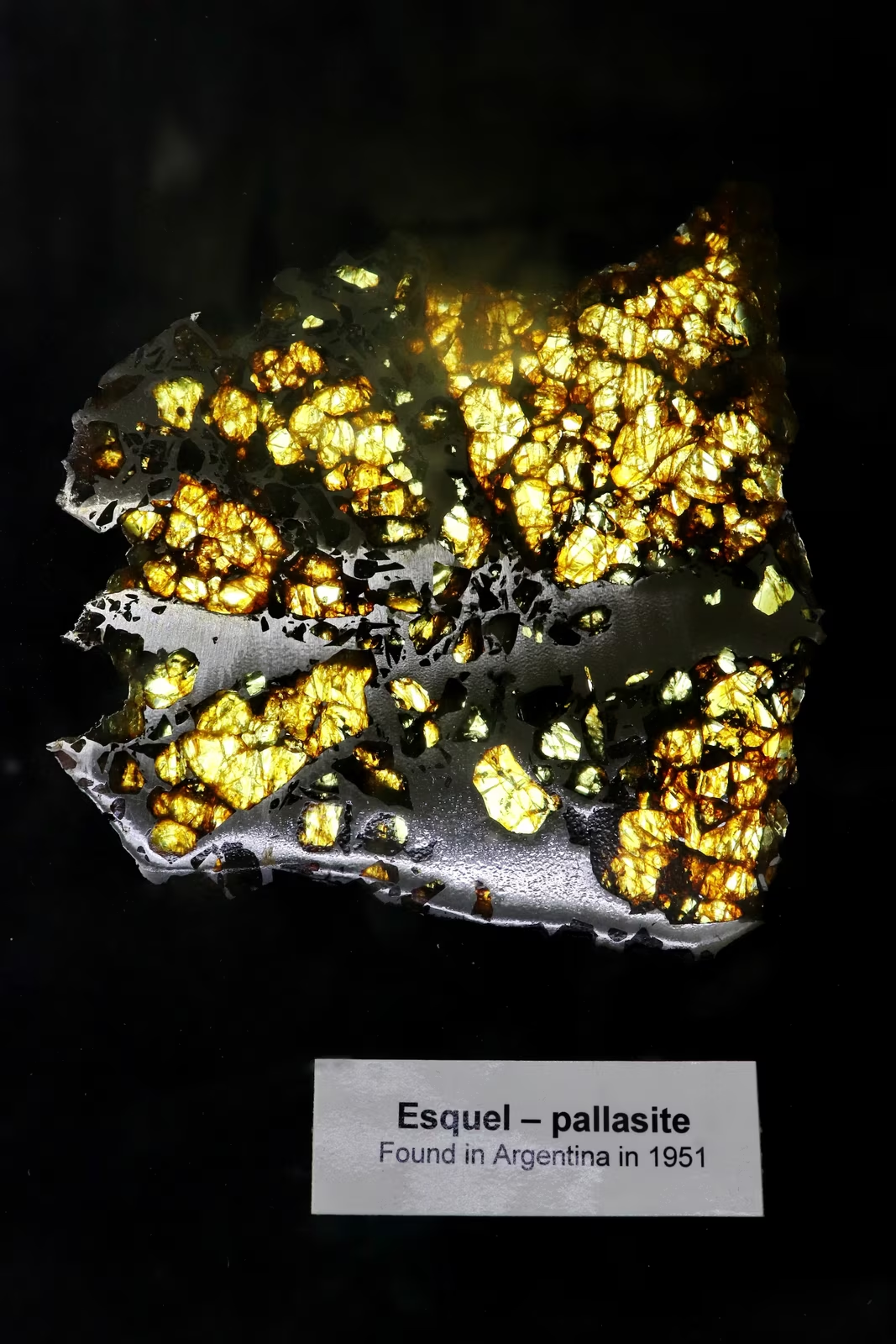
Fig. 12.4 Polished slice of the Esquel pallasite. Yellow-green olivine crystals are surrounded by a silvery Fe-Ni metallic matrix. Pallasites likely sample the core-mantle boundary of a differentiated planetesimal. Image credit: UCLA Meteorite Gallery, CC BY-SA 4.0 (Wikimedia Commons).#
12.1.3. The chondrite groups#
Within the chondrites, three broad groupings dominate. Ordinary chondrites are the most common falls (about 80% of observed falls), originating from dry, silicate-rich inner main belt asteroids and subdivided into H, L, and LL groups. Carbonaceous chondrites are volatile-rich and chemically primitive, subdivided into groups including CI and CM. Enstatite chondrites are the most reduced, dominated by metallic iron, suggesting formation in hot, low-oxygen disk regions close to the Sun.
CI chondrites occupy a special place in cosmochemistry because their non-volatile composition matches the solar photosphere [Lodders, 2003]. Samples returned from Ryugu by Hayabusa2 in 2020 confirm that CI chondrites represent real, accessible asteroids [Yokoyama et al., 2023].
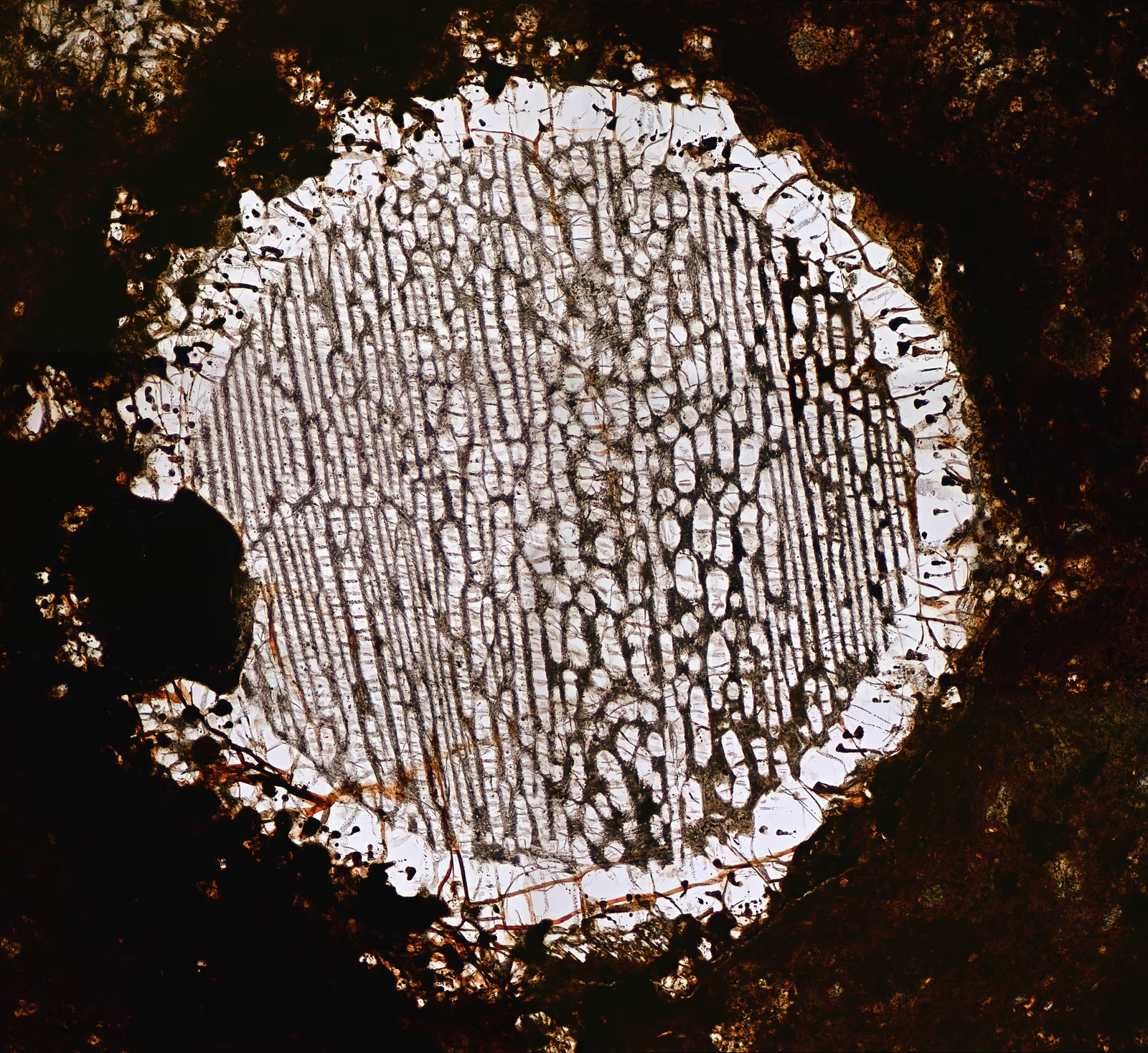
Fig. 12.5 Cross-polarised thin-section image of a chondrule in the NWA 5930 chondrite. The bright, interlocking crystals are olivine and pyroxene, frozen from a molten droplet that cooled in seconds to minutes inside the protoplanetary disk. Each chondrule is roughly a millimetre across. Image credit: H. Raab, CC BY-SA 3.0 (Wikimedia Commons).#
12.1.4. Chondrules and CAIs: the oldest solids#
The two most diagnostic components of a chondrite are millimetre-scale objects that formed in the disk before incorporation into parent bodies.
Calcium-Aluminium-rich Inclusions (CAIs) are the oldest known solar system materials, consisting of refractory oxides and silicates of Ca, Al, Mg, and Ti that condensed from hot gas above \(\sim 1400\) K. They range from sub-millimetre aggregates to centimetre-scale lumps, appearing white or grey against the darker chondrite matrix (Fig. 12.2). Three independent radiogenic chronometers (\(^{238}\mathrm{U}\)-\(^{206}\mathrm{Pb}\), \(^{235}\mathrm{U}\)-\(^{207}\mathrm{Pb}\), and \(^{232}\mathrm{Th}\)-\(^{208}\mathrm{Pb}\)) yield the same CAI age of \(4567.30\) Myr to within \(\pm 0.16\) Myr [Connelly et al., 2012]. That age defines the zero point of the solar system timescale, against which all other events are dated.
Chondrules are roughly spherical beads of olivine, pyroxene, glass, and metal that crystallised from molten droplets (Fig. 12.5), making up 60 to 80% of most chondrites by volume. Their textures record peak temperatures of \(\sim 1500\)-\(1900\) K and cooling rates from hundreds to thousands of K per hour over timescales of seconds to hours [Hewins et al., 2005].
How chondrules formed remains an unsolved problem in cosmochemistry. Candidate heating mechanisms include nebular shocks from gravitational instabilities, magnetic reconnection in current sheets, the X-wind model, and impact jetting between molten planetesimals [Connolly Jr. and Jones, 2016]. Pb-Pb ages of individual chondrules run from the CAI age to \(2.6\) Myr later, but primary chondrule formation was concentrated in the first million years after CAIs; the existing chondrules were then reworked over the lifetime of the disk [Bollard et al., 2017, Connelly et al., 2012]. Chondrules therefore formed while the disk cooled and the first planetesimals grew.
Fig. 12.6 places the two components on the time axis and sketches a chondrule’s heating event.
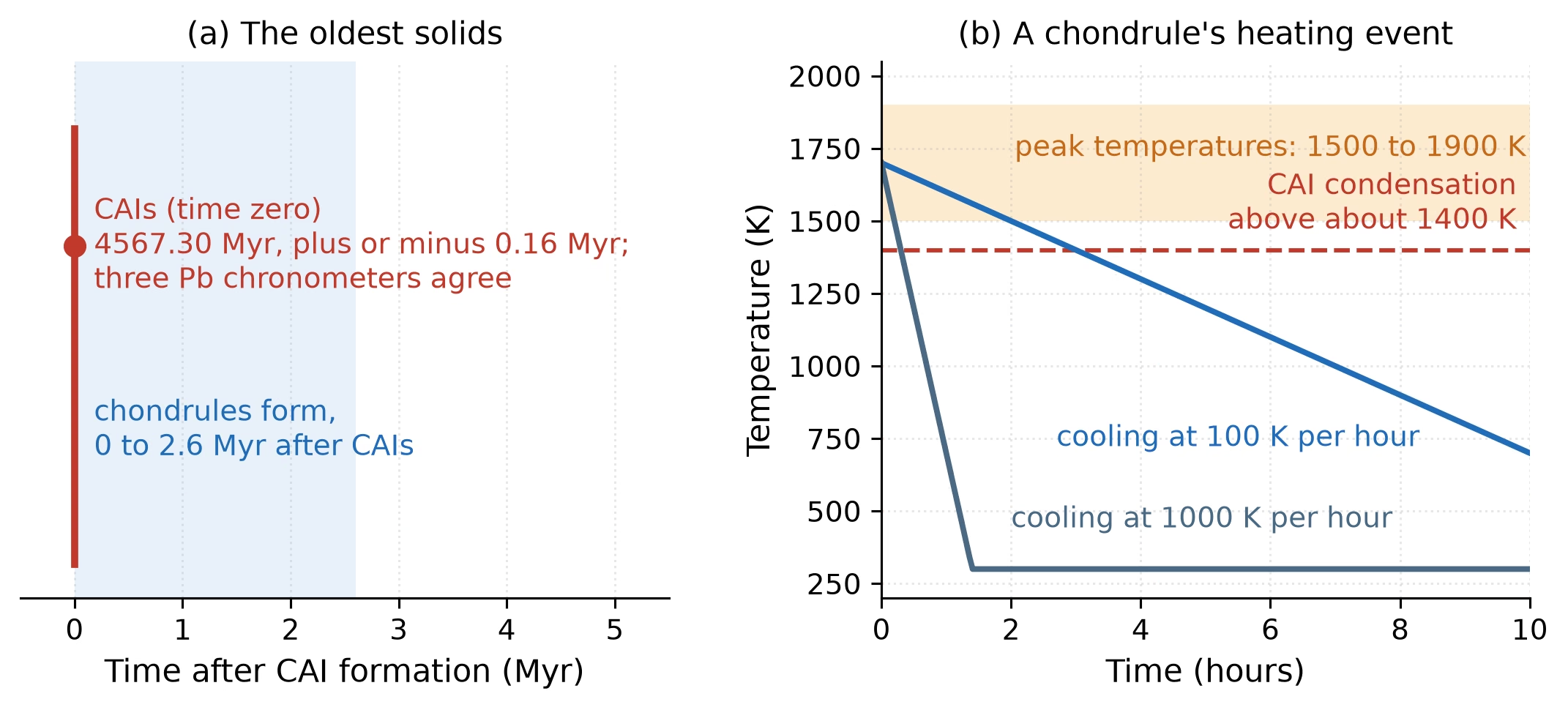
Fig. 12.6 (a) The oldest solids on the solar system time axis: CAIs at 4567.30 Myr (three Pb chronometers agree to within 0.16 Myr) define \(t = 0\), and individual chondrules date from \(t = 0\) to \(2.6\) Myr. (b) A chondrule’s heating event: peak temperatures of 1500 to 1900 K followed by cooling at hundreds to thousands of kelvin per hour, drawn as linear cooling from a 1700 K peak at 100 and at 1000 K per hour; CAIs condensed from gas above about 1400 K. Course-original figure.#
12.1.5. Isotopic dating of the early solar system#
Radioactive decay provides the chronometer of planetary science. A parent isotope decays to a daughter isotope at a rate proportional to its abundance:
where \(\lambda\) is the decay constant and \(t_{1/2} = \ln 2 / \lambda\) is the half-life. Measuring parent and daughter abundances gives the time elapsed since cooling below the closure temperature, locking daughter atoms in minerals.
Long-lived chronometers have half-lives exceeding the age of the solar system and remain active today. Primary systems include \(^{238}\mathrm{U} \to {}^{206}\mathrm{Pb}\) (\(t_{1/2} = 4.47\) Gyr), \(^{235}\mathrm{U} \to {}^{207}\mathrm{Pb}\) (\(t_{1/2} = 0.704\) Gyr), \(^{87}\mathrm{Rb} \to {}^{87}\mathrm{Sr}\), and \(^{147}\mathrm{Sm} \to {}^{143}\mathrm{Nd}\). The Pb-Pb system is the most precise because its two parallel decay chains provide an internal cross-check.
Short-lived chronometers had half-lives of a few Myr or less and are extinct today. Recorded only as daughter-isotope anomalies, they resolve processes on disk and planetesimal timescales:
Parent |
Daughter |
\(t_{1/2}\) (Myr) |
What it dates |
|---|---|---|---|
\(^{26}\mathrm{Al}\) |
\(^{26}\mathrm{Mg}\) |
0.717 |
CAI condensation, chondrule heating, planetesimal melting |
\(^{53}\mathrm{Mn}\) |
\(^{53}\mathrm{Cr}\) |
3.7 |
Aqueous alteration, early planetesimal differentiation |
\(^{182}\mathrm{Hf}\) |
\(^{182}\mathrm{W}\) |
8.9 |
Core formation in differentiated bodies |
\(^{129}\mathrm{I}\) |
\(^{129}\mathrm{Xe}\) |
16 |
Volatile retention in chondrites |
\(^{244}\mathrm{Pu}\) |
fission Xe |
80 |
Old-rock retention of fissiogenic Xe |
Cross-calibrating long-lived absolute ages with short-lived relative ages yields a high-resolution timeline for the first 10 Myr. Anchored to the Pb-Pb age of CAIs (\(t = 0\)), this dates planetesimal differentiation from \(t \approx 0.5\) to \(4\) Myr and protoplanet growth from \(t \approx 5\) Myr onward [Kleine et al., 2009, Kruijer et al., 2017]. Most chondrules date to \(t \approx 1\) to \(3\) Myr by this cross-calibration, though the earliest individual Pb-Pb ages extend to \(t = 0\). The rapid decay of two of these clocks, \(^{26}\mathrm{Al}\) and \(^{60}\mathrm{Fe}\), over the first 10 Myr of solar-system history is shown in Fig. 12.7.
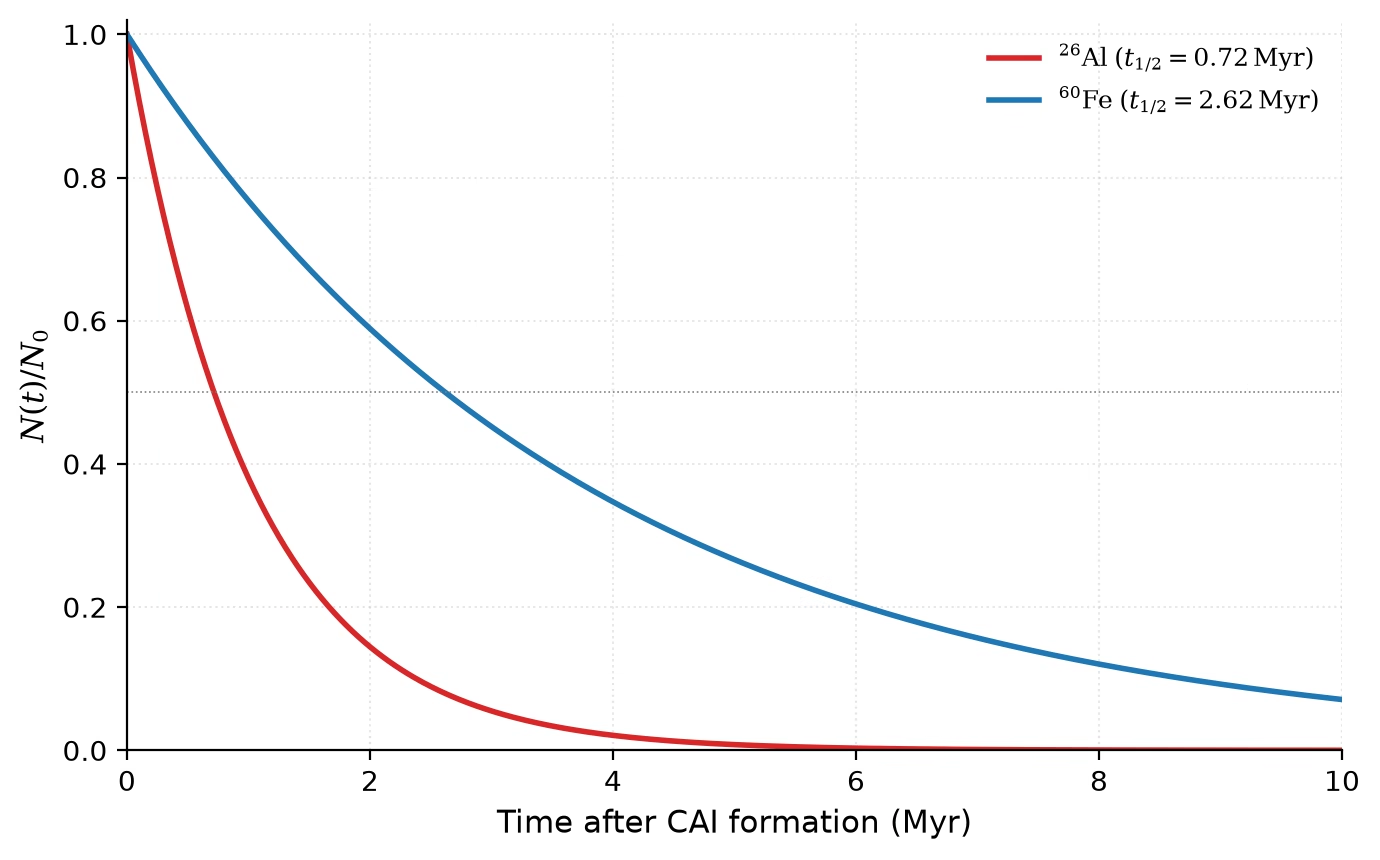
Fig. 12.7 Abundance decay curves of the key short-lived radionuclides \(^{26}\mathrm{Al}\) (\(t_{1/2} = 0.72\) Myr; [Castillo-Rogez et al., 2009]) and \(^{60}\mathrm{Fe}\) (\(t_{1/2} = 2.62\) Myr; [Rugel et al., 2009]) over the first 10 Myr after CAI formation. Rapid decay of these extinct isotopes powered early planetesimal melting and differentiation. Course-original figure.#
12.2. Blackboard derivation: The Pb-Pb isochron age of CAIs#
Blackboard derivation: The Pb-Pb isochron age of CAIs
We now derive the Pb-Pb isochron age of the oldest solar system solids. This is the single most important number in this lecture and the cleanest illustration of how multiple radioactive systems can be combined to bypass model assumptions.
Setup. Uranium has two long-lived isotopes that both decay to lead: \(^{238}\mathrm{U}\) to \(^{206}\mathrm{Pb}\) with decay constant \(\lambda_{238} = \ln 2 / (4.4683 \text{ Gyr})\), and \(^{235}\mathrm{U}\) to \(^{207}\mathrm{Pb}\) with \(\lambda_{235} = \ln 2 / (0.7038 \text{ Gyr})\). Lead also has a primordial isotope, \(^{204}\mathrm{Pb}\), that has no significant radiogenic source and is therefore a stable reference. We will measure ratios relative to \(^{204}\mathrm{Pb}\) throughout.
Step 1: Radiogenic daughter from the parent measured today. For each U-Pb system, the present amount of radiogenic daughter is the parent that has decayed:
Here \(t\) is the elapsed time since the system closed (the “age”), and the asterisk distinguishes radiogenic Pb produced in situ from any inherited initial Pb.
Step 2: Real rocks carry initial Pb. A real rock contains both initial and radiogenic Pb. Dividing each isotope by the stable reference \(^{204}\mathrm{Pb}\), we can write the present-day measured ratios as
where the subscript \(0\) denotes the initial (closure-time) ratio and “now” denotes the modern measurement. These two equations contain three unknowns each: the elapsed time \(t\), the initial Pb ratio, and the U/Pb ratio of the rock. Knowing only one isotope ratio you cannot solve for \(t\).
Fig. 12.8 shows where the argument is heading: several minerals from one rock fall on a straight line in the Pb-Pb plane, the line’s slope gives the age, and its intercept region gives the initial lead.
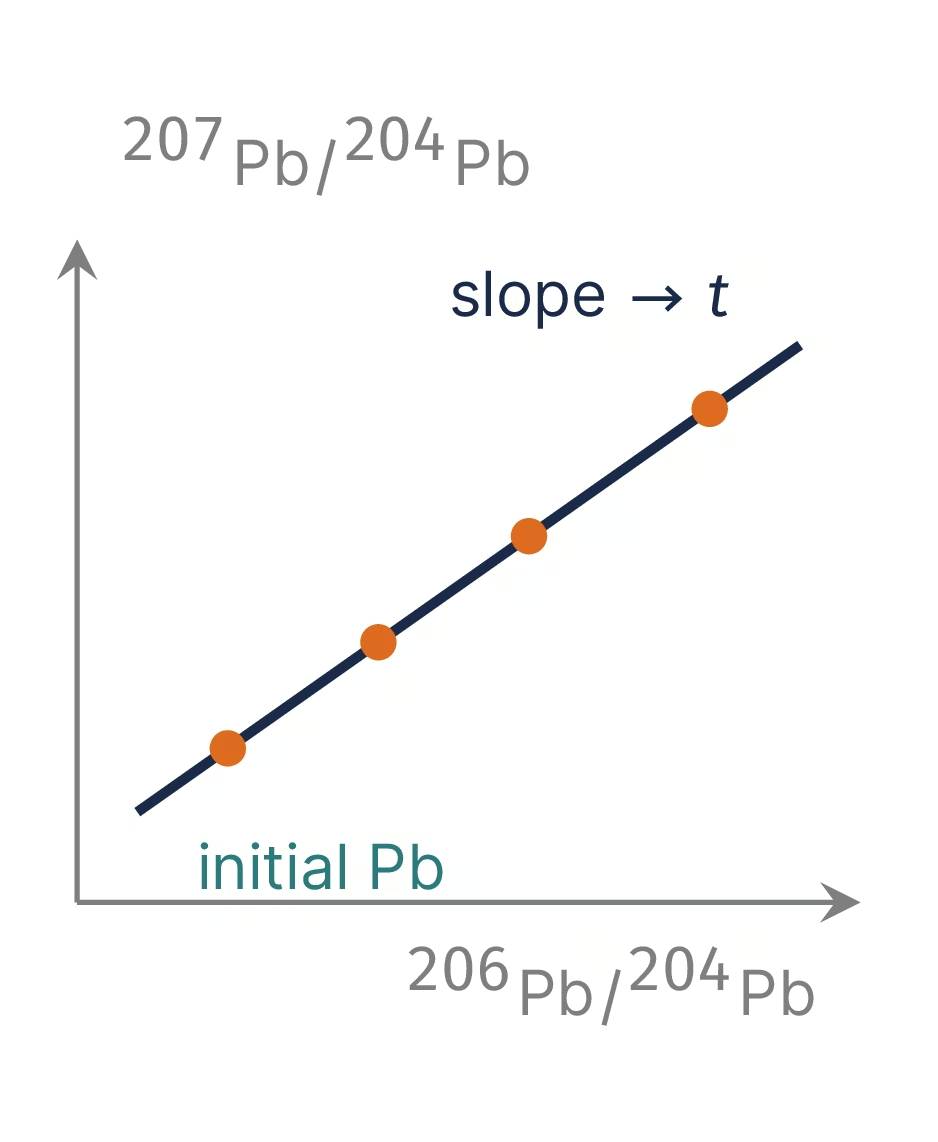
Fig. 12.8 Setup sketch of the board derivation of the Pb-Pb isochron age: measured \(^{207}\mathrm{Pb}/^{204}\mathrm{Pb}\) against \(^{206}\mathrm{Pb}/^{204}\mathrm{Pb}\) for several phases of one rock (orange points) fall on the isochron; its slope depends on the age \(t\) alone, and the initial Pb composition sits at the low-ratio end. Course-original figure.#
Step 3: Subtract the initial ratios and divide. For each isotope, move the initial ratio to the left-hand side and divide by the U/Pb ratio, so that the time function stands alone on the right; for \(^{206}\mathrm{Pb}\) this gives
and similarly for \(^{207}\mathrm{Pb}\). Now consider a suite of cogenetic samples, that is, several sub-samples of the same rock or several minerals that formed at the same time and from the same Pb reservoir. They all share the same initial Pb ratios and the same age \(t\). What differs between samples is the U/Pb ratio, because U and Pb partition differently into different mineral phases (U is incompatible in olivine, for example, while Pb is incompatible in apatite).
Take the ratio of the two equations above for the same sample, dividing the \(^{207}\)Pb/\(^{204}\)Pb expression by the \(^{206}\)Pb/\(^{204}\)Pb expression. The \(^{204}\)Pb terms cancel and the U-isotope ratio simplifies to the present-day \(^{235}\mathrm{U}/{}^{238}\mathrm{U}\) value, leaving
The right-hand side depends only on time (and on the present-day \(^{235}\mathrm{U}/{}^{238}\mathrm{U}\) ratio of the rock, which is well-measured: about \(1/137.8\) in CAIs once a small natural variability [Brennecka et al., 2010] is corrected for). The left-hand side is the slope of a line in a plot of \(({}^{207}\mathrm{Pb}/{}^{204}\mathrm{Pb})\) versus \(({}^{206}\mathrm{Pb}/{}^{204}\mathrm{Pb})\): this is the Pb-Pb isochron.
Why this is self-calibrating. For a suite of cogenetic samples that share an age and an initial Pb composition, all the measured points lie on a straight line. The slope depends only on \(t\), and the intercept gives the initial Pb ratio. You do not need to assume an initial Pb composition before fitting the data: it falls out of the fit. In contrast, a single U-Pb system (just \(^{238}\mathrm{U}\)-\(^{206}\mathrm{Pb}\)) requires an external estimate of the initial Pb to extract an age. The double system removes that assumption; this is why the Pb-Pb method is the gold standard for absolute dating in cosmochemistry.
Step 4: The CAI age. Connelly et al. [2012] performed Pb-Pb dating on individual CAIs from the Efremovka CV3 chondrite (CAIs 22E, 31E, 32E), complemented by the Allende CAI SJ101, after acid leaching to remove non-radiogenic contamination. The measured isochrons gave a CAI age of
The same work reported chondrule ages from Allende and NWA 5697 extending from about \(4567.3\) Myr down to \(4564.7\) Myr, leading Connelly et al. [2012] to argue that chondrule formation began essentially contemporaneously with CAIs. The later Pb-Pb work of Bollard et al. [2017] on 22 chondrules supports this early start: primary chondrule formation fell within the first million years after CAIs, and the existing chondrules were then reworked over the lifetime of the disk; most chondrules therefore carry short-lived-chronometer ages of \(\sim 1\)–\(3\) Myr after CAIs. The CAI age has been confirmed by independent samples and laboratories to within the same precision [Amelin et al., 2010]. This is the absolute zero of the solar system clock (Fig. 12.9 shows the Pb-Pb isochrons for the dated CAIs and chondrules).
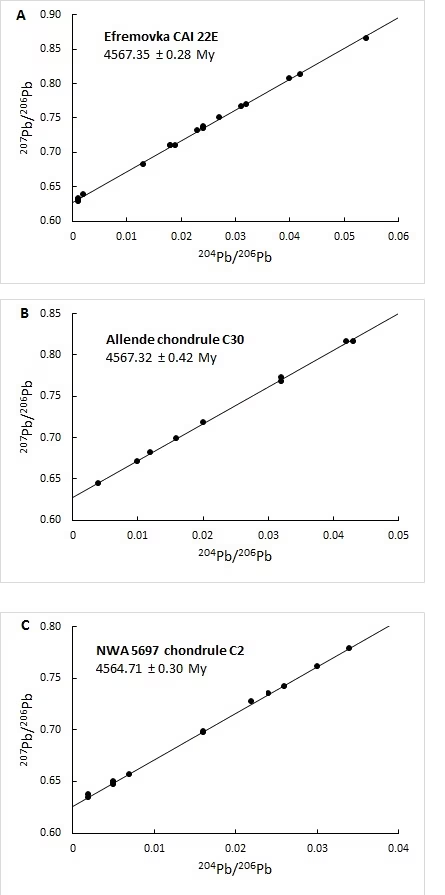
Fig. 12.9 Pb-Pb isochrons for (A) the Efremovka CAI 22E, (B) an Allende chondrule (C30), and (C) an NWA 5697 chondrule (C2). Each panel plots \(^{207}\mathrm{Pb}/^{206}\mathrm{Pb}\) versus \(^{204}\mathrm{Pb}/^{206}\mathrm{Pb}\) for cogenetic mineral fractions; on this inverse isochron the intercept at zero \(^{204}\mathrm{Pb}/^{206}\mathrm{Pb}\) gives the radiogenic \(^{207}\mathrm{Pb}/^{206}\mathrm{Pb}\) ratio, which yields the absolute age. The single-isochron age for CAI 22E, \(4567.35 \pm 0.28\) Myr, is consistent with the weighted-mean CAI age \(4567.30 \pm 0.16\) Myr derived from multiple CAIs in the main text. The Allende chondrule is contemporaneous with CAIs to within uncertainties, while the NWA chondrule is about 2.6 Myr younger. Figure adapted from Connelly et al. [2012].#
12.2.1. Petrographic and shock metamorphism#
The petrographic type of a chondrite, on a scale from 1 to 7, records how much its parent body altered it after accretion. By convention, type 3 is the least altered. Types 2 and 1 record progressively heavier aqueous alteration, where low-temperature reactions with water form clays and erase original chondrules. Types 4 through 7 record increasing thermal metamorphism, where higher temperatures coarsen mineral grains, equilibrate compositions, and destroy chondrule outlines.
The shock stage, denoted S1 (unshocked) through S6 (heavily shocked, partially melted), records impact history [Stöffler et al., 1991]. Shock features include planar fractures in olivine and pyroxene crystals, dark melt veins, and high-pressure minerals such as ringwoodite and majorite that form at pressures of tens of GPa.
Fig. 12.10 lays out both scales.
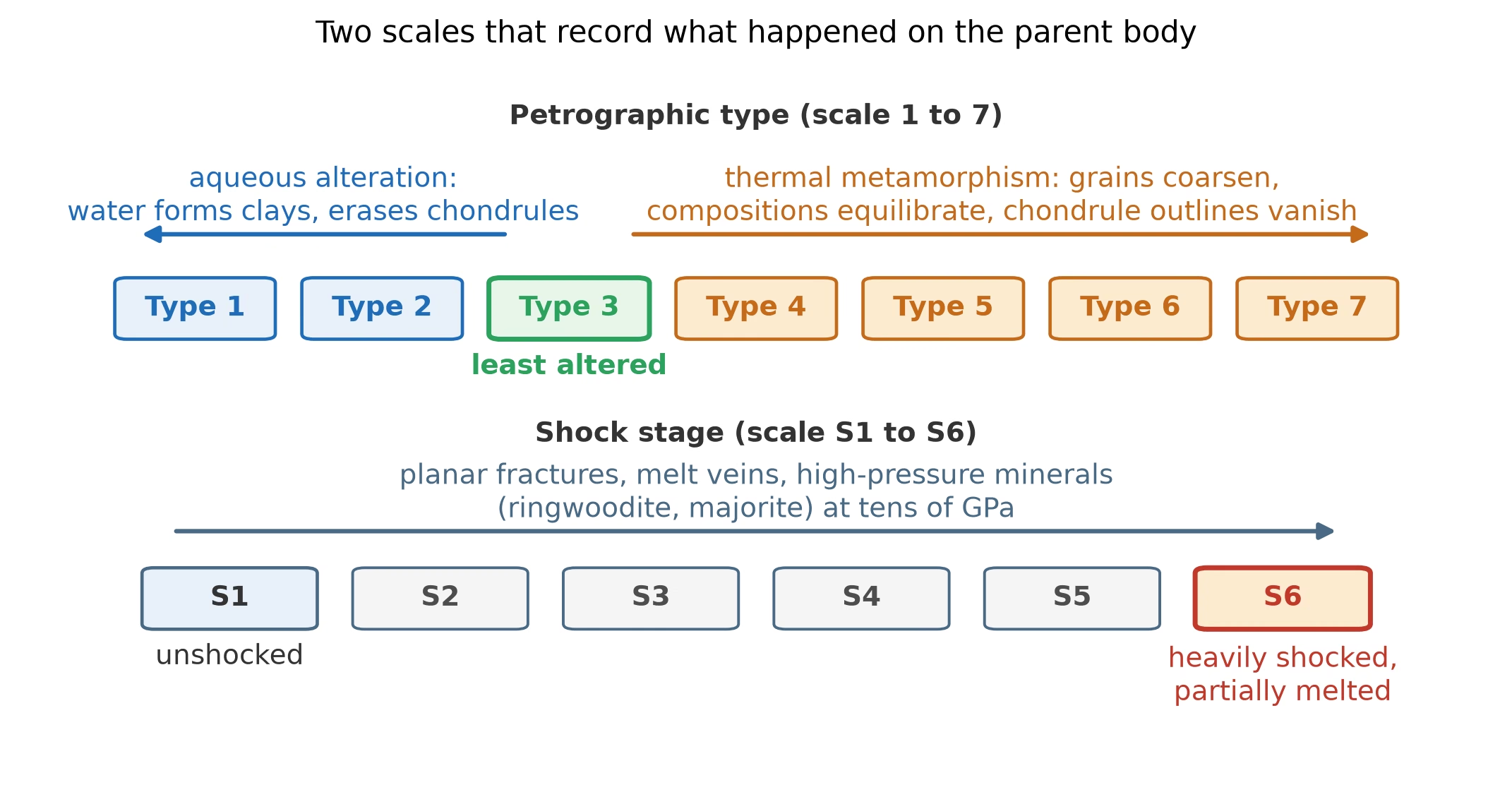
Fig. 12.10 The two scales that record what a parent body did to a chondrite. Petrographic type 3 is the least altered; types 2 and 1 record increasing aqueous alteration, in which water forms clays and erases chondrules, and types 4 to 7 increasing thermal metamorphism, in which grains coarsen, compositions equilibrate and chondrule outlines vanish. The shock stage runs from S1 (unshocked) to S6 (heavily shocked, partially melted), with planar fractures, melt veins and high-pressure minerals such as ringwoodite and majorite formed at tens of GPa. Course-original figure.#
12.2.2. Differentiated bodies, lunar and Martian meteorites#
Achondrites, irons, and stony irons all come from parent bodies that experienced bulk melting. The primary heat source was the decay of \(^{26}\mathrm{Al}\), with a half-life of 0.7 Myr and an initial abundance of about \(5 \times 10^{-5}\) relative to stable \(^{27}\mathrm{Al}\). This delivered enough heat to melt planetesimals larger than \(\sim 20\) km formed at the start of the CAI epoch, whereas bodies accreting after \(\sim 1.5\) Myr never melted and remained chondrites [Hevey and Sanders, 2006].
The most important achondrite group are the HED meteorites (howardites, eucrites, and diogenites), which make up \(\sim 6\%\) of falls and share a unique parent, the asteroid (4) Vesta. The Dawn mission confirmed this link (Fig. 12.11), showing that the giant Rheasilvia impact basin excavated deep layers and likely ejected the HED meteorites into space [Russell et al., 2012].
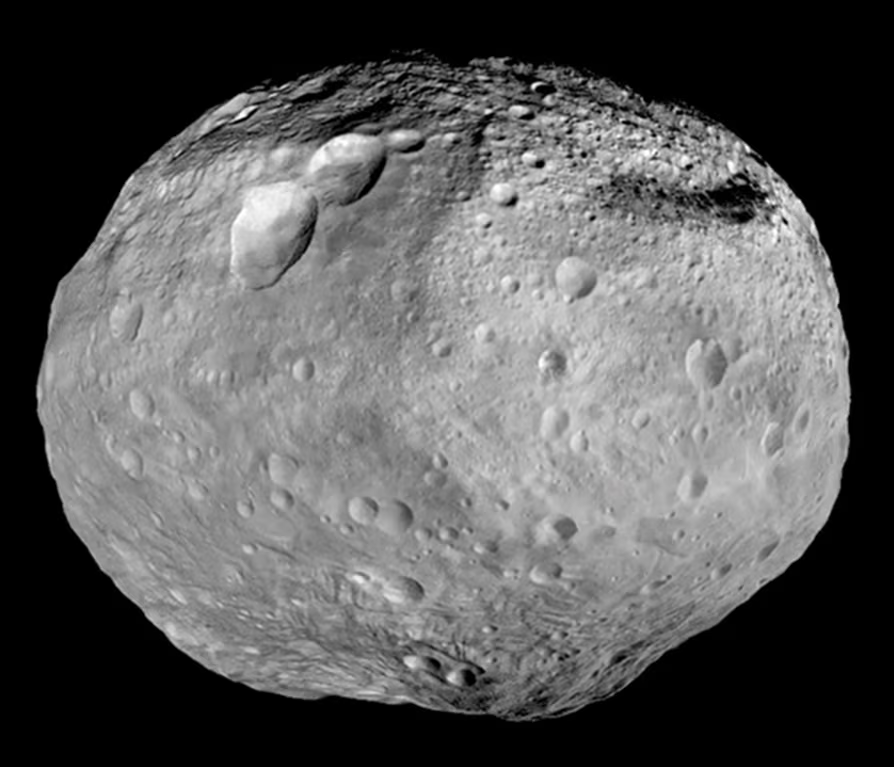
Fig. 12.11 Mosaic of (4) Vesta from NASA’s Dawn mission, taken in 2011–2012. Vesta is the second-largest asteroid in the main belt and the parent body of the HED meteorite suite. The southern hemisphere is dominated by the giant Rheasilvia impact basin (visible at lower right), which is responsible for delivering Vesta-derived material to Earth as meteorites. Image credit: NASA/JPL-Caltech/UCLA/MPS/DLR/IDA, public domain.#
In addition to asteroidal achondrites, two groups come from larger planetary bodies:
Lunar meteorites match Apollo and Luna sample compositions and sample regions of the Moon never visited by spacecraft.
Martian meteorites (the SNC group) contain trapped atmospheric noble gases whose composition matches measurements in Mars’s atmosphere [Bogard and Johnson, 1983].
Both groups are launched when large impacts eject material above the parent body escape velocity, eventually reaching Earth.
12.2.3. Oxygen isotopes as a parent-body fingerprint#
The oxygen three-isotope plot (\(\delta^{17}\mathrm{O}\) versus \(\delta^{18}\mathrm{O}\)) is the primary tool for identifying meteorite parent bodies [Clayton et al., 1973]. Oxygen has three stable isotopes: \(^{16}\mathrm{O}\), \(^{17}\mathrm{O}\), and \(^{18}\mathrm{O}\). On Earth, natural processes operate by mass-dependent fractionation, where heavier isotopes react slightly slower and fractionation in \(^{17}\mathrm{O}/^{16}\mathrm{O}\) is half that in \(^{18}\mathrm{O}/^{16}\mathrm{O}\). All terrestrial samples therefore lie on a single line of slope \(1/2\).
Meteorites do not follow this terrestrial trend. In CAIs, oxygen isotopes define a slope-1 line displaced from the terrestrial line, indicating mixing with a nearly pure \(^{16}\mathrm{O}\) reservoir [Yurimoto and Kuramoto, 2004]. Each meteorite group occupies a distinct cluster: ordinary chondrites plot above the terrestrial line, carbonaceous chondrites plot below it, enstatite chondrites and lunar samples lie on the terrestrial line, and the HED and SNC groups plot on lines consistent with Vesta and Mars [Greenwood et al., 2017].
This isotopic clustering identifies parent bodies of unknown meteorites and classifies returned samples. Hayabusa2 samples from Ryugu plot with CI chondrites, whereas OSIRIS-REx samples from Bennu fall near ungrouped carbonaceous chondrites while sharing CI-like bulk composition [Lauretta et al., 2024, Yokoyama et al., 2023].
Fig. 12.12 sketches the diagram.
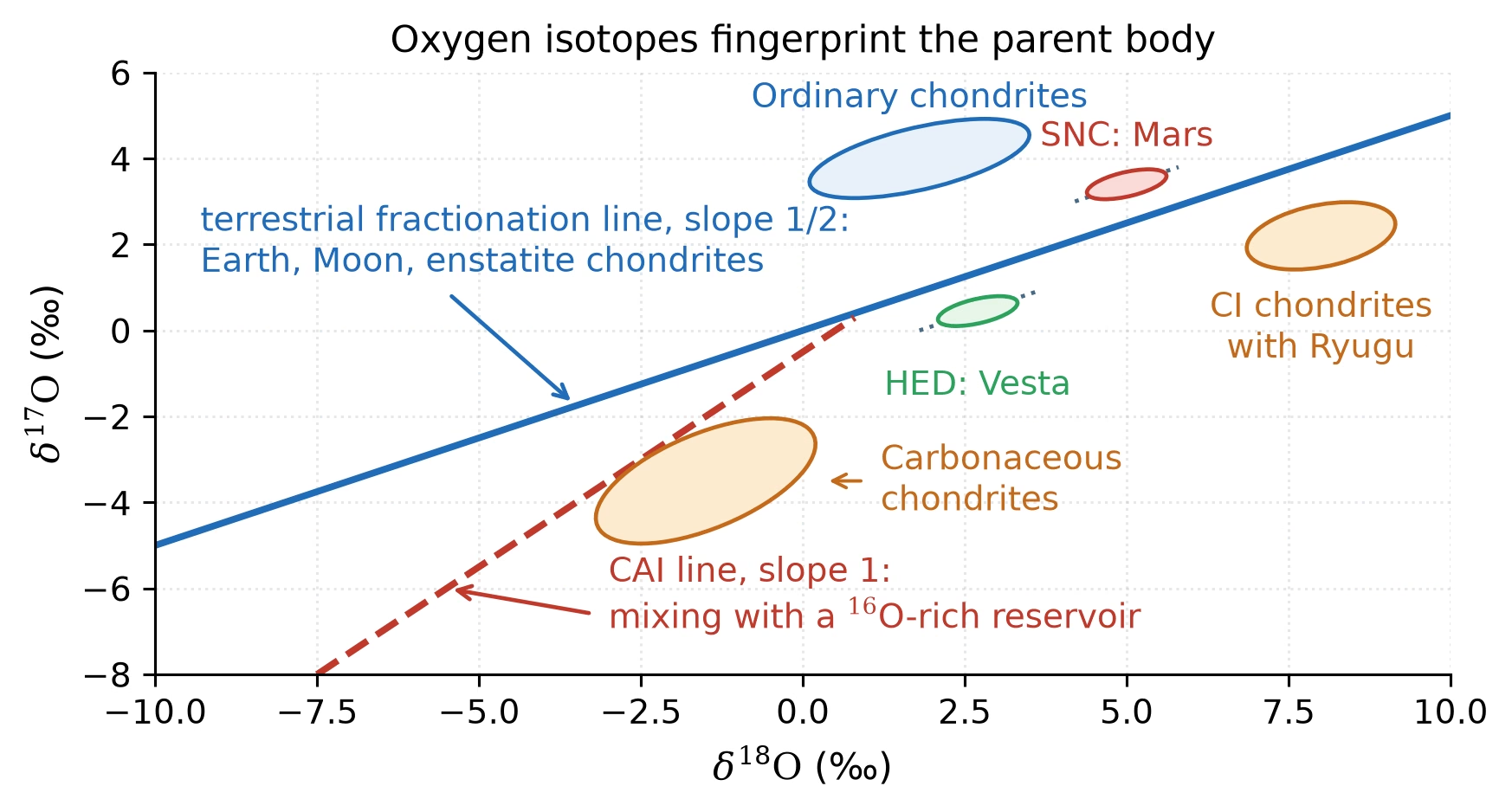
Fig. 12.12 Schematic oxygen three-isotope plot, \(\delta^{17}\)O against \(\delta^{18}\)O. Mass-dependent fractionation puts every terrestrial sample, the Moon and the enstatite chondrites on the terrestrial fractionation line of slope 1/2; CAIs define a slope-1 line that records mixing with a nearly pure \(^{16}\)O reservoir. Ordinary chondrites plot above the terrestrial line, carbonaceous chondrites below it, CI chondrites together with the Ryugu samples, and the HED and SNC groups on their own parallel lines for Vesta and Mars. Cluster positions are schematic; the slopes and the ordering above and below the terrestrial line follow the text. Course-original figure.#
12.2.4. The NC-CC isotopic dichotomy: three competing interpretations#
Nucleosynthetic anomalies split meteorites into non-carbonaceous (NC) and carbonaceous (CC) reservoirs that did not mix for at least the first \(\sim 3\)–\(4\) Myr [Kruijer et al., 2017, Warren, 2011].
Three competing physical interpretations explain this dichotomy (Fig. 12.13).
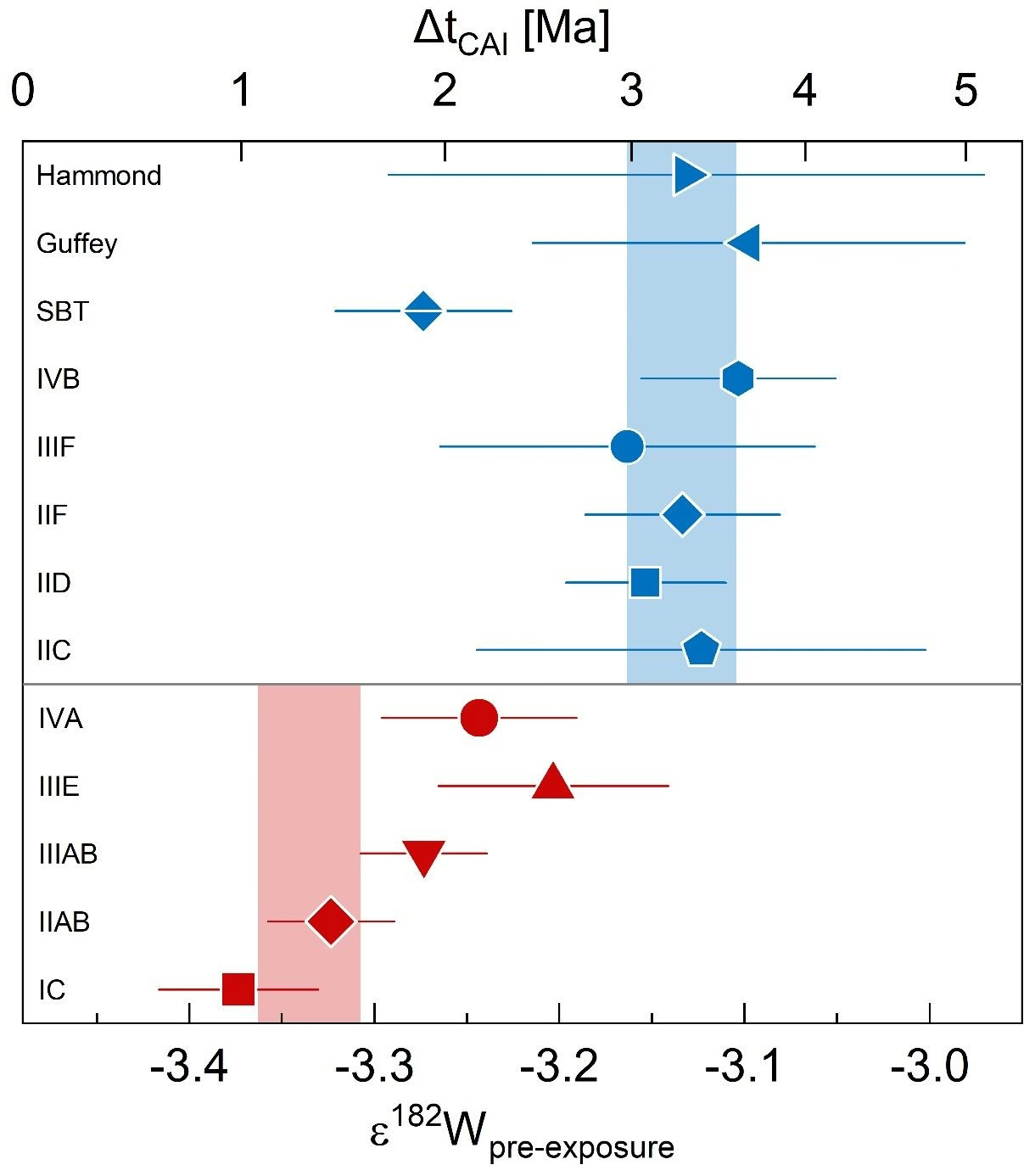
Fig. 12.13 Hf-W metal-silicate constraints show NC core formation at \(\Delta t_{\text{CAI}} = 1.0\) to \(2.6\) Myr (\(\varepsilon^{182}\mathrm{W} = -3.37\) to \(-3.20\)) and CC core formation at \(3.0\) to \(3.6\) Myr (\(\varepsilon^{182}\mathrm{W} = -3.16\) to \(-3.10\)). The separation of roughly \(2\) Myr between the two reservoirs is the key constraint that all three interpretations must satisfy (from Figure 5 of Spitzer et al. [2021]).#
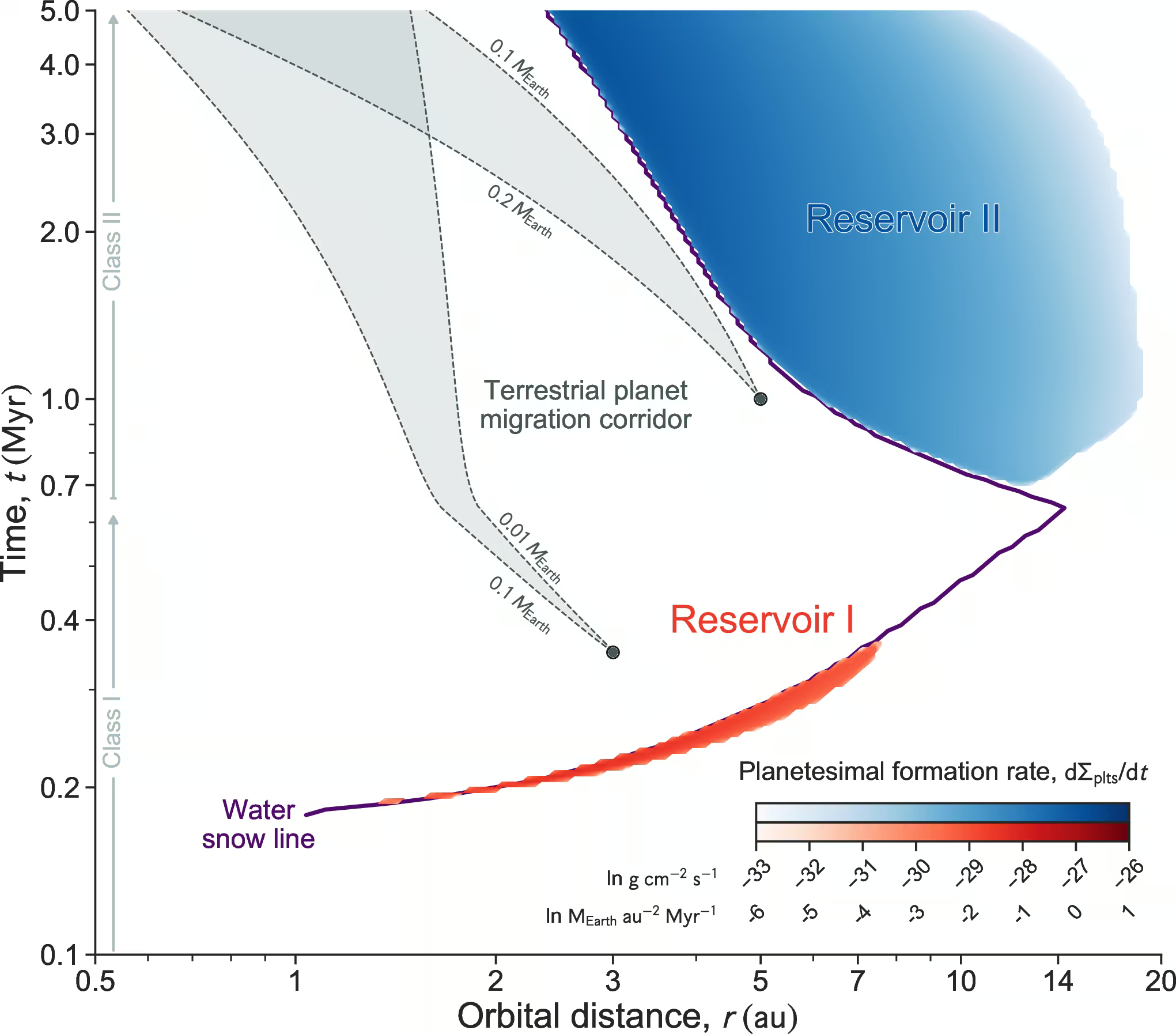
Fig. 12.14 Planetesimal formation rate \(\dd \Sigma_{\text{plts}} / \dd t\) across orbital distance \(r\) and time \(t\) after CAI formation, where outward snow-line migration produces early dry NC bodies (Reservoir I) and inward migration forms later ice-rich CC bodies (Reservoir II). This bifurcation arises from disk thermal evolution without requiring an early formed Jupiter barrier (from Figure 1 of Lichtenberg et al. [2021]).#
Three competing hypotheses explain the physical cause of this bifurcation:
A spatial cause [Kruijer et al., 2017]: a \(\sim 20\,\Mearth\) early Jupiter core opens a disk gap, blocking inward drift of CC pebbles (Lecture 2).
A dynamical cause [Lichtenberg et al., 2021]: snow-line migration produces two distinct planetesimal reservoirs (Fig. 12.14), with Jupiter halting pebble drift once it reaches the pebble isolation mass.
A temporal cause [Schiller et al., 2018, Spitzer et al., 2020]: the composition of the inner-disk solids changed rapidly with time during the infall from the parent molecular cloud, so planetesimals that formed at different times locked in different compositions.
12.3. Part 2: Small body populations and dynamics#
We move now from individual rocks to entire populations. Where in the solar system do small bodies live, what shapes their orbits, and what does the present distribution tell us about the dynamical history of the planets?
12.3.1. The asteroid belt: structure and orbital dynamics#
The asteroid belt is the largest reservoir of small bodies inside Neptune’s orbit, situated between \(a = 2.1\) AU and \(a = 3.3\) AU with \(e < 0.3\) (Fig. 12.15). Its total mass is approximately \(4 \times 10^{-4}\,\Mearth\), of which Ceres contributes nearly \(40\%\) [Bottke et al., 2020].
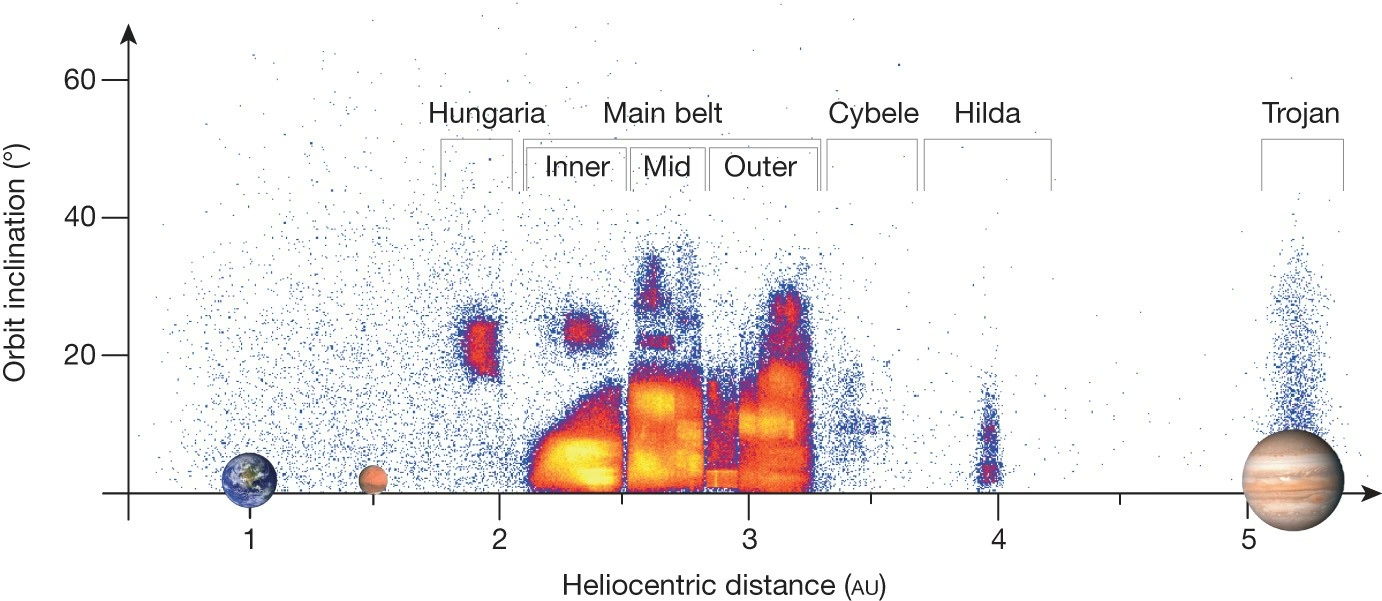
Fig. 12.15 The asteroid belt in context: orbital inclination as a function of heliocentric distance for catalogued asteroids. Each point is a single body and the colour intensity scales with the local number density. Yellow points show the high-density regions of the main belt between \(\sim 2.1\) and \(\sim 3.3\) AU, with the Hungarias and Hildas labelled and the Jupiter Trojans visible at \(5.2\) AU. The vertical Kirkwood resonances at \(2.5\), \(2.8\), and \(3.3\) AU appear as gaps in the density. From Figure 1 of DeMeo and Carry [2014].#
The Kirkwood gaps are depletions in semimajor axis where mean-motion resonances with Jupiter pump eccentricities to planet-crossing values over \(10^4\)-\(10^6\) years. These dynamical sinks continuously supply near-Earth asteroids [Wisdom, 1985] (Fig. 12.16).
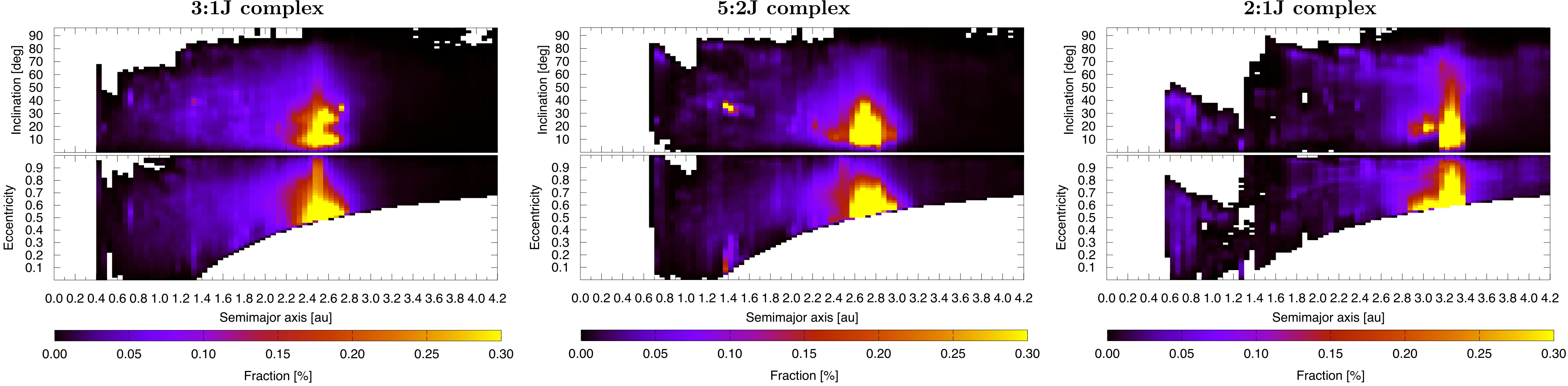
Fig. 12.16 Steady-state orbit distributions of the near-Earth objects that leave the main belt through the three principal Jupiter mean-motion resonances: the 3:1J complex at \(a \approx 2.50\) AU (left), the 5:2J complex at \(a \approx 2.82\) AU (middle), and the 2:1J complex at \(a \approx 3.27\) AU (right). Each column holds two panels for one escape route: inclination against semimajor axis on top, eccentricity against semimajor axis below. The colour scale is the fraction of the steady-state population in each bin, from black (empty) through purple and orange to yellow (highest). The yellow concentration in each column is close to the semimajor axis of its own resonance, and the population spreads to eccentricities above \(0.5\) and to inclinations of several tens of degrees, which is what makes these orbits planet-crossing. Assembled from the steady-state column of Figure 5 of Granvik et al. [2018].#
12.3.2. Asteroid families and spectral taxonomy#
Asteroid families are clusters of asteroids sharing similar proper elements (orbital elements averaged over secular variations), representing collisional debris from a disrupted parent body. Their size distribution and orbital spread constrain parent body sizes, impact energies, and disruption ages [Nesvorný et al., 2015] (Fig. 12.17).
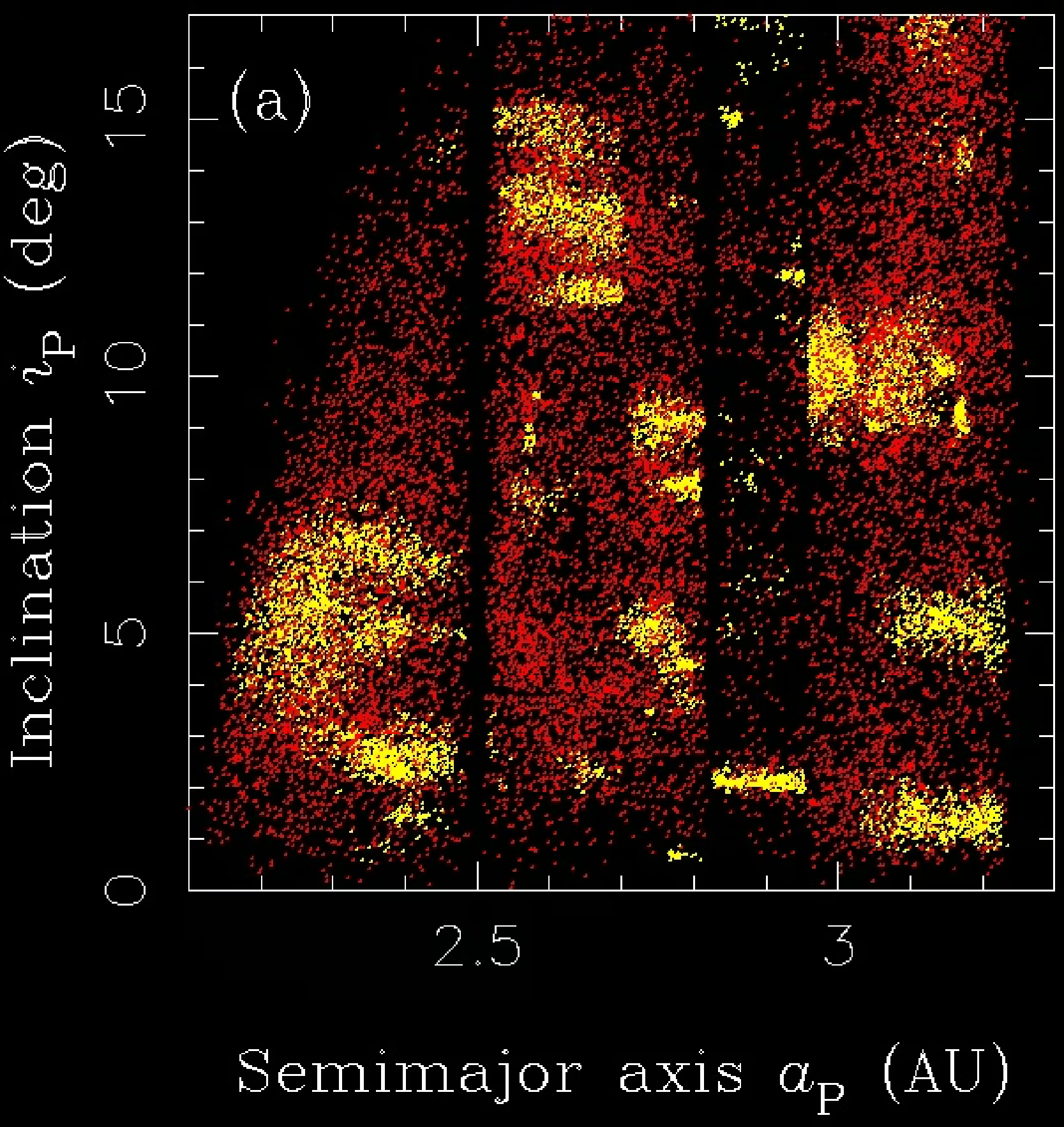
Fig. 12.17 Asteroid families in the main belt revealed by hierarchical clustering, plotted in proper inclination \(i_{\text{P}}\) versus proper semimajor axis \(a_{\text{P}}\). The principal Hirayama families (Themis, Eos, Koronis, Eunomia, Vesta, Flora) appear as concentrations in \((a_{\text{P}}, i_{\text{P}})\) space (from Figure 1a of Nesvorný et al. [2015]).#
Asteroids are classified into spectral types based on visible and near-infrared reflectance. Major classes include carbonaceous C-types (carbonaceous chondrite analogues), silicaceous S-types (ordinary chondrite analogues with 1 and 2 \(\mu\)m absorptions), metallic M-types, basaltic V-types, and primitive D- and P-types.
Rocky S-types dominate the inner belt inside the snow line, whereas volatile-rich C-types dominate the outer belt (Fig. 12.18) [DeMeo and Carry, 2014].
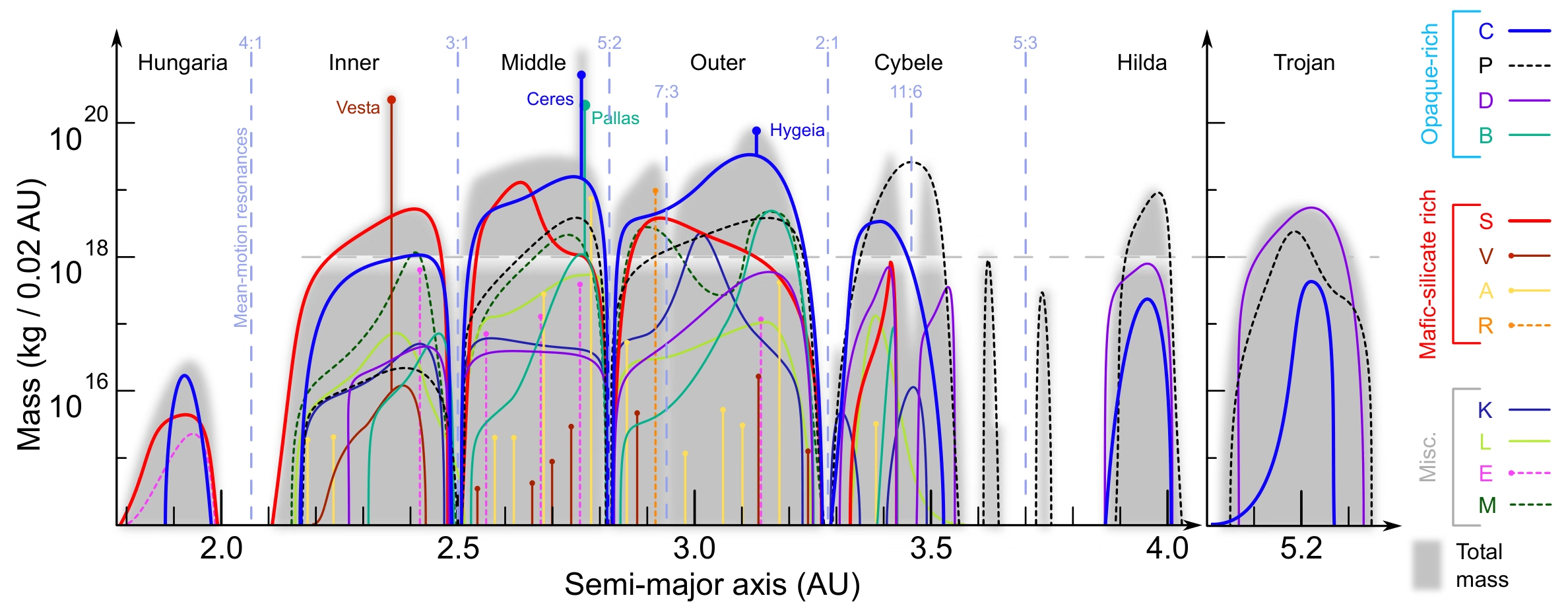
Fig. 12.18 Compositional mass distribution across the asteroid belt in \(0.02\) AU bins from the Hungarias to the Trojans, showing total mass (grey) and the spectral classes; the horizontal line at \(10^{18}\) kg is the limit of the 1980s surveys, and below it the modern data resolve the individual classes. Silicaceous S-types dominate the inner belt while carbonaceous C-, B-, P-, and D-types dominate the outer belt, with V-type material concentrated near \(a = 2.4\) AU, reflecting the disk volatile gradient (from Figure 3 of DeMeo and Carry [2014]).#
This taxonomic structure records giant-planet migration in the early solar system, which implanted carbonaceous bodies into the outer belt and reshuffled the asteroid belt [Raymond and Izidoro, 2017, Walsh et al., 2011] (Lecture 2).
12.3.3. Near-Earth asteroids and the impact hazard#
A near-Earth asteroid (NEA) is one with perihelion \(q < 1.3\) AU. Because the typical NEA residence time is only \(\sim 10\) Myr before ejection or collision, the steady-state population requires continuous resupply [Bottke et al., 2002].
The main asteroid belt supplies new NEAs through Kirkwood gaps (particularly the 3:1 and 5:2 resonances), the \(\nu_6\) secular resonance (a matching of orbital precession rates where an asteroid’s apsidal precession matches Saturn’s), and the Yarkovsky effect.
About 2,500 NEAs are classified as Potentially Hazardous Asteroids (PHAs): larger than \(\sim 140\) m and approaching Earth’s orbit within \(0.05\) AU.
The Yarkovsky effect is a non-gravitational force caused by asymmetric thermal re-emission of absorbed sunlight on a rotating body. For a 1 km basaltic main-belt asteroid (\(\rho \sim 2.5\) g cm\(^{-3}\), \(a \sim 2\) AU), \(\mathrm{d}a/\mathrm{d}t \sim 10^{-4}\) AU per Myr, so a drift of \(0.01\) AU into a nearby Kirkwood resonance takes \(\sim 10^8\) years. The resulting recoil slowly changes the semimajor axis, drifting asteroids over \(10^8\) years into resonances that pump eccentricities onto planet-crossing orbits [Bottke et al., 2006].
Because recoil force scales with absorbed solar power while acceleration scales inversely with mass \(m \propto \rho R^3\), the secular semimajor-axis drift rate scales as
so a smaller, less dense, closer-in body drifts faster [Bottke et al., 2006]. This \(1/D\) supply scaling explains why smaller NEAs dominate the population, with drift directly measured on (6489) Golevka (Fig. 12.19).
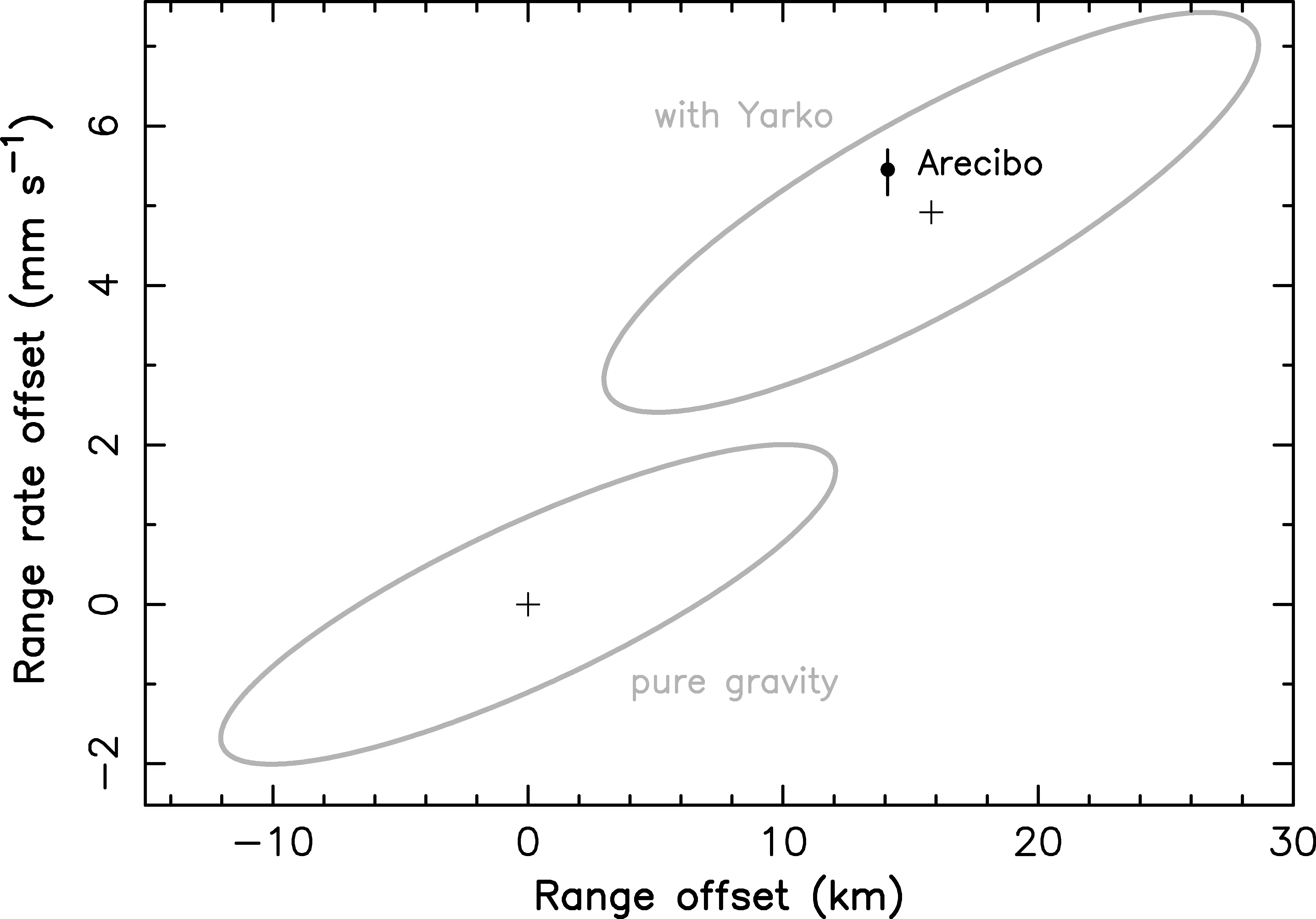
Fig. 12.19 Direct detection of the Yarkovsky effect on the near-Earth asteroid (6489) Golevka. The plot shows the orbital solution in range vs range-rate offset (relative to a fit using only gravitational perturbations), projected into the plane of radar observables. The grey ellipse labelled “pure gravity” represents the 90% confidence region for the orbital solution if Yarkovsky is excluded; the grey ellipse labelled “with Yarko” is the predicted solution including the nominal Yarkovsky force. The Arecibo measurements of May 2003 (black symbol with \(\sim 5\) mm/s uncertainty) fall squarely on the Yarkovsky-included prediction. From Figure 2 of Vokrouhlický et al. [2015].#
The YORP effect (Yarkovsky-O’Keefe-Radzievskii-Paddack) is a thermal recoil torque from asymmetric radiation that modifies the rotation rate and spin axis of bodies smaller than \(\sim 10\) km, driving them to rotational fission or slowing them to near zero. This spin-up has been directly detected on the near-Earth asteroid (54509) YORP (Fig. 12.20).
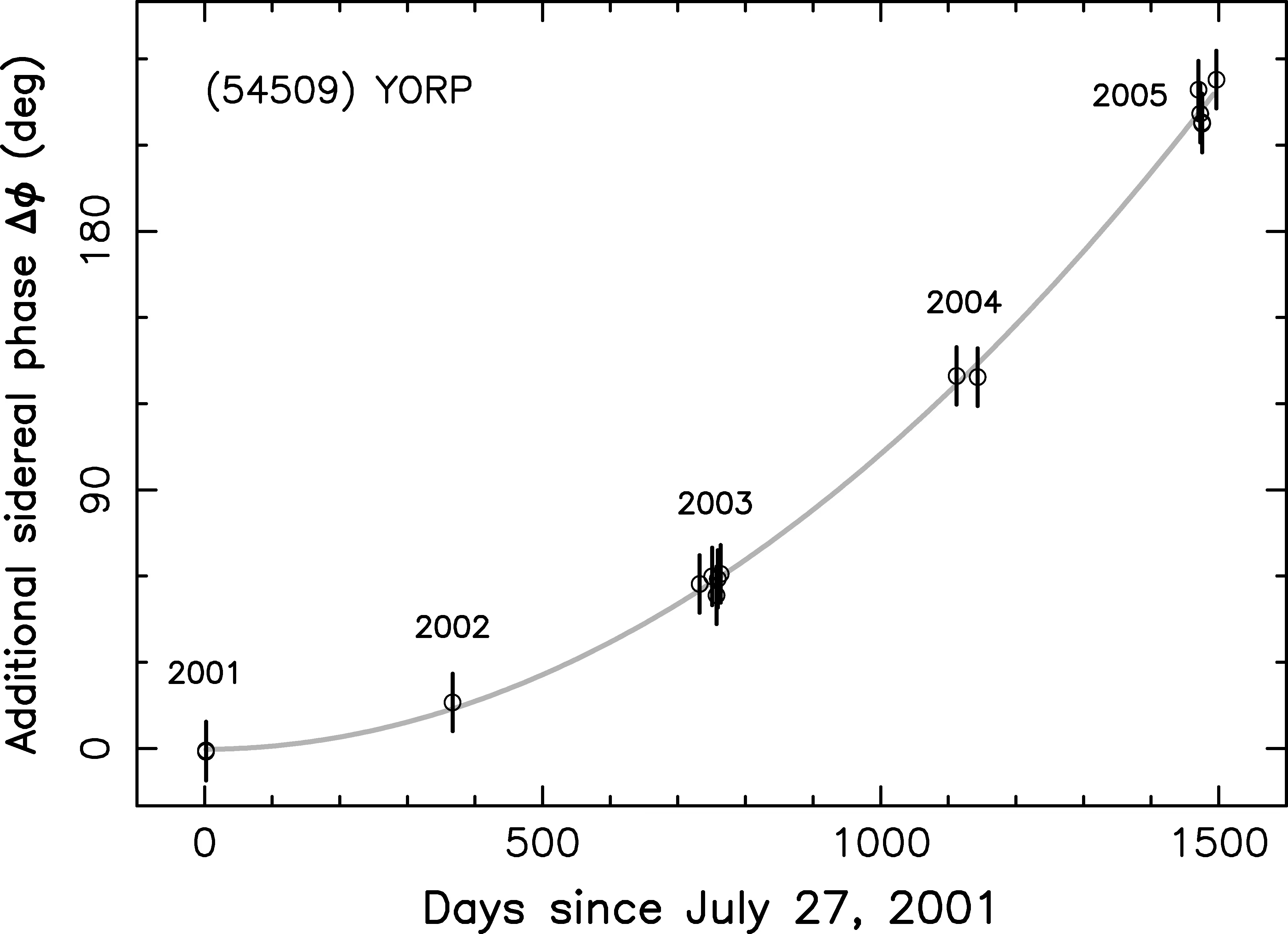
Fig. 12.20 Direct detection of the YORP effect on the small near-Earth asteroid (54509) YORP. The vertical axis shows the additional sidereal rotation phase (in degrees) accumulated relative to a constant-rotation model; the horizontal axis is time in days since 27 July 2001. Black points are independent measurements from successive radar and optical apparitions; the grey curve is a quadratic fit corresponding to a rotational acceleration \(\dd \omega / \dd t \simeq 350 \times 10^{-8}\) rad d\(^{-2}\). The accelerating spin is the predicted YORP signature: an asymmetric thermal recoil torque acting on an irregular rotating body. Adapted from Figure 5 of Vokrouhlický et al. [2015].#
12.3.4. Impact frequency and planetary defence#
The impact rate follows a power law with exponent \(-2.3\) (Fig. 12.21); the \(10\) km Chicxulub impactor that ended the Cretaceous at \(66\) Ma is the largest well-dated example (cratering physics in Lecture 7).
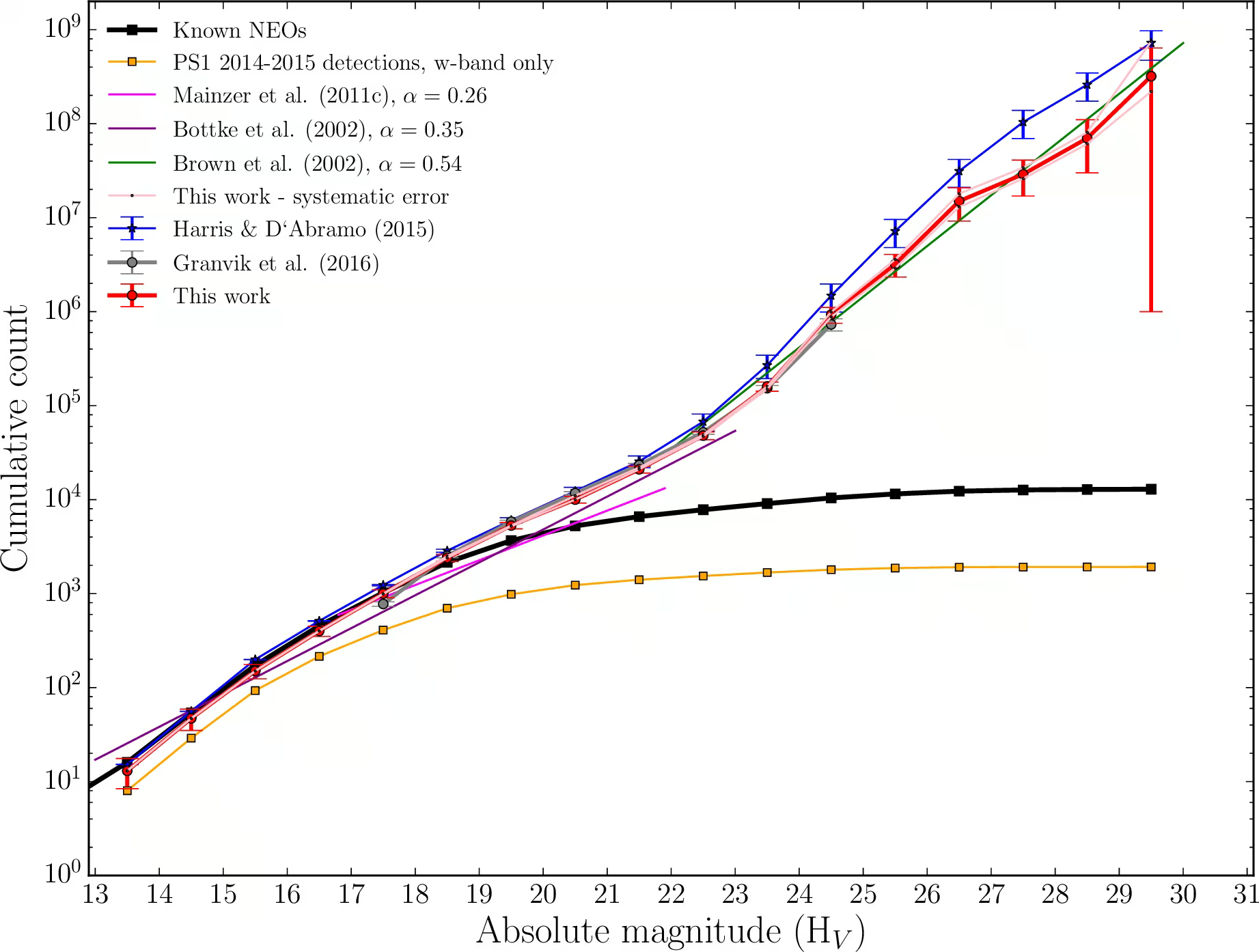
Fig. 12.21 Cumulative size-frequency distribution of near-Earth objects versus absolute magnitude \(H_V\) (Schunová-Lilly et al. [2017], Fig. 9). The power-law distribution spans five orders of magnitude, consistent with models from Bottke et al. [2002] and Granvik et al. [2018].#
Impact rates scale inversely with size: 10 to 80 m airbursts occur every decade to few millennia (e.g., Chelyabinsk, Fig. 12.22, [Brown et al., 2013], and Tunguska), 140 m impacts every \(\sim 30{,}000\) years, 1 km disruptions every \(\sim 500{,}000\) years, and 10 km extinctions every \(\sim 100\) Myr.
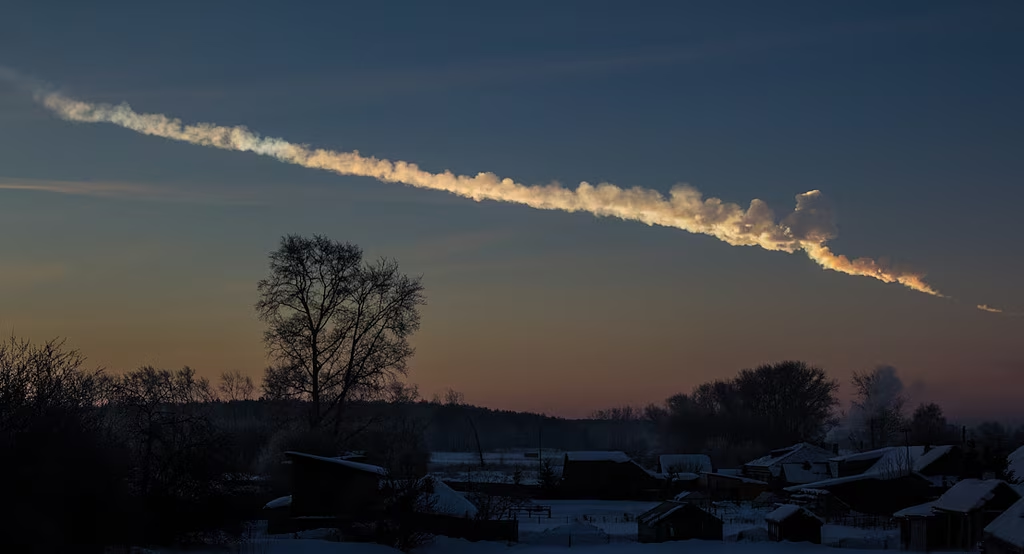
Fig. 12.22 Vapour trail of the 15 February 2013 Chelyabinsk meteor, formed when a 19 m asteroid disintegrated at \(\sim 30\) km altitude releasing 0.5 Mt TNT equivalent. The shock wave shattered windows and injured about 1,500 people (image credit: Alex Alishevskikh, CC BY-SA 2.0).#
In 2022, NASA’s DART mission demonstrated planetary defence by deflecting Dimorphos, shortening its orbital period by \(33.0 \pm 1.0\) minutes (Fig. 12.23) [Thomas et al., 2023], with ejecta recoil giving momentum enhancement \(\beta = 3.61^{+0.19}_{-0.25}\) [Cheng et al., 2023].
Equating asteroid gravity to differential solar tides defines the stable Hill sphere and yields the Hill radius
For Didymos (\(a \approx 1.64\) AU, mass \(m \approx 5.6 \times 10^{11}\) kg), the Hill radius is \(r_H \approx 110\) km [Daly et al., 2023]. Dimorphos orbits at \(\sim 1.2\) km, well inside the stable limit of \(0.5 \, r_H\).
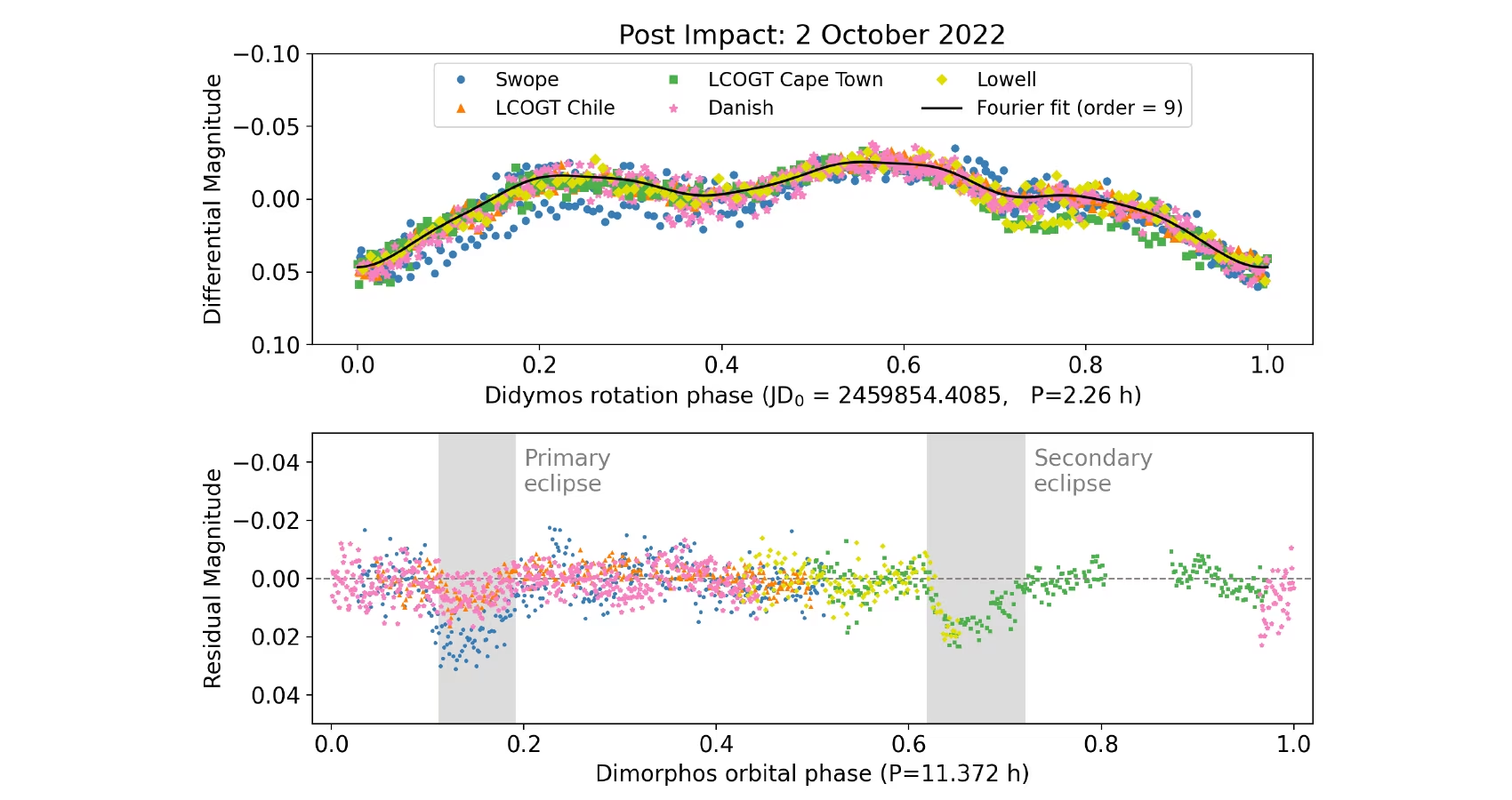
Fig. 12.23 Photometric lightcurves of Didymos-Dimorphos six days after DART impact, showing Didymos’s 2.26 hr rotation (top) and Dimorphos’s new \(11.372\) hr orbit (bottom). Kinetic impact reduced the orbital period by \(33.0 \pm 1.0\) minutes (\(3\sigma\)) via ejecta momentum enhancement (Thomas et al. [2023], Fig. 3).#
ESA’s Hera mission (launched 2024) will survey the crater to refine momentum-transfer efficiency, making planetary defence a quantitative engineering discipline [Michel et al., 2022].
12.3.5. Ceres and the dwarf planets of the inner solar system#
Ceres is the largest body in the asteroid belt and the only inner solar system dwarf planet, a near-spherical body with a mean radius of \(470\) km and a mass of \(9.4 \times 10^{20}\) kg.
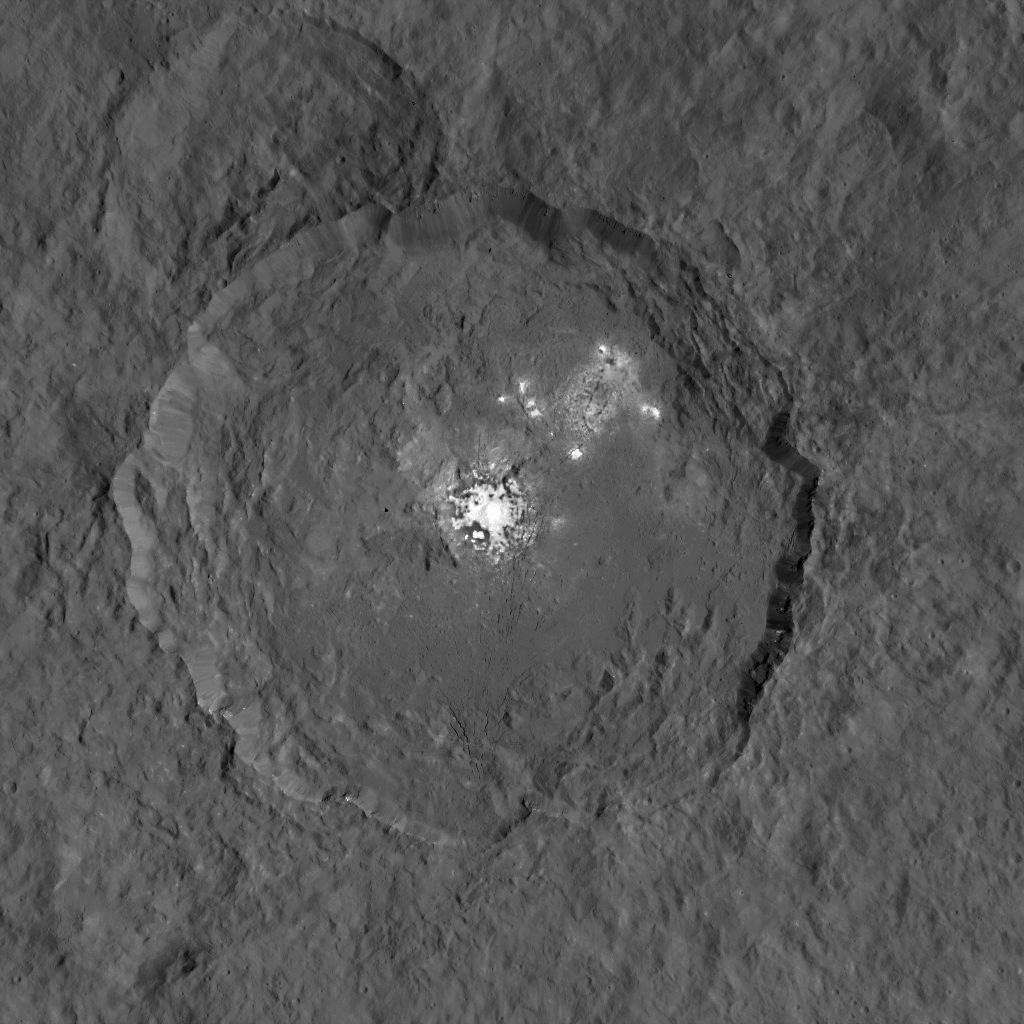
Fig. 12.24 The Occator crater on Ceres, imaged by NASA’s Dawn mission. The bright deposits in the crater floor (Cerealia Facula and Vinalia Faculae) are evaporitic salts, primarily sodium carbonate (\(\mathrm{Na_2CO_3}\)), interpreted as relict brine that erupted from a subsurface reservoir and froze. Image credit: NASA/JPL-Caltech/UCLA/MPS/DLR/IDA, public domain.#
In Occator crater (Fig. 12.24), bright evaporitic salts of sodium carbonate and ammonium chloride formed when subsurface brine erupted and froze [De Sanctis et al., 2016]. This indicates that Ceres has, or had until recently, a partially liquid water layer at depth and probably an internal heat source, making it similar to icy moons such as Enceladus and Europa (Lecture 11).
Its surface ammonia and high water content suggest Ceres formed beyond the snow line and was captured into the asteroid belt during the Nice-Model rearrangement [McKinnon, 2008]. This is one of the more direct pieces of evidence that the asteroid belt is a mixture of inner-disk and outer-disk material.
12.3.6. The Kuiper Belt and scattered disk#
Beyond Neptune lies the trans-Neptunian region, a reservoir of small bodies with distinct dynamical sub-populations (Fig. 12.25) [Bannister et al., 2018].
The cold classical Kuiper Belt consists of unscattered primordial orbits between 42 and 47 AU [Parker et al., 2011]. The hot classical Kuiper Belt has inclinations up to \(30^{\circ}\) excited by giant-planet instability. The resonant population is locked in mean-motion resonances, dominated by plutinos at \(a \approx 39.4\) AU. The scattered disk has perihelia near Neptune (\(q \sim 30\) AU), while detached objects have decoupled perihelia (\(q > 40\) AU).
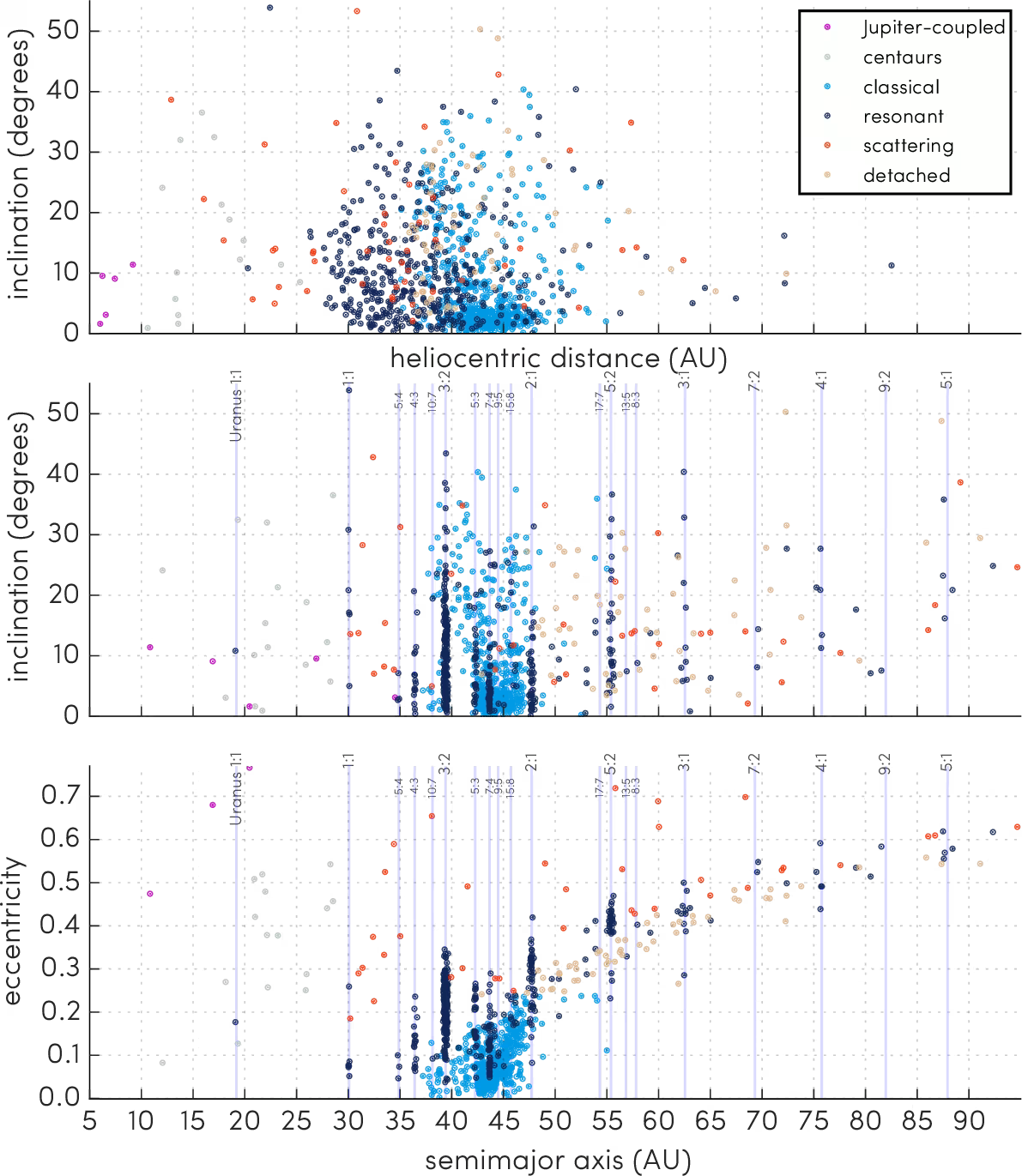
Fig. 12.25 Orbital parameters of the 1142 characterised trans-Neptunian objects discovered by the Outer Solar System Origins Survey (OSSOS) and affiliated programmes (CFEPS, MiLat, AlexWP), classified into Jupiter-coupled (dark blue), centaurs (cyan), classical (light blue), resonant (red), scattering (orange), and detached (dark red) populations. Top: orbital inclination versus heliocentric distance. Middle: orbital inclination versus semimajor axis. Bottom: eccentricity versus semimajor axis. Pale blue vertical lines mark the locations of the principal Neptune mean-motion resonances; the cold classical population is the dense low-inclination cluster between 42 and 47 AU. From Figure 4 of Bannister et al. [2018].#
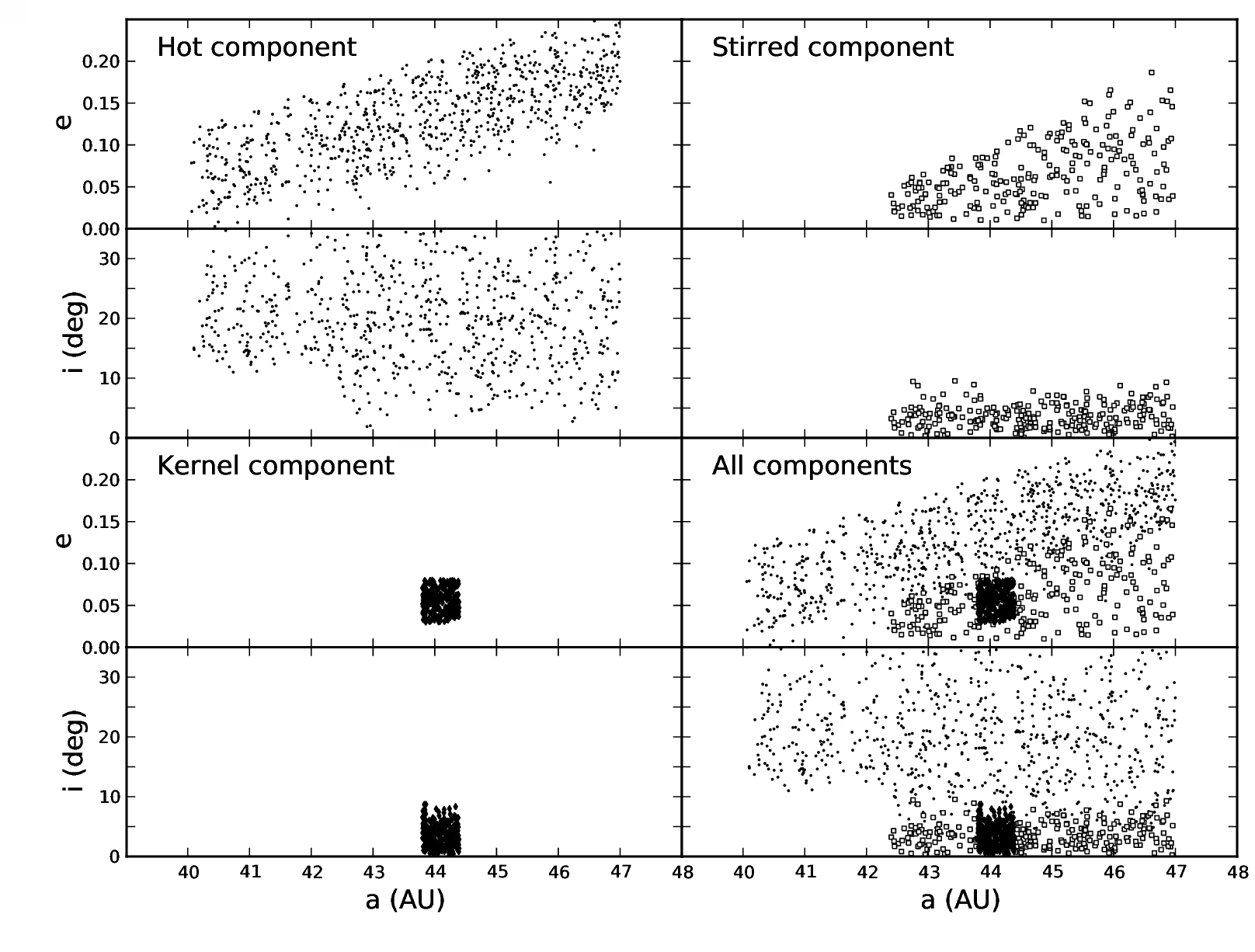
Fig. 12.26 The three components of the CFEPS-L7 synthetic model of the main classical Kuiper belt, separated into the broad-inclination “hot” component (top left), the dynamically active “stirred” component (top right), the dense low-inclination “kernel” near \(a \approx 44\) AU (bottom left), and the combined model (bottom right). Each panel shows orbital eccentricity \(e\) vs semimajor axis \(a\) (upper sub-panel) and inclination \(i\) vs \(a\) (lower sub-panel). The kernel and the broader hot component coexist in the same range of \(a\) but occupy completely different parts of \((e, i)\) space, evidence that the cold classicals were never strongly perturbed by Neptune while the hot classicals were excited by the giant-planet instability described by the Nice Model. From Figure 4 of Petit et al. [2011].#
The bimodal inclination distribution, resonant populations, and scattered disk provide empirical evidence for giant-planet migration under the Nice Model (Lecture 2) (Fig. 12.26).
12.3.7. Pluto: a dwarf planet visited#
The July 2015 New Horizons flyby revealed Pluto as a geologically diverse dwarf planet [Stern et al., 2015] (Fig. 12.27).
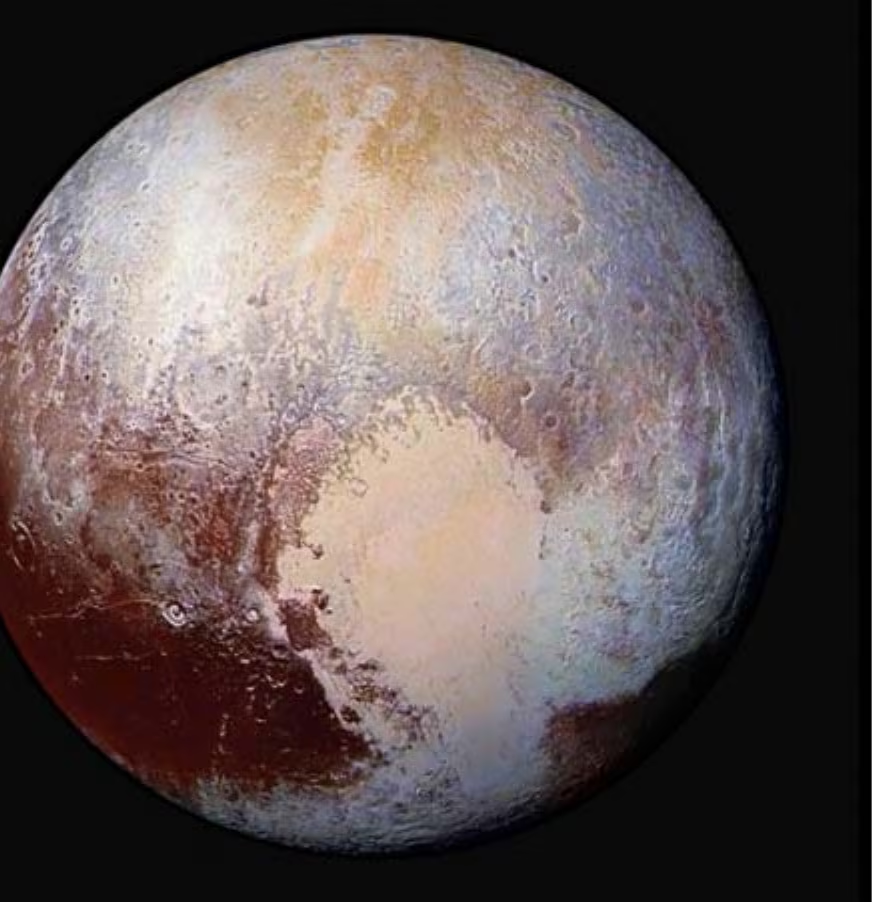
Fig. 12.27 True-colour Ralph instrument image of Pluto acquired by New Horizons during the 2015 flyby, showing the bright heart-shaped Tombaugh Regio and dark equatorial band Cthulhu Macula rich in tholins. From Figure 3 of Stern et al. [2015].#
Pluto’s density of \(1860 \pm 13\) kg m\(^{-3}\) (radius \(1187 \pm 4\) km, mass \(1.303 \times 10^{22}\) kg) implies roughly two-thirds rock and one-third water ice [Stern et al., 2015].
The most prominent feature is Sputnik Planitia, a \(\sim 1{,}000\) km wide nitrogen-ice basin where polygonal cells overturn every \(\sim 10^{6}\) years via solid-state convection powered by radiogenic decay in the rocky interior [McKinnon et al., 2016] (Fig. 12.28). The absence of craters indicates a surface age under 10 Myr.
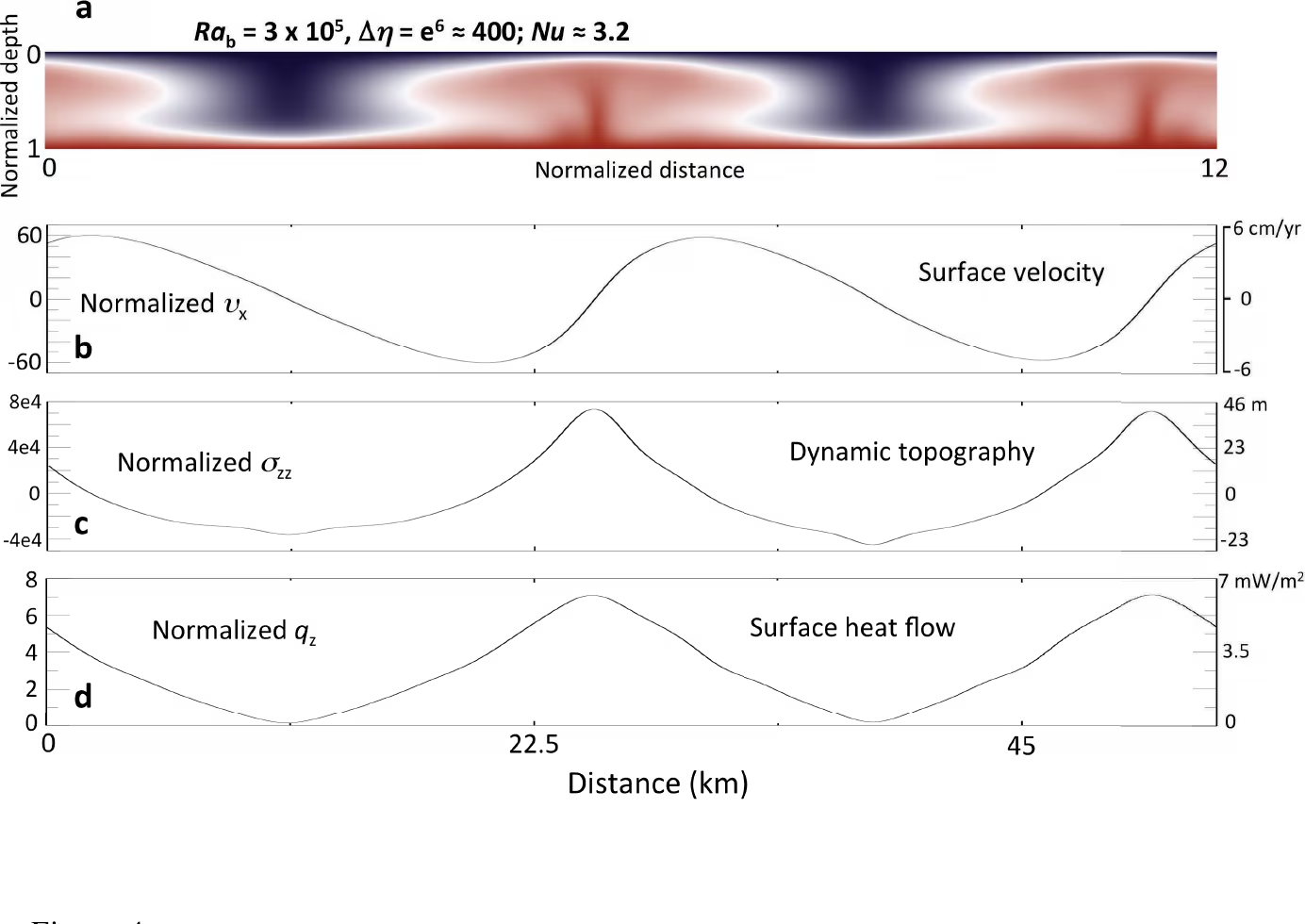
Fig. 12.28 Numerical model of solid-state convection in a layer of \(\mathrm{N_2}\) ice in Sputnik Planitia, driven at Rayleigh number \(\mathrm{Ra}_b \approx 3 \times 10^5\) with overturn timescales of \(\sim 10^6\) years. Panels show temperature, surface velocity, dynamic topography, and heat flow across one convective cell (from Figure 4 of McKinnon et al. [2016]).#
A positive gravity anomaly at Sputnik Planitia suggests a subsurface ocean, a liquid layer between the rocky core and ice shell [Nimmo et al., 2016].
Pluto has a thin nitrogen atmosphere (around 10 \(\mu\)bar) undergoing slow escape, closer to Jeans escape than to hydrodynamic escape because the upper atmosphere is so cold [Gladstone et al., 2016].
12.3.8. Charon and the small moons#
Charon (radius \(606\) km) and Pluto form a binary: their barycentre lies outside Pluto, the only such case among planet-moon systems in the solar system. Its polar cap, Mordor Macula, is interpreted as photochemically processed methane that escaped Pluto’s atmosphere and froze onto Charon [Grundy et al., 2016] (Fig. 12.29) (Fig. 12.30).
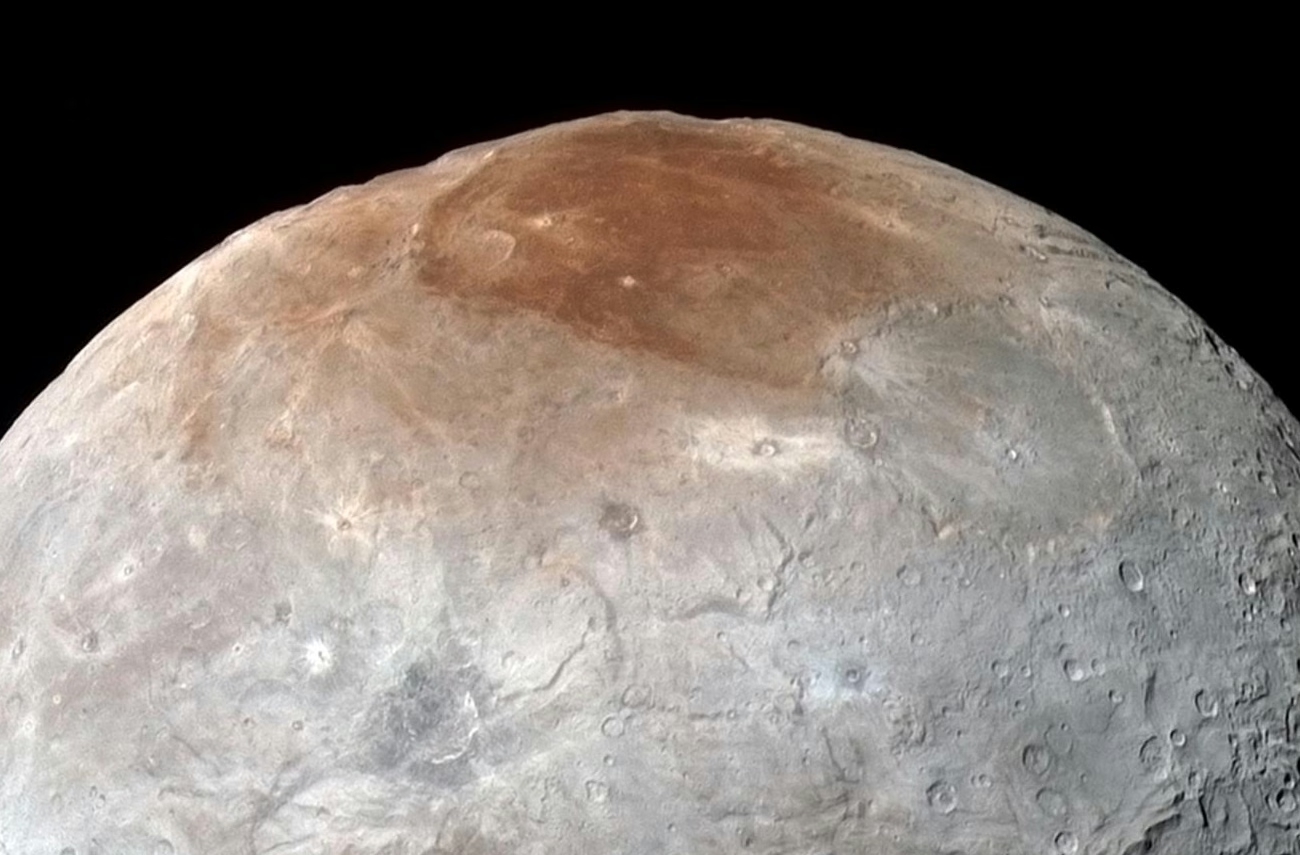
Fig. 12.29 Charon imaged by New Horizons. The dark reddish region at the north pole is Mordor Macula, an accumulation of photochemically processed organic compounds (tholins) sourced from Pluto’s escaping atmosphere. The chasm visible across the equator is part of an extensional tectonic system. Image credit: NASA/JHUAPL/SwRI, public domain.#
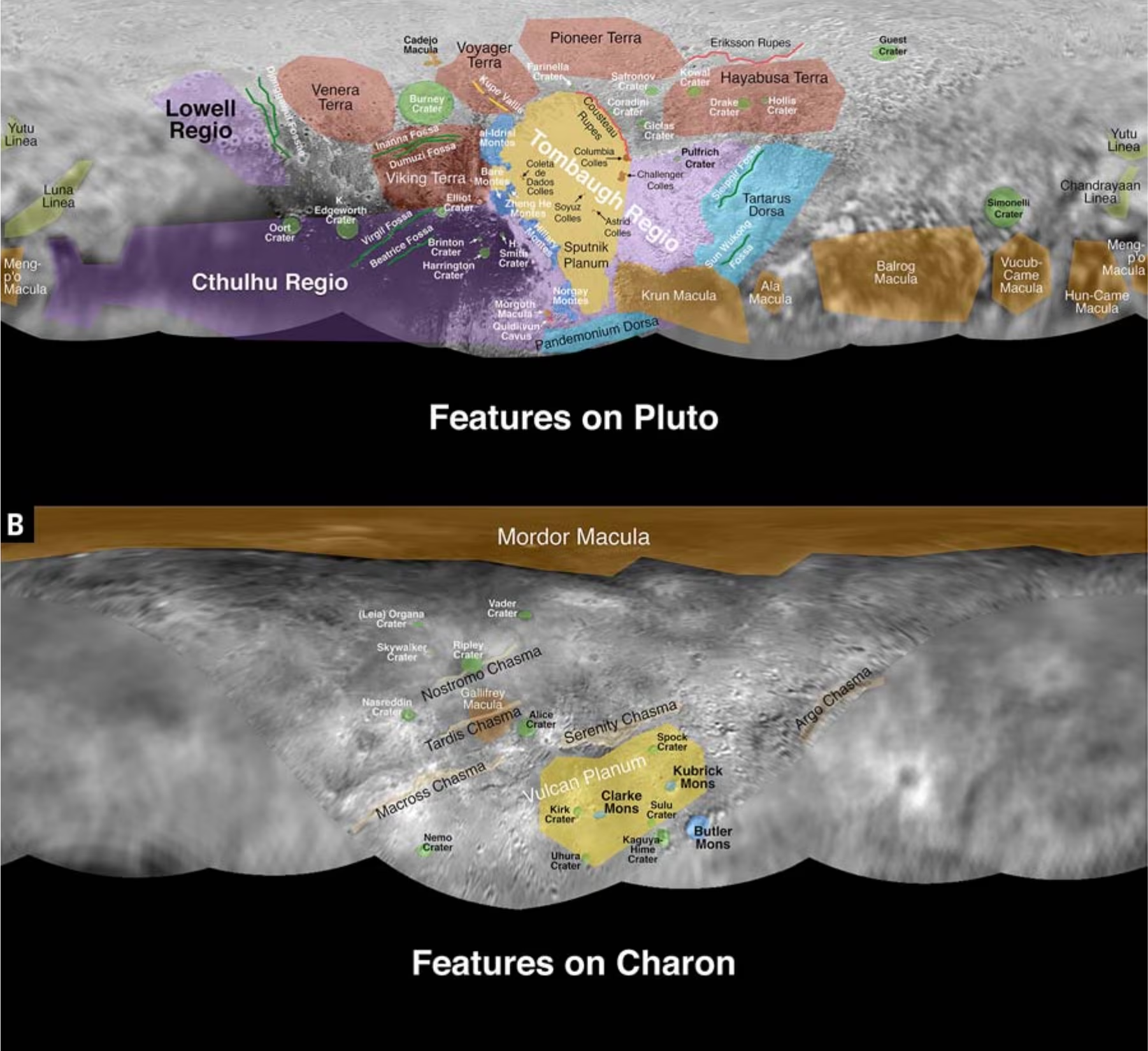
Fig. 12.30 Cylindrical projections of Pluto (top) and Charon (bottom) with informally named features overlaid, derived from New Horizons imaging during the 2015 flyby. The colour-coded regions on Pluto separate the named maculae, regiones, planitiae, terrae, and montes; the colour-coded regions on Charon highlight the polar Mordor Macula and the equatorial chasms (Argo, Serenity, Macross). The Pluto-Charon system is a true binary whose barycentre lies outside Pluto. From Figure 2 of Stern et al. [2015].#
The four small moons (Styx, Nix, Kerberos, Hydra) are likely fragments of the same collision that produced Charon [Canup, 2011].
12.3.9. Arrokoth: a pristine cold classical KBO#
The New Horizons flyby of (486958) Arrokoth at \(44.6\) AU revealed a contact binary: two lobes joined at a narrow neck by a gentle merger under a few m s\(^{-1}\) [Stern et al., 2019].
This morphology indicates formation by the streaming instability, the gravitational collapse of a pebble swarm into a bound object. Arrokoth shows that \(\sim 35\) km planetesimals form by gentle gravitational collapse rather than hierarchical accretion [McKinnon et al., 2020] (Fig. 12.31).
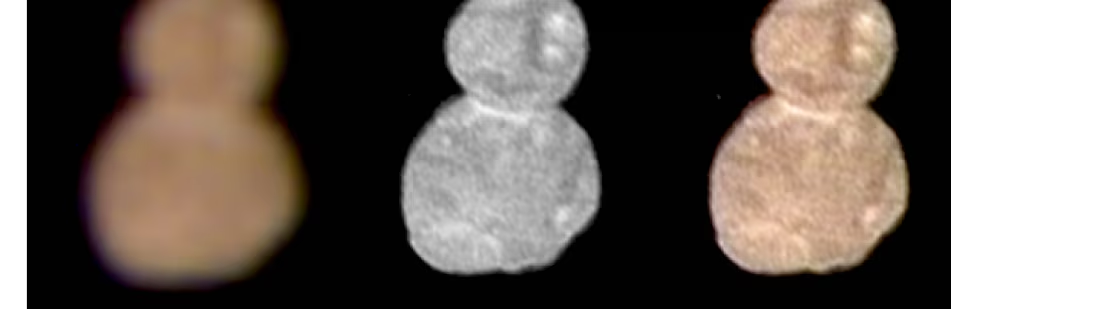
Fig. 12.31 Enhanced colour image of (486958) Arrokoth (then informally “Ultima Thule”) at 1.5 km/pixel resolution, taken by New Horizons during the 1 January 2019 flyby. The two flattened lobes (“Ultima” and “Thule”) are joined at a narrow neck and share a uniform reddish colour, consistent with formation from a single locally collapsing pebble cloud. The contact-binary morphology and the absence of a high-energy impact crater at the neck are signatures of a gentle low-velocity merger (\(\lesssim\) few m s\(^{-1}\)). From Figure 2 of Stern et al. [2019].#
12.3.10. The other dwarf planets#
The IAU recognises three other trans-Neptunian dwarf planets: Eris, a scattered-disk object (Fig. 12.33); Haumea, a fast-rotating ellipsoid with rings; and Makemake, a classical KBO.
Candidate dwarf planets include Gonggong, Quaoar, Orcus and Salacia. Sedna belongs to a different class: its detached orbit (perihelion 76 AU, aphelion about 900 AU) may point to an inner Oort cloud population or to an early stellar encounter, and it is one of a handful of extreme trans-Neptunian objects whose orbits appear to cluster in orientation (Fig. 12.32), the observation that motivates the Planet 9 hypothesis of an undiscovered distant planet [Batygin et al., 2019].
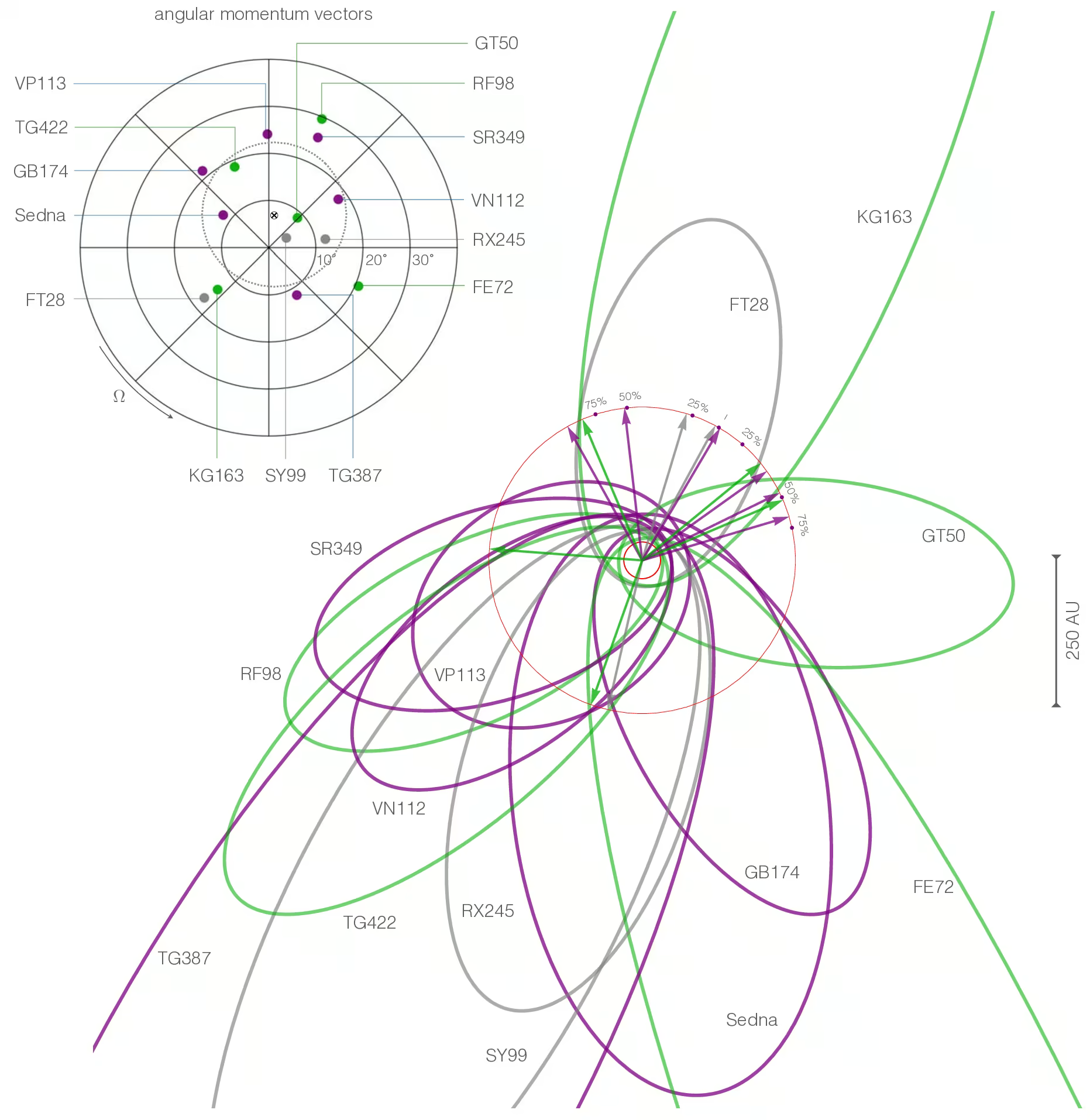
Fig. 12.32 Orbits of the distant trans-Neptunian objects, including Sedna, projected on the ecliptic (main panel; the bar marks 250 AU), with arrows giving the direction of each perihelion and the inset showing the orbit-pole (angular momentum) vectors. The perihelion directions and the poles are not spread evenly around the sky, which is the apparent clustering that motivates the Planet 9 hypothesis. Reproduced from Batygin et al. [2019].#
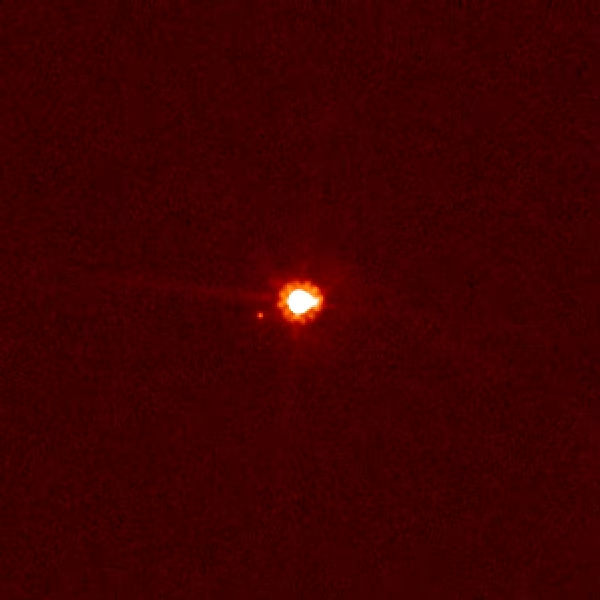
Fig. 12.33 Eris and its moon Dysnomia imaged by the Hubble Space Telescope. Eris is approximately the same size as Pluto but more massive, hence denser. Its discovery in 2005 directly precipitated the IAU’s 2006 planet definition. Image credit: NASA/ESA/M. Brown, public domain.#
Fig. 12.34 shows the occultation light curve that revealed the ring of Haumea.
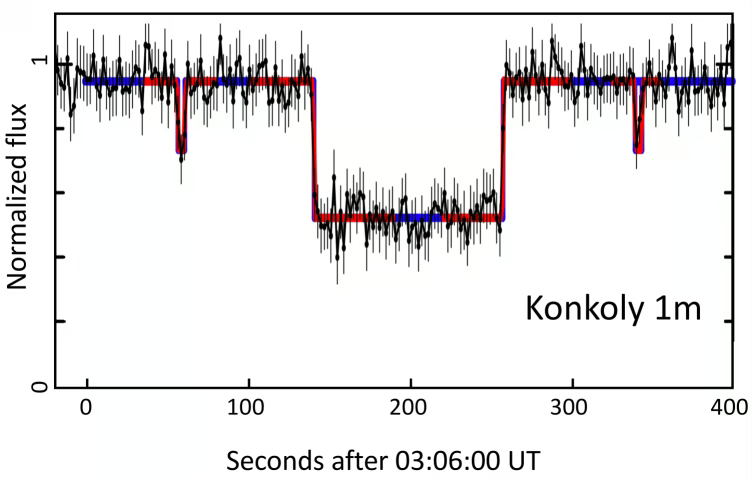
Fig. 12.34 Stellar occultation light curve of the dwarf planet Haumea on 21 January 2017, recorded with the 1 m telescope at Konkoly Observatory (Hungary). The deep central drop is the body of Haumea; the two narrower symmetric dips on either side reveal a \(\sim 70\) km wide, \(\sim 2{,}287\) km radius ring, the first ring system discovered around a trans-Neptunian object [Ortiz et al., 2017]. Figure adapted from Sicardy et al. [2024].#
12.3.11. The Oort cloud#
The Oort cloud is the most distant component of the solar system: a roughly spherical shell of icy bodies at heliocentric distances of approximately \(2{,}000\) to \(50{,}000\) AU. Jan Oort inferred its existence in 1950 from the orbital statistics of long-period comets, whose orbital energies concentrate at nearly bound values (Fig. 12.35) [Oort, 1950]. Incoming comets arrive isotropically from all directions with semimajor axes clustering near \(20{,}000\) to \(50{,}000\) AU, implying a steady-state reservoir of \(\sim 10^{11}\) to \(10^{12}\) objects with a total mass of \(1\) to \(10\,\Mearth\) [Brasser and Morbidelli, 2013].
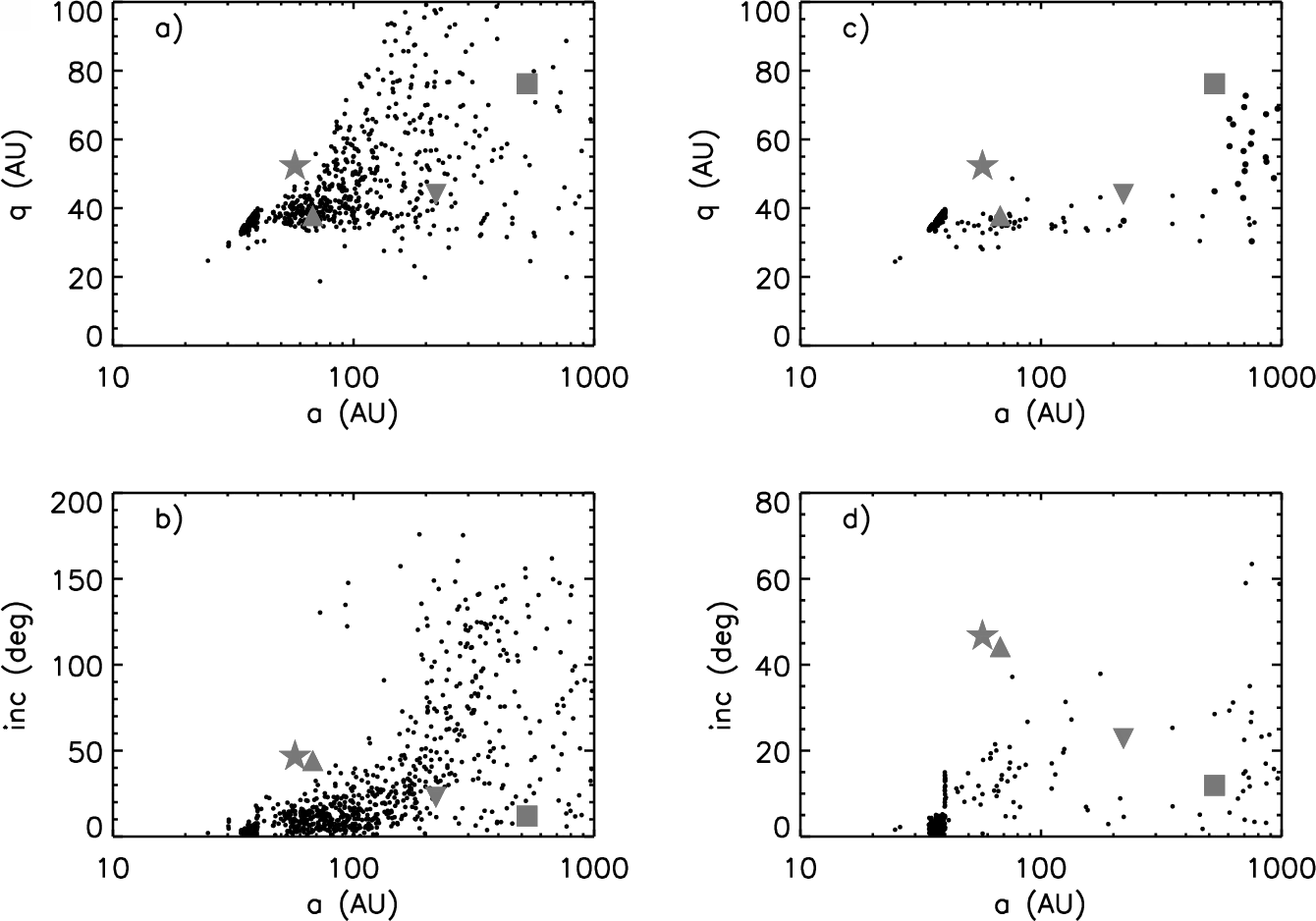
Fig. 12.35 Final structure of the simulated Oort cloud and scattered disk after 4.5 Gyr of evolution from the solar system’s birth in an embedded star cluster. Top row: perihelion \(q\) (AU) vs semimajor axis \(a\) for two simulations of Oort cloud formation. Bottom row: orbital inclination vs \(a\) for the same two simulations. The transition from the planetary region (small \(a\)) through the scattered disk and into the inner (\(a \sim 10^{3}\) AU) and outer (\(a \sim 10^{4}\) AU) Oort cloud is visible as a continuous distribution. Inner-cloud bodies retain a wide range of inclinations imposed by the cluster phase, while outer-cloud bodies are nearly isotropic. The Oort cloud has never been directly observed; its existence is inferred from this kind of dynamical model and from the orbital statistics of long-period comets. From Figure 13 of Kaib and Quinn [2008].#
Giant planets scattered planetesimals between Jupiter and Neptune onto eccentric orbits, where passing stars and the galactic tide lifted their perihelia into the outer cloud [Dones et al., 2004].
12.3.12. Comets: composition, structure, and activity#
A comet is a small icy body that becomes active when its perihelion brings it close enough to the Sun for surface ices to sublimate. Whipple’s “dirty snowball” model [Whipple, 1950] describes a comet as a mixture of water ice, refractory dust, and organic molecules. Measured comets exhibit high porosity (\(50\)-\(75\%\)) and a low bulk density of order \(0.5\) g cm\(^{-3}\).
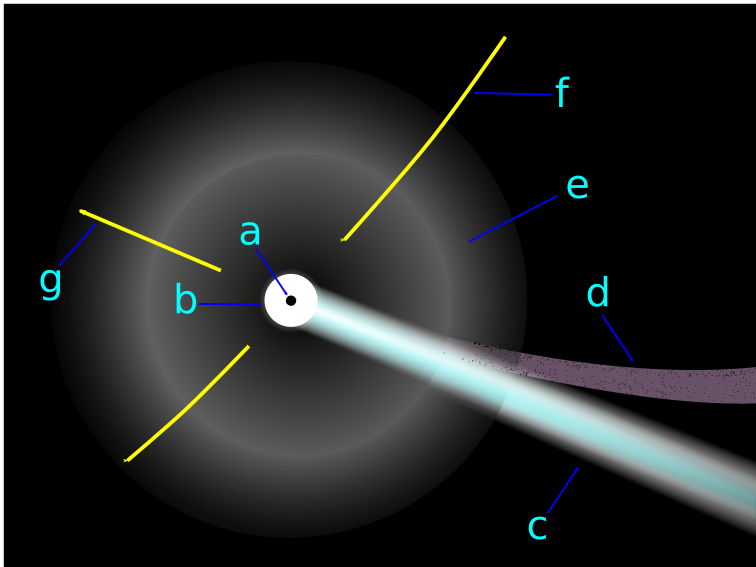
Fig. 12.36 Schematic anatomy of an active comet. The solid nucleus (1–30 km across) is surrounded by an extended coma of sublimated gas and dust. Two distinct tails point in different directions: the ion tail (blue) is shaped by the solar wind and points anti-sunward, while the dust tail (yellow) is shaped by radiation pressure on dust particles and lags behind the nucleus along its orbit. Image credit: Wikimedia Commons, public domain.#
Far from the Sun, a comet is an inert nucleus (a dark body 1–30 km across with albedo \(\sim 4\%\)). Inside roughly 5 AU, ice sublimation creates an extended coma of gas and dust (\(10^4\)-\(10^6\) km across), an ion tail swept anti-sunward by the solar wind, and a dust tail pushed by radiation pressure (Fig. 12.36).
Halley’s Comet (Fig. 12.37) is the prototypical example with a 76-year orbital period (Fig. 12.38). Its 1986 apparition revealed an irregular \(15 \times 8 \times 8\) km nucleus whose active jets are confined to small surface fractions.
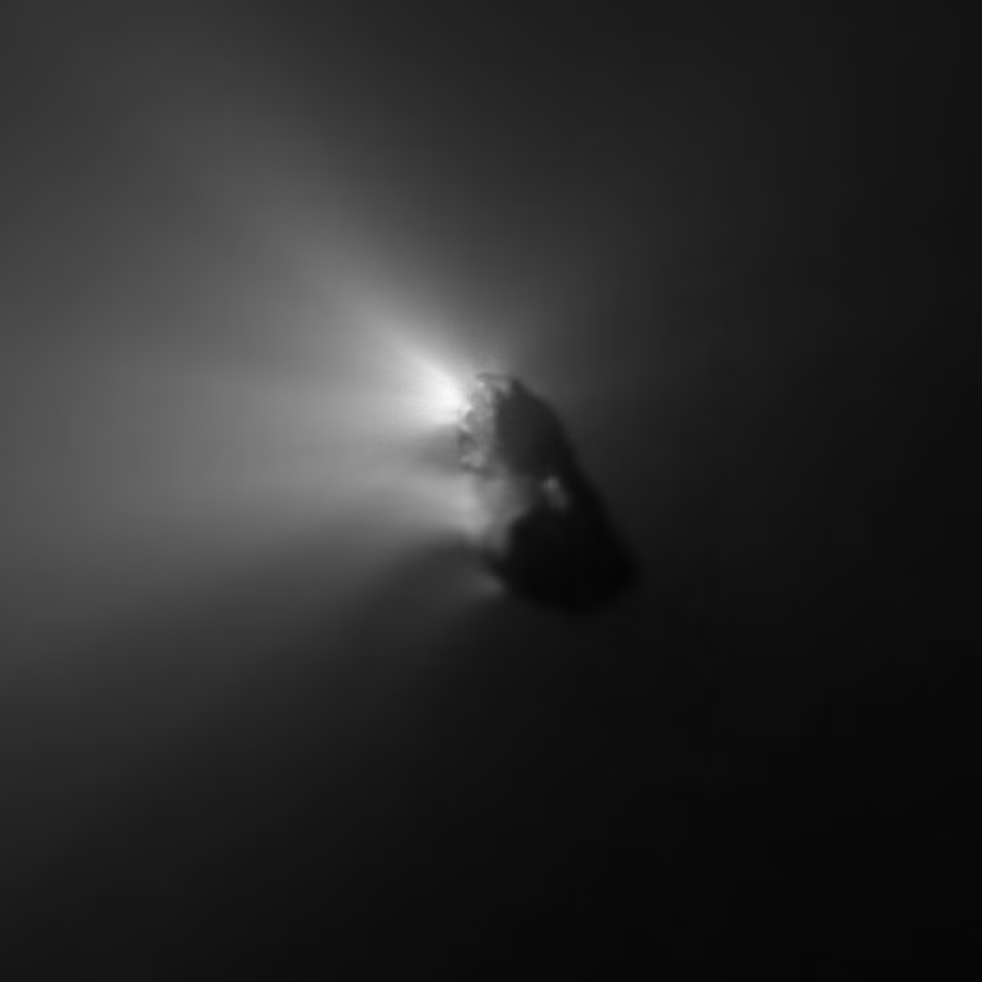
Fig. 12.37 Comet 1P/Halley imaged by the Giotto Halley Multicolour Camera (HMC) on 13-14 March 1986, the first close-up view of a cometary nucleus. The nucleus is approximately \(15 \times 8 \times 8\) km, very dark (albedo \(\sim 0.04\)), and irregular; bright jets of gas and dust emerge from a few discrete active regions on the sunward (left) side. Image credit: ESA / Halley Multicolour Camera Team / MPAe Lindau, public domain.#
12.3.13. Short-period and long-period comets#
Short-period comets (\(P < 200\) yr) have low-inclination, prograde orbits near the ecliptic plane. They divide into Jupiter-family comets (JFCs; \(P < 20\) yr, \(T_J > 2\)) and intermediate-period Halley-type comets.
The Tisserand parameter is an approximate constant of motion in the restricted three-body problem, derived from the Jacobi integral. Because \(T_J\) is conserved across encounters with Jupiter while individual orbital elements vary, it is the standard cometary classifier. For semimajor axis \(a\), eccentricity \(e\), and inclination \(i\), it is given by
where \(a_J = 5.20\) AU is Jupiter’s semimajor axis. Main-belt asteroids have \(T_J > 3\) (Ceres, \(T_J \approx 3.3\)), Jupiter-family comets have \(2 < T_J < 3\) (67P/Churyumov-Gerasimenko, \(T_J \approx 2.7\)), and long-period comets have \(T_J < 2\) (1P/Halley, \(T_J \approx -0.6\)).
Jupiter-family comets originate in the trans-Neptunian scattered disk, where objects perturbed inward by Neptune are captured into Jupiter-controlled orbits [Volk and Malhotra, 2008]. Most JFCs survive in these orbits for \(\sim 10^4\) to \(10^5\) yr before ejection or collision.
Long-period comets (\(P > 200\) yr) have isotropic orbital orientations and eccentricities approaching 1. They originate in the Oort cloud, deflected inward by the galactic tide and passing stars. Many make a single passage before ejection, while some are captured into Halley-type orbits.
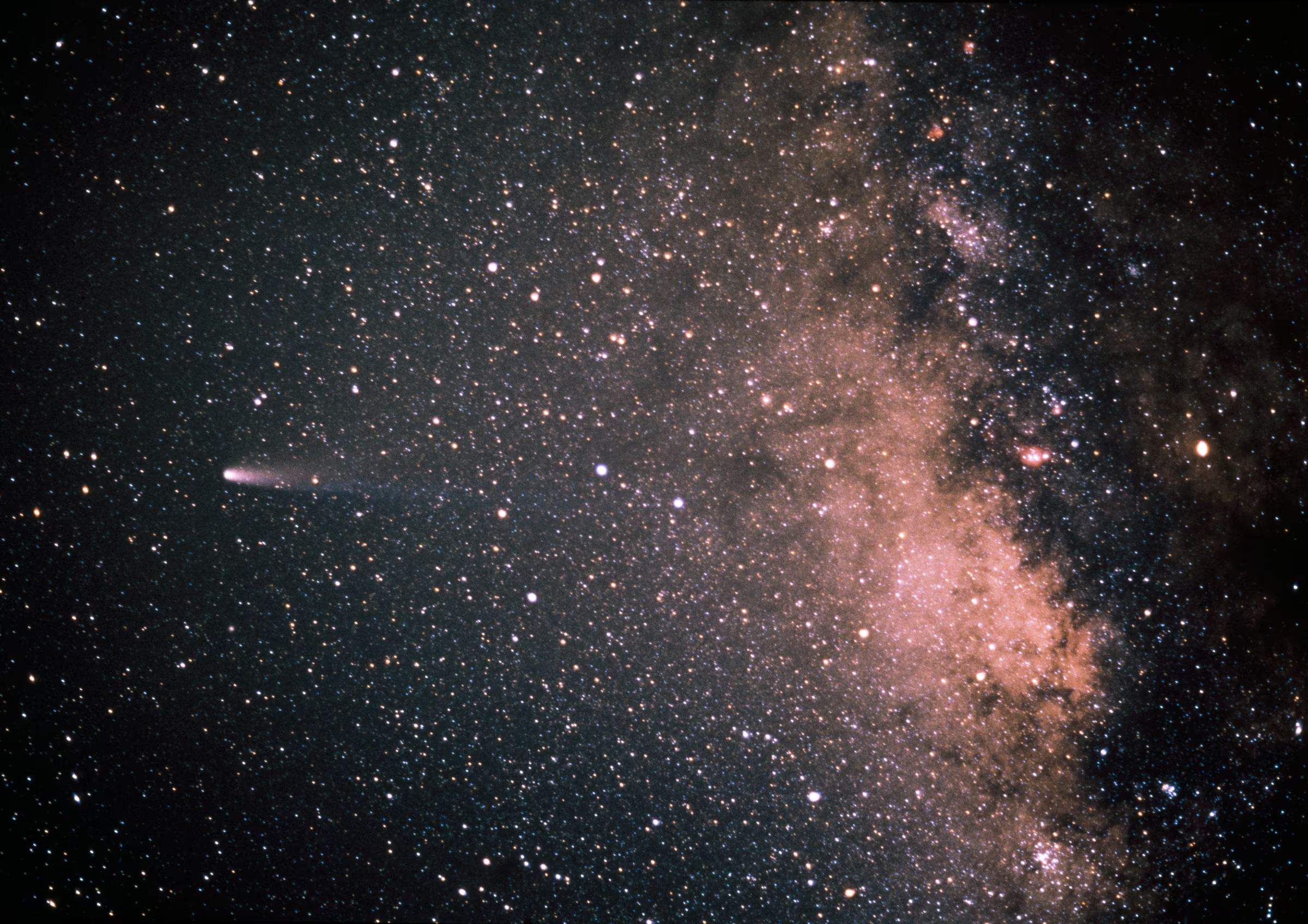
Fig. 12.38 Comet 1P/Halley photographed against the Milky Way on 21 March 1986 during its most recent apparition. The bright coma surrounds the nucleus and the long tail extends across many degrees of sky. Halley is the only short-period comet bright enough to be visible to the unaided eye. Image credit: R. Haefner / European Southern Observatory, CC BY 4.0 (Wikimedia Commons).#
12.3.14. The D/H ratio of cometary water#
Earth’s ocean water has a deuterium-to-hydrogen ratio (D/H) of \(\sim 1.56 \times 10^{-4}\) (the standard mean ocean water value, or VSMOW), which is closely matched by carbonaceous chondrites. Comets span a factor of 3 in D/H with no clean separation between dynamical classes: 103P/Hartley 2 (Fig. 12.39) is near VSMOW [Hartogh et al., 2011], whereas 67P/Churyumov-Gerasimenko is about three times VSMOW [Altwegg et al., 2015].
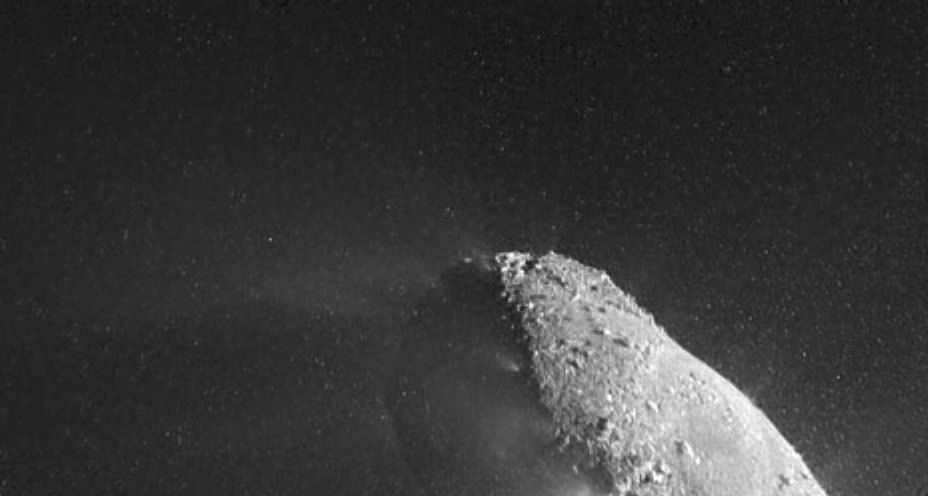
Fig. 12.39 Comet 103P/Hartley 2 imaged by NASA’s EPOXI mission during the close flyby on 4 November 2010. The peanut-shaped nucleus is approximately 2.2 km long with two distinct lobes joined by a smoother waist; bright jets of gas and dust emerge from both ends. Hartley 2 is notable for having a D/H ratio in its water consistent with Earth’s oceans, in contrast to most other measured comets. Image credit: NASA/JPL-Caltech/UMD, public domain.#
Mixing models show that carbonaceous chondrite water must dominate Earth’s volatile budget by mass, with only a small cometary contribution [Alexander, 2017]. Earth’s water thus reflects inner solar system processing of mostly carbonaceous-chondrite-like material (Lecture 9).
12.4. Part 3: Messengers and visitors#
This final part of the lecture surveys recent results from in situ space missions, sample return, and interstellar visitors.
12.4.1. Rosetta and 67P/Churyumov-Gerasimenko#
The European Space Agency’s Rosetta mission was the first to orbit a comet, escorting 67P/Churyumov-Gerasimenko through perihelion before a controlled descent in 2016 (Fig. 12.40).
In November 2014, the lander Philae made the first soft landing on a cometary nucleus.
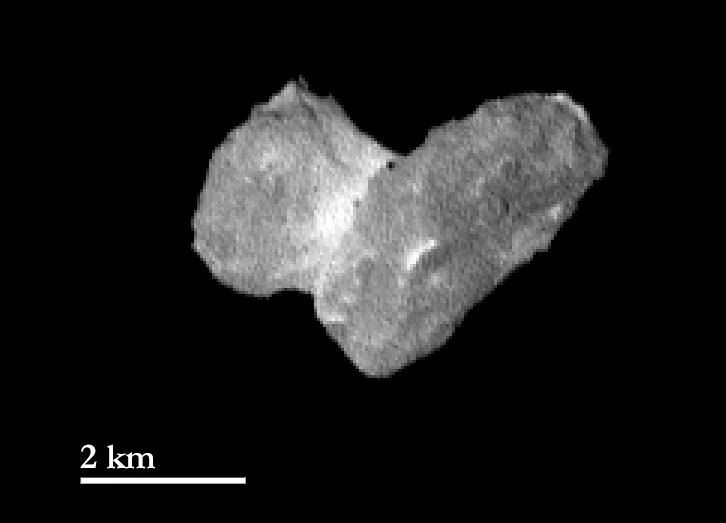
Fig. 12.40 The nucleus of comet 67P/Churyumov-Gerasimenko imaged by Rosetta. The bilobed “duck” shape is one of the most distinctive features of the comet; the two lobes are joined at a narrow neck region (the bright collar visible in this image). The bilobed morphology is interpreted as a contact binary formed from the gentle merger of two primordial cometesimals, much like Arrokoth on a smaller scale. Image credit: ESA/Rosetta/MPS for OSIRIS Team MPS/UPD/LAM/IAA/SSO/INTA/UPM/DASP/IDA (ESA Standard Licence).#
Rosetta’s headline scientific findings include:
The bilobed nucleus is a contact binary, formed by the gentle merger of two primordial cometesimals at low velocity [Massironi et al., 2015].
Bulk density of \(0.533 \pm 0.006\) g cm\(^{-3}\) implies a porosity of \(\sim 70\)-\(80\%\) in a fluffy aggregate of dust and ice.
Cometary water D/H of \((5.3 \pm 0.7) \times 10^{-4}\) is approximately three times the terrestrial ocean value, not matching Earth’s water [Altwegg et al., 2015].
Detection of glycine, phosphorus, methylamine, and other prebiotic molecules in the coma by the ROSINA mass spectrometer [Altwegg et al., 2016].
12.4.2. Asteroid sample return: Hayabusa, Hayabusa2, OSIRIS-REx#
Sample-return missions deliver physical material from small bodies back to Earth, establishing direct links between laboratory meteorite groups and known asteroid parent bodies.
Hayabusa returned microscopic grains from S-type asteroid (25143) Itokawa in 2010 (Fig. 12.41), confirming a link to LL-class ordinary chondrites [Nakamura et al., 2011]. Itokawa, Ryugu and Bennu are all rubble piles: aggregates of boulders and gravel held together by weak self-gravity rather than monolithic rock, with bulk densities near \(1.2\) to \(1.9\) g cm\(^{-3}\) and macroporosities of tens of per cent (Lecture 8).
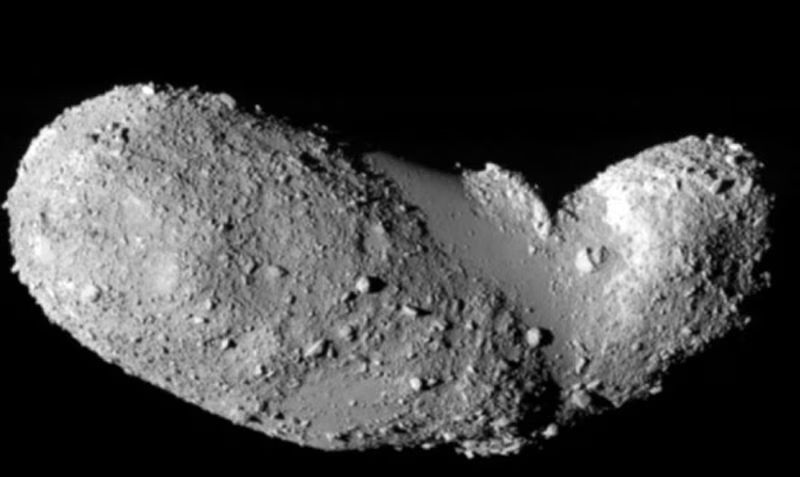
Fig. 12.41 The S-type near-Earth asteroid (25143) Itokawa imaged by Hayabusa AMICA in 2005. Itokawa is approximately 535 m long with a distinctive bilobed sea-otter profile: two rougher lobes joined by the smoother “Muses Sea” neck region (the central tan area). The complete absence of large craters and the high boulder fraction are signatures of a rubble-pile internal structure: a body held together by self-gravity and inter-fragment friction rather than by internal cohesion. Itokawa is the parent body of the LL-class ordinary chondrites. Image credit: ISAS / JAXA, CC BY 4.0.#
Hayabusa2 visited the carbonaceous (Cb-type) asteroid (162173) Ryugu and returned 5.4 g of sample in 2020 (Fig. 12.42). The returned material is rich in water-bearing phyllosilicates, carbonates, and organic molecules, including amino acids and the nucleobase uracil, with a bulk composition matching CI chondrites [Naraoka et al., 2023, Oba et al., 2023, Yokoyama et al., 2023].
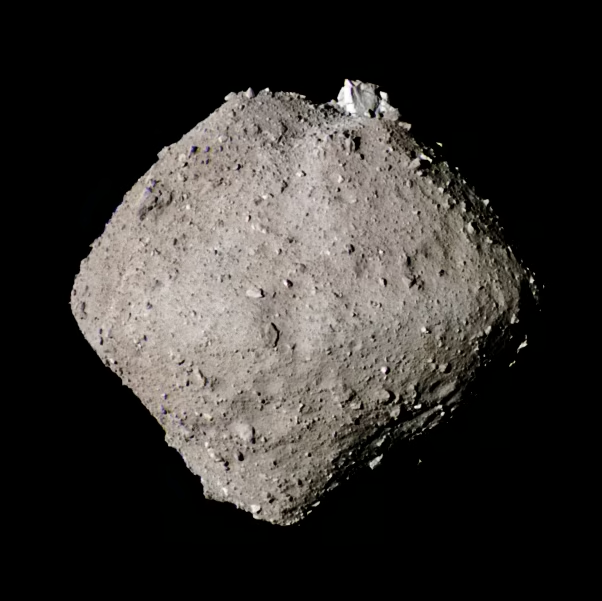
Fig. 12.42 The Cb-type near-Earth asteroid (162173) Ryugu imaged by Hayabusa2 ONC-T on 12 July 2018, showing an approximately 900 m diameter “spinning top” shape produced by past rapid rotation. Image credit: JAXA / Hayabusa2 ONC team, processed by Kevin M. Gill, CC BY 2.0.#
OSIRIS-REx visited the carbonaceous (B-type) asteroid (101955) Bennu and returned 121 g of sample in 2023 (Fig. 12.43). Analyses revealed hydrated phyllosilicates, carbonates, and organic matter with a CI-chondrite-like bulk composition, recording extensive aqueous alteration on an outer-solar-system precursor [Lauretta et al., 2024].
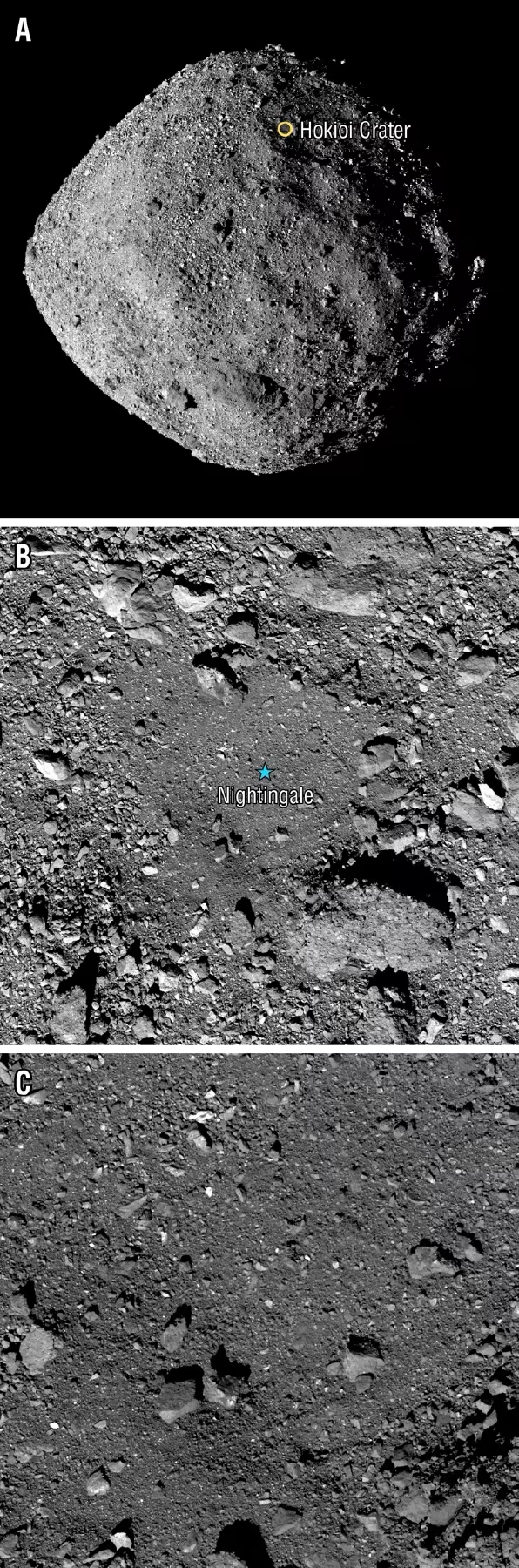
Fig. 12.43 (101955) Bennu and the OSIRIS-REx sample collection site at three nested zoom levels, showing the \(\sim 490\) m rubble-pile asteroid (top) down to the 1.4 m field of view at Nightingale (bottom). From Figure 1 of Lauretta et al. [2024].#
12.4.3. Lucy: a tour of the Trojans#
Jupiter Trojans are asteroids librating around the L4 and L5 Lagrange points in Jupiter’s orbit, \(60^{\circ}\) ahead of and behind the planet.
Their D-type spectra resemble Kuiper Belt objects, which suggests capture from distant planetesimals during the Nice-model instability [Morbidelli et al., 2005] (Lecture 2). NASA’s Lucy mission (launched October 2021) is a 12-year tour visiting eight Trojans across both swarms between 2027 and 2033. En route to the Trojans, Lucy encountered the inner main-belt asteroid (152830) Dinkinesh, discovering that its orbiting moonlet Selam is a contact binary (Fig. 12.44).
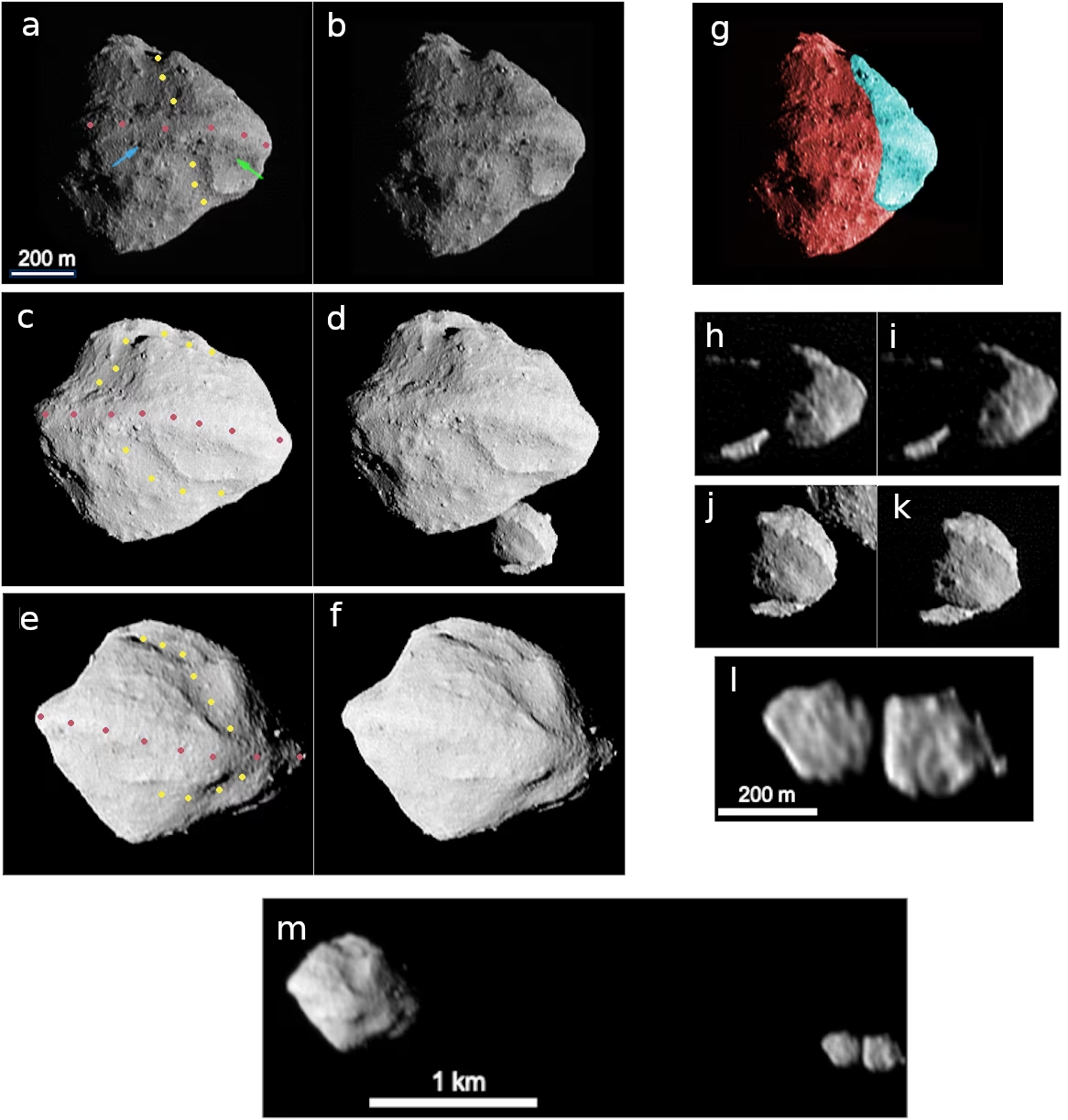
Fig. 12.44 The Dinkinesh-Selam system imaged by NASA’s Lucy mission during its flyby on 1 November 2023. (a-f) Three stereo pairs of the inner main-belt asteroid (152830) Dinkinesh, about 720 m across, on approach, near closest approach and on departure; yellow dots trace its longitudinal trough, red dots its equatorial ridge, and the moonlet appears behind the primary in (d). (g) Dinkinesh with the trough section (cyan) shifted back into place. (h-l) The moonlet Selam, a contact binary of two near-equal lobes of about 210 and 230 m, and (m) the pair at their true separation (scale bars 200 m and 1 km). Reproduced from Levison et al. [2024], Fig. 1.#
12.4.4. Psyche: the metal world#
(16) Psyche (\(\sim 222\) km effective diameter) is the largest M-type asteroid, interpreted as the exposed core [Elkins-Tanton et al., 2020] of a differentiated planetesimal whose silicate mantle was stripped by a giant impact. Fig. 12.45 shows the shape that radar and adaptive-optics imaging give it: a flattened body whose outline departs from an ellipsoid at three depressions.
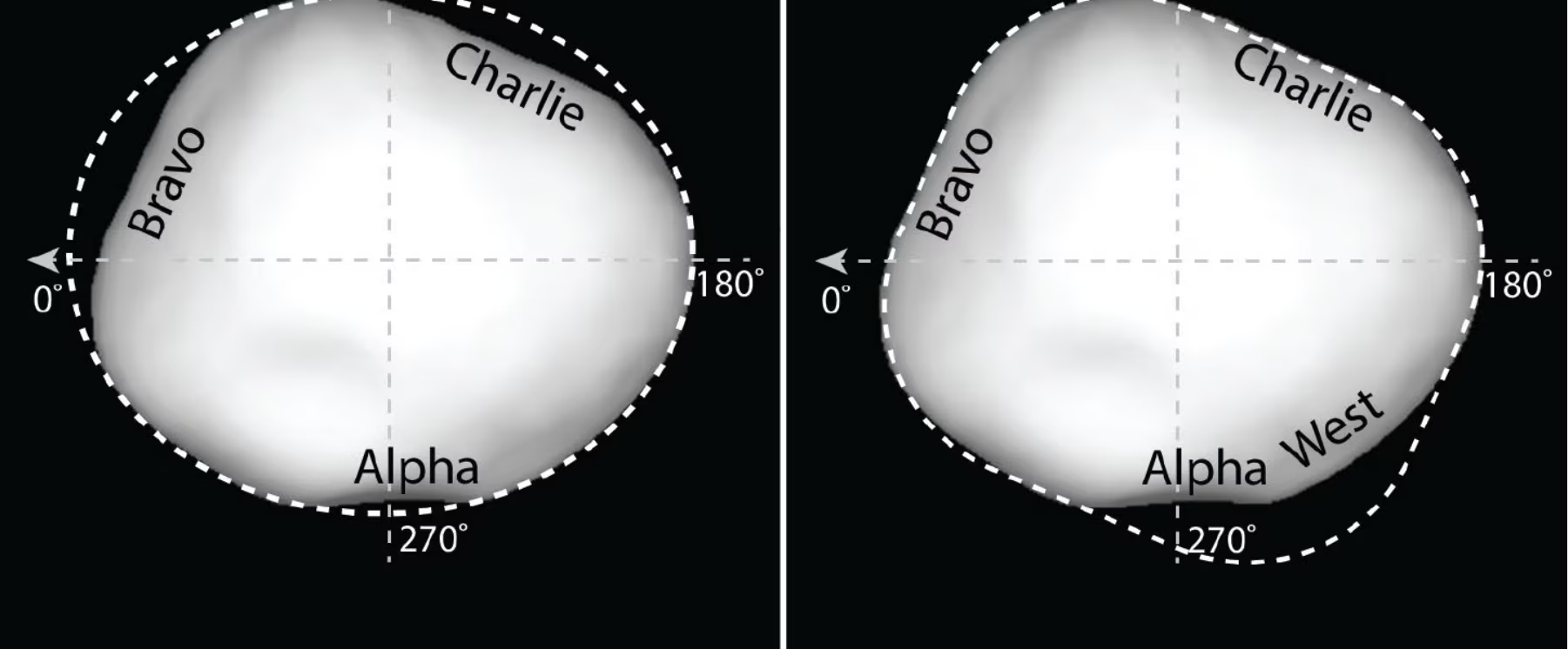
Fig. 12.45 Shape of (16) Psyche seen from above its south pole, from a combined radar and adaptive-optics model. Left: the best-fit ellipsoid (dashed) over the shape model, with the regions Alpha, Bravo and Charlie where the body falls short of the ellipsoid. Right: a rounded-rectangle outline that follows the model more closely at Bravo and Charlie; Alpha West marks a further depression. Longitudes 0°, 180° and 270° are indicated. Reproduced from Shepard et al. [2021].#
12.4.5. Interstellar visitors#
Interstellar objects are bodies originating outside the solar system on unbound, hyperbolic orbits. Discovered in October 2017, 1I/’Oumuamua was the first confirmed interstellar visitor, a small (\(\sim 100\)–\(200\) m long), highly elongated body with non-gravitational acceleration but no detectable coma [Micheli et al., 2018]. Its detection implies a much higher space density of interstellar objects than pre-discovery models predicted (Fig. 12.46).
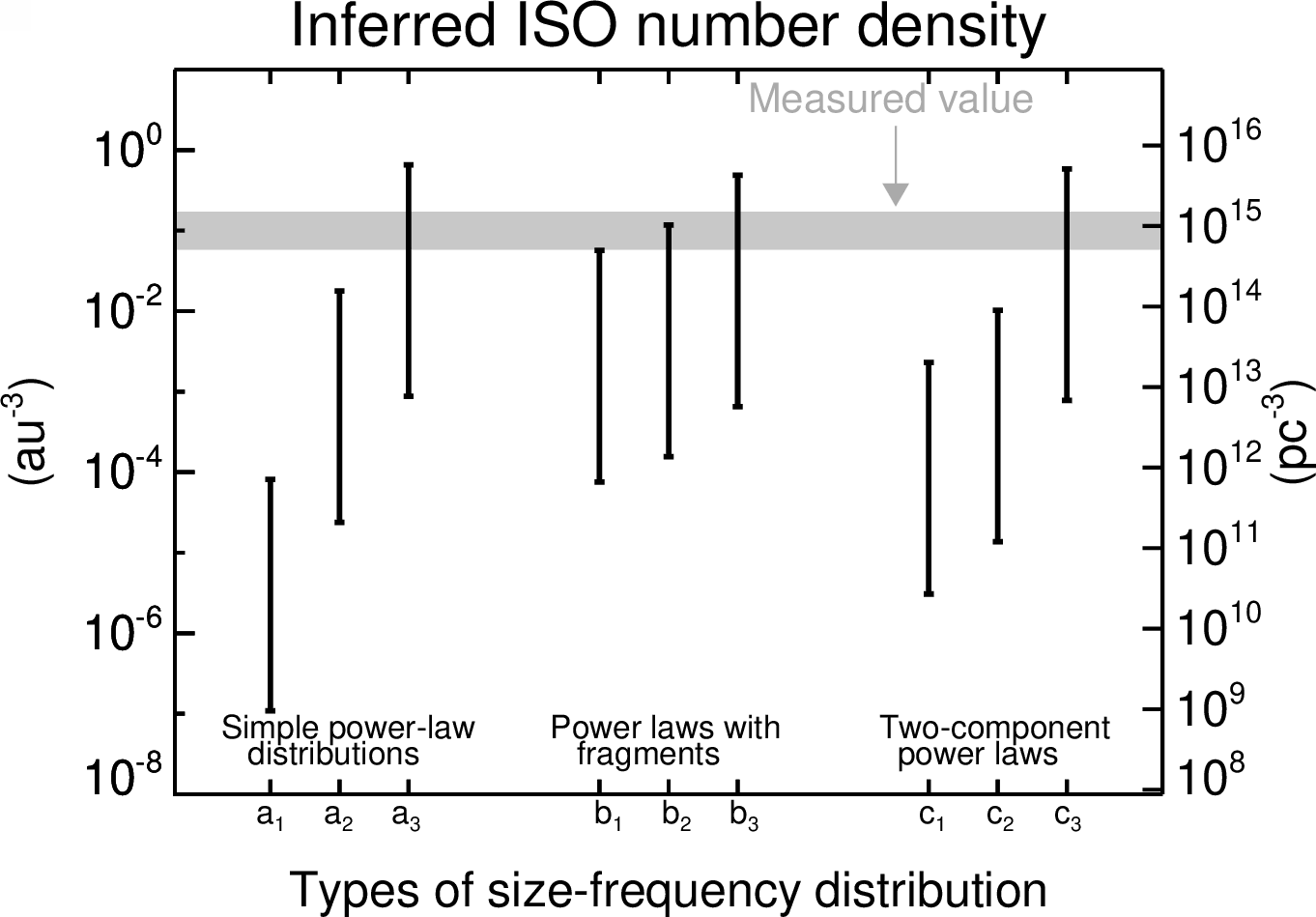
Fig. 12.46 Inferred space number density of interstellar objects in pc\(^{-3}\) implied by the discovery of 1I/’Oumuamua, broken down by assumed population type along the horizontal axis (asteroidal, comets from giant-planet ejection, comets from white-dwarf disruption, free-floating planetary fragments, two-population mixed models). The vertical axis is the implied space density. The Pan-STARRS detection of a single ISO already implies densities orders of magnitude larger than pre-discovery predictions for any reasonable assumed population, and survey statistics now imply \(\sim 10^{4}\) ISOs larger than \(\sim 100\) m within Neptune’s orbit at any given time. From Figure 2 of 'Oumuamua ISSI Team et al. [2019].#
Discovered in August 2019, 2I/Borisov was the first confirmed interstellar comet (Fig. 12.47). Spectroscopy revealed a CO abundance of at least 173% relative to water, compared to typical solar-system cometary values near 4% [Bodewits et al., 2020]. A CO/H\(_2\)O ratio above unity indicates that Borisov formed beyond the CO snowline in a colder region of its host system.
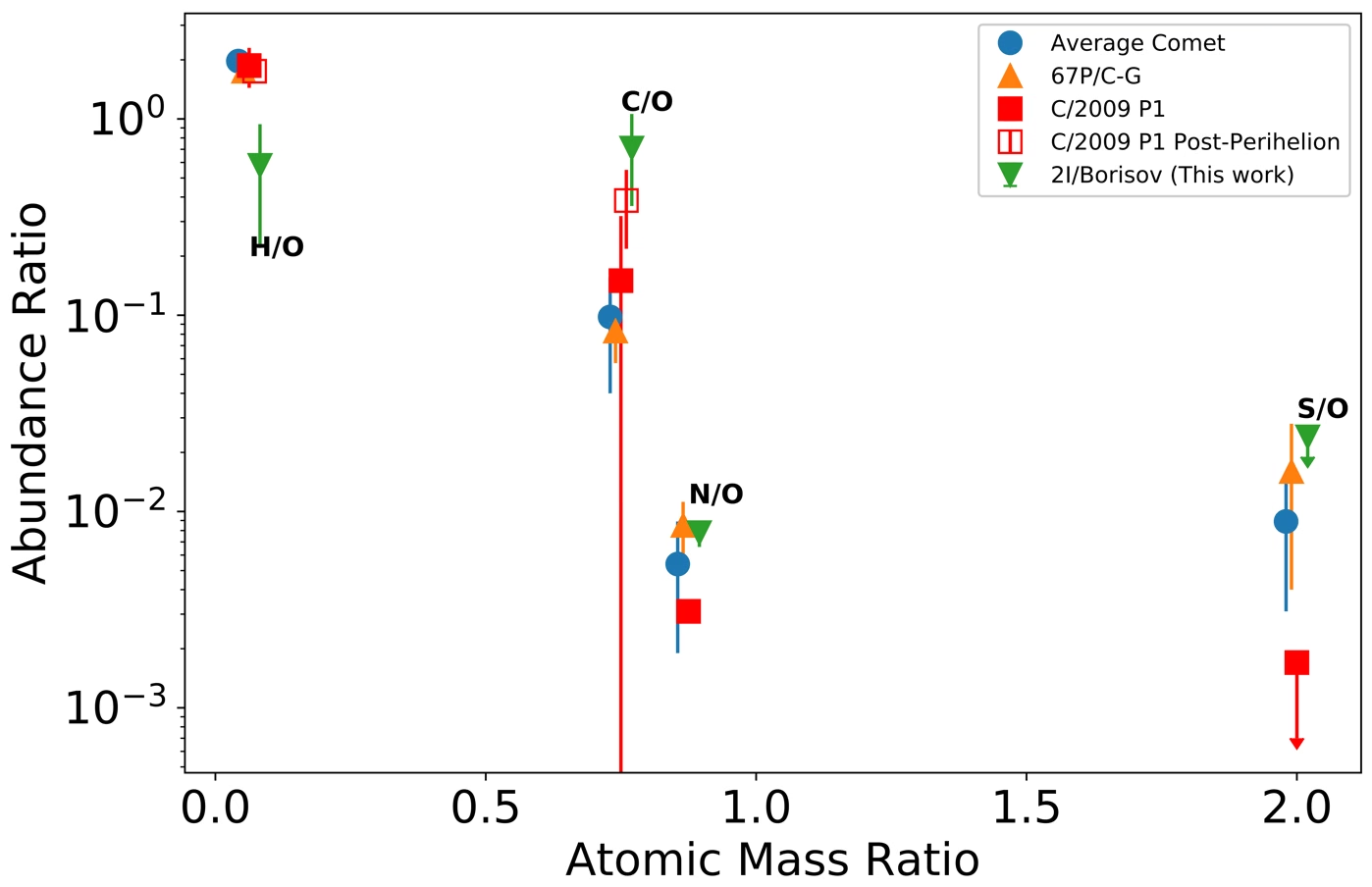
Fig. 12.47 Composition of volatiles in the coma of 2I/Borisov compared with comets in our solar system. The vertical axis is the elemental abundance ratio with respect to atomic oxygen; the horizontal axis is the atomic mass ratio of the element to oxygen, which spreads the four ratios H/O, C/O, N/O, and S/O across the plot. Each ratio has five symbols: average solar-system comets (blue circle), 67P/Churyumov-Gerasimenko (orange triangle), comet C/2009 P1 (Garradd) averaged (filled red square) and after perihelion (open red square), and 2I/Borisov (green triangle). Error bars are \(1\sigma\), and a small arrow below a symbol marks an upper limit, as for S/O in Borisov. Borisov has C/O \(= 0.71 \pm 0.35\), about seven times the average cometary value of \(0.098 \pm 0.058\), while its H/O of \(0.58 \pm 0.36\) is about three times lower than the cometary average of \(1.97 \pm 0.13\). Both differences point to a carbon-rich, water-poor ice inventory and therefore to formation beyond the CO snowline of its host planetary system. From Figure 3 of Bodewits et al. [2020].#
12.4.6. Open questions and frontier topics#
Several key questions remain open across small-body science:
Structure of the Oort cloud: The Oort cloud remains an inferred population with no direct observations, imaging, or samples.
Origin of Earth’s water: The relative contributions of carbonaceous chondrites and comets remain under active investigation, connecting to Lecture 9 and Lecture 14.
Dynamically new comets: ESA’s Comet Interceptor (launch 2029) will wait at the Sun-Earth L2 point for a comet entering the inner solar system for the first time [Snodgrass and Jones, 2019].
Interstellar visitors: Each interstellar object samples the formation chemistry of another planetary system, providing a comparative cosmochemistry probe across stars.
The multi-spacecraft architecture of ESA’s Comet Interceptor will observe an incoming pristine or interstellar target from multiple directions simultaneously (Fig. 12.48).
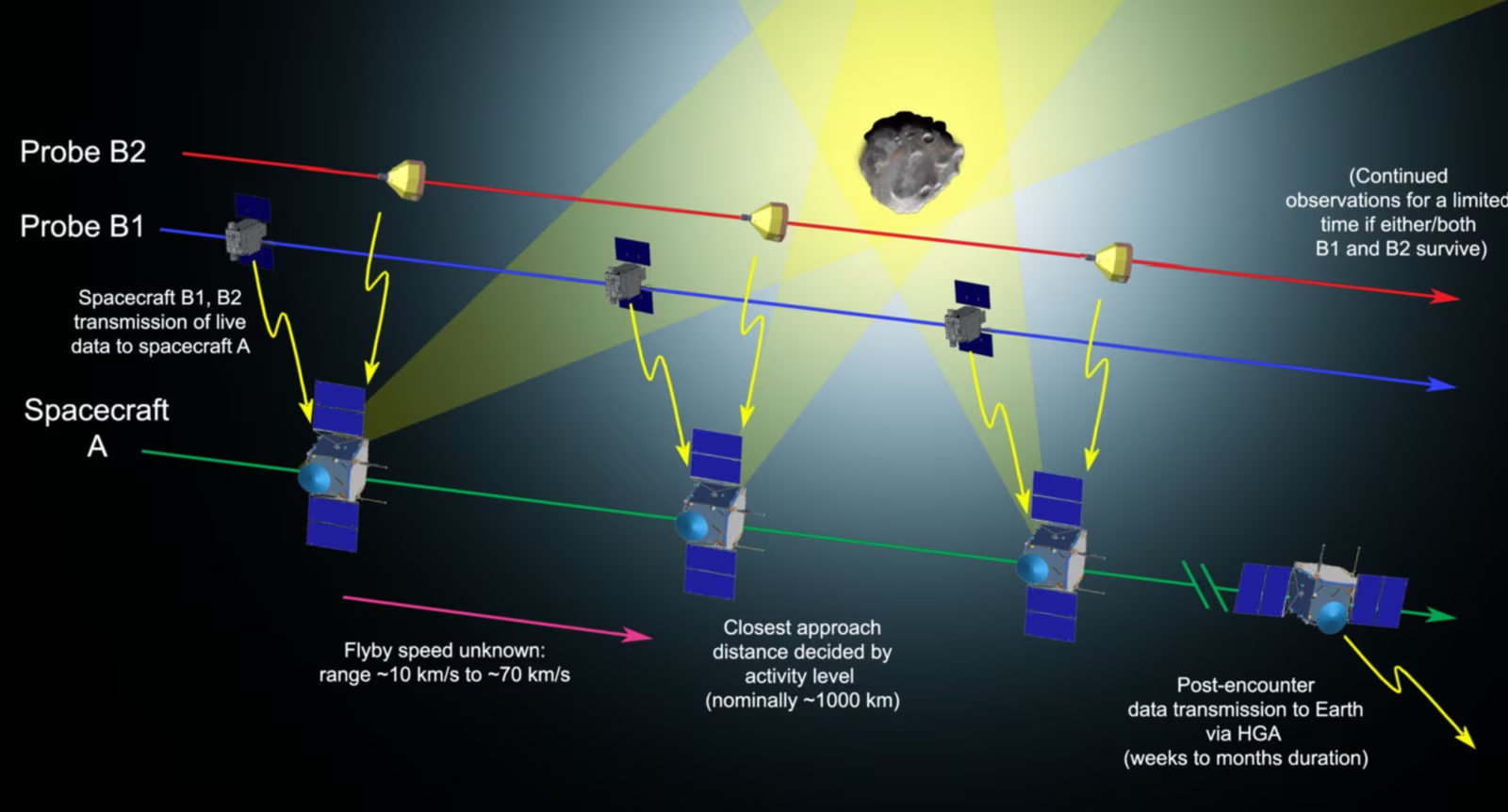
Fig. 12.48 Schematic of the planned ESA Comet Interceptor mission, showing the multi-spacecraft flyby geometry. The main spacecraft and two smaller probes will sample a single target from multiple directions, allowing the first 3D reconstruction of an active comet’s nucleus, coma, and plasma environment. Image credit: ESA, CC BY-SA 3.0 IGO.#
12.5. Summary and takeaways#
Small bodies are the formation fossils of the solar system: everything that did not become a planet. The inner small bodies (main-belt asteroids and the meteorites they deliver) are dominantly rocky leftovers; the outer small bodies (Kuiper Belt, scattered disk, Oort cloud, comets) are dominantly icy leftovers.
Kirkwood gaps in the main belt, the bimodal inclination distribution of the classical Kuiper Belt, the existence of a populated 3:2 resonance with Neptune (the plutinos including Pluto), and the trapped Trojan swarms at Jupiter’s L4 and L5 Lagrange points are all fossils of giant-planet migration.
Meteorites are the only solar-system samples that can be studied in a terrestrial laboratory, and they provide direct ground-truth on ages and compositions that no spacecraft instrument can match. The Pb-Pb age of CAIs at \(4567.30 \pm 0.16\) Myr anchors time zero, with parallel uranium decay chains making the isochron method self-calibrating.
The NC-CC dichotomy is one of the most important open problems in cosmochemistry. Three competing physical interpretations (Jupiter as an early gravitational barrier, snow-line migration with pebble isolation, and a temporal-epoch model with no spatial barrier) each match the existing data and each make different predictions for how the solar system’s planetesimal reservoirs were structured in time and space.
Recent missions have transformed our understanding of small bodies. Rosetta gave us cometary geophysics and the closest direct sample of comet structure. Hayabusa2 and OSIRIS-REx returned carbonaceous material from Ryugu and Bennu, linking spectral types to chondrite groups, while DART demonstrated kinetic asteroid deflection.
The new and most unexpected category is interstellar visitors. They are the first physical samples of other planetary systems directly observable in our solar neighbourhood, linking small bodies to the exoplanet science of Lecture 13.
12.6. References#
Alexander, Conel M. O'D. 2017. “The origin of inner solar system water.” Philosophical Transactions of the Royal Society A, 375:20150384. doi:10.1098/rsta.2015.0384, https://ui.adsabs.harvard.edu/abs/2017RSPTA.37550384A/abstract.
Altwegg, Kathrin, Balsiger, Hans, Bar-Nun, Akiva, Berthelier, Jean Jacques, Bieler, Andre, Bochsler, Peter, Briois, Christelle, Calmonte, Ursina, Combi, Michael, Cottin, Hervé, De Keyser, Johan, Dhooghe, Frederik, Fiethe, Björn, Fuselier, Stephen A., Gasc, Sebastien, Gombosi, Tamas I., Hansen, Kenneth C., Haessig, Myrtha, Jäckel, Annette, Kopp, Ernst, Korth, Axel, Le Roy, Léna, Mall, Urs, Marty, Bernard, Mousis, Olivier, Owen, Tobias, Rème, Henri, Rubin, Martin, Sémon, Thierry, Tzou, Chia-Yu, Waite, James Hunter, and Wurz, Peter. 2016. “Prebiotic chemicals—amino acid and phosphorus—in the coma of comet 67P/Churyumov-Gerasimenko.” Science Advances, 2:e1600285. doi:10.1126/sciadv.1600285, https://ui.adsabs.harvard.edu/abs/2016SciA....2E0285A/abstract.
Altwegg, Kathrin, Balsiger, Hans, Bar-Nun, Akiva, Berthelier, Jean Jacques, Bieler, Andre, Bochsler, Peter, Briois, Christelle, Calmonte, Ursina, Combi, Michael, De Keyser, Johan, Eberhardt, Peter, Fiethe, Björn, Fuselier, Stephen, Gasc, Sebastien, Gombosi, Tamas I., Hansen, Kenneth C., Hässig, Myrtha, Jäckel, Annette, Kopp, Ernst, Korth, Axel, LeRoy, Léna, Mall, Urs, Marty, Bernard, Mousis, Olivier, Neefs, Eddy, Owen, Tobias, Rème, Henri, Rubin, Martin, Sémon, Thierry, Tzou, Chia-Yu, Waite, Hunter, and Wurz, Peter. 2015. “67P/Churyumov-Gerasimenko, a Jupiter-family comet with a high D/H ratio.” Science, 347(6220):1261952. doi:10.1126/science.1261952, https://ui.adsabs.harvard.edu/abs/2015Sci...347A.387A/abstract.
Amelin, Yuri, Kaltenbach, Angela, Iizuka, Tsuyoshi, Stirling, Claudine H., Ireland, Trevor R., Petaev, Michail, and Jacobsen, Stein B. 2010. “U–Pb chronology of the solar system's oldest solids with variable ²³⁸U/²³⁵U.” Earth and Planetary Science Letters, 300:343–350. doi:10.1016/j.epsl.2010.10.015, https://ui.adsabs.harvard.edu/abs/2010E&PSL.300..343A/abstract.
Bannister, Michele T., Gladman, Brett J., Kavelaars, J. J., Petit, Jean-Marc, Volk, Kathryn, Chen, Ying-Tung, Alexandersen, Mike, Gwyn, Stephen D. J., Schwamb, Megan E., Ashton, Edward, Benecchi, Susan D., Cabral, Nahuel, Dawson, Rebekah, Delsanti, Audrey, Fraser, Wesley C., Granvik, Mikael, Greenstreet, Sarah, Guilbert-Lepoutre, Aurelie, Ip, Wing-Huen, Jakubik, Marian, Jones, R. Lynne, Kaib, Nathan, Lacerda, Pedro, Van Laerhoven, Christa, Lawler, Samantha, Lehner, Matthew J., Lin, Hsing Wen, Lykawka, Patryk Sofia, Marsset, Michael, Murray-Clay, Ruth, Pike, Rosemary E., Rousselot, Philippe, Shankman, Cory, and Vernazza, Pierre. 2018. “OSSOS. VII. 800+ trans-Neptunian objects: the complete data release.” The Astrophysical Journal Supplement Series, 236:18. doi:10.3847/1538-4365/aab77a, https://ui.adsabs.harvard.edu/abs/2018ApJS..236...18B/abstract.
Batygin, Konstantin, Adams, Fred C., Brown, Michael E., and Becker, Juliette C. 2019. “The Planet Nine hypothesis.” Physics Reports, 805:1–53. doi:10.1016/j.physrep.2019.01.009, arXiv:1902.10103, https://ui.adsabs.harvard.edu/abs/2019PhR...805....1B/abstract.
Bodewits, Dennis, Noonan, John W., Feldman, Paul D., Bannister, Michele T., Farnocchia, Davide, Harris, Walter M., Li, Jian-Yang, Mandt, Kathleen E., Parker, Joel Wm., and Xing, Zexi. 2020. “The carbon monoxide-rich interstellar comet 2I/Borisov.” Nature Astronomy, 4:867–871. doi:10.1038/s41550-020-1095-2, https://ui.adsabs.harvard.edu/abs/2020NatAs...4..867B/abstract.
Bogard, Donald D. and Johnson, Pratt. 1983. “Martian gases in an Antarctic meteorite?.” Science, 221(4611):651–654. doi:10.1126/science.221.4611.651, https://ui.adsabs.harvard.edu/abs/1983Sci...221..651B/abstract.
Bollard, Jean, Connelly, James N., Whitehouse, Martin J., Pringle, Emily A., Bonal, Lydie, Jorgensen, Jes K., Nordlund, Åke, Moynier, Frederic, and Bizzarro, Martin. 2017. “Early formation of planetary building blocks inferred from Pb isotopic ages of chondrules.” Science Advances, 3:e1700407. doi:10.1126/sciadv.1700407, https://ui.adsabs.harvard.edu/abs/2017SciA....3E0407B/abstract.
Bottke, William F., Morbidelli, Alessandro, Jedicke, Robert, Petit, Jean-Marc, Levison, Harold F., Michel, Patrick, and Metcalfe, Travis S. 2002. “Debiased orbital and absolute magnitude distribution of the near-Earth objects.” Icarus, 156:399–433. doi:10.1006/icar.2001.6788, https://ui.adsabs.harvard.edu/abs/2002Icar..156..399B/abstract.
Bottke, William F., Vokrouhlický, David, Rubincam, David P., and Nesvorný, David. 2006. “The Yarkovsky and YORP effects: implications for asteroid dynamics.” Annual Review of Earth and Planetary Sciences, 34:157–191. doi:10.1146/annurev.earth.34.031405.125154, https://ui.adsabs.harvard.edu/abs/2006AREPS..34..157B/abstract.
Bottke, William F., Vokrouhlický, David, and Walsh, Kevin J. 2020. “The asteroid belt as a relic from a chaotic early solar system.” In Vesta and Ceres: Insights from the Dawn Mission for the Origin of the Solar System. Cambridge University Press.
Brasser, Ramon and Morbidelli, Alessandro. 2013. “Oort cloud and scattered disc formation during a late dynamical instability in the solar system.” Icarus, 225:40–49. doi:10.1016/j.icarus.2013.03.012, https://ui.adsabs.harvard.edu/abs/2013Icar..225...40B/abstract.
Brennecka, Gregory A., Weyer, Stefan, Wadhwa, Meenakshi, Janney, Philip E., Zipfel, Jutta, and Anbar, Ariel D. 2010. “²³⁸U/²³⁵U variations in meteorites: extant ²⁴⁷Cm and implications for Pb-Pb dating.” Science, 327(5964):449–451. doi:10.1126/science.1180871, https://ui.adsabs.harvard.edu/abs/2010Sci...327..449B/abstract.
Brown, Peter G., Assink, Jelle D., Astiz, Luciana, Blaauw, Rhiannon, Boslough, Mark B., Borčin, Jiří, Brachet, Naomi, Brown, David, Campbell-Brown, Margaret D., Ceranna, Lars, Cooke, Bill, de Groot-Hedlin, Catherine, Drob, Douglas P., Edwards, Wayne, Evers, László G., Garces, Milton, Gill, Jeffrey, Hedlin, Michael, Kingery, Aaron, Laske, Gabi, Le Pichon, Alexis, Mialle, Pierrick, Moser, Donald E., Saffer, Adam, Silber, Eric, Smets, Pieter, Spalding, Richard E., Spurný, Pavel, Tagliaferri, Edward, Uren, David, Weryk, Robert J., Whitaker, Robert, and Krzeminski, Zbigniew. 2013. “A 500-kiloton airburst over Chelyabinsk and an enhanced hazard from small impactors.” Nature, 503:238–241. doi:10.1038/nature12741, https://ui.adsabs.harvard.edu/abs/2013Natur.503..238B/abstract.
Canup, Robin M. 2011. “On a giant impact origin of Charon, Nix, and Hydra.” The Astronomical Journal, 141:35. doi:10.1088/0004-6256/141/2/35, https://ui.adsabs.harvard.edu/abs/2011AJ....141...35C/abstract.
Castillo-Rogez, Julie, Johnson, Torrence V., Lee, Man Hoi, Turner, Neal J., Matson, Dennis L., and Lunine, Jonathan. 2009. “²⁶Al decay: heat production and a revised age for Iapetus.” Icarus, 204(2):658–662. Adopted here for the ²⁶Al half-life (0.717 Myr) and its heat production. doi:10.1016/j.icarus.2009.07.025, https://ui.adsabs.harvard.edu/abs/2009Icar..204..658C/abstract.
Cheng, Andrew F., Agrusa, Harrison F., Barbee, Brent W., Meyer, Alex J., Farnham, Tony L., Raducan, Sabina D., Richardson, Derek C., Dotto, Elisabetta, Zinzi, Angelo, Della Corte, Vincenzo, Statler, Thomas S., Chesley, Steven, Naidu, Shantanu P., Hirabayashi, Masatoshi, Li, Jian-Yang, Eggl, Siegfried, Rivkin, Andrew S., Chabot, Nancy L., Daly, R. Terik, Ernst, Carolyn M., Lin, Erik, Rainey, Emma S. G., Pravec, Petr, and Scheirich, Petr. 2023. “Momentum transfer from the DART mission kinetic impact on asteroid Dimorphos.” Nature, 616:457–460. doi:10.1038/s41586-023-05878-z, https://ui.adsabs.harvard.edu/abs/2023Natur.616..457C/abstract.
Clayton, Robert N., Grossman, Lawrence, and Mayeda, Toshiko K. 1973. “A component of primitive nuclear composition in carbonaceous meteorites.” Science, 182(4111):485–488. doi:10.1126/science.182.4111.485, https://ui.adsabs.harvard.edu/abs/1973Sci...182..485C/abstract.
Connelly, James N., Bizzarro, Martin, Krot, Alexander N., Nordlund, Åke, Wielandt, Daniel, and Ivanova, Marina A. 2012. “The absolute chronology and thermal processing of solids in the solar protoplanetary disk.” Science, 338(6107):651–655. doi:10.1126/science.1226919, https://ui.adsabs.harvard.edu/abs/2012Sci...338..651C/abstract.
Connolly Jr., Harold C. and Jones, Rhian H. 2016. “Chondrules: the canonical and noncanonical views.” Journal of Geophysical Research: Planets, 121(10):1885–1899. doi:10.1002/2016JE005113, https://ui.adsabs.harvard.edu/abs/2016JGRE..121.1885C/abstract.
Daly, R. Terik, Ernst, Carolyn M., Barnouin, Olivier S., Chabot, Nancy L., Rivkin, Andrew S., Cheng, Andrew F., Adams, Elena Y., Agrusa, Harrison F., Abel, Elisabeth D., Alford, Amy L., Asphaug, Erik I., Atchison, Justin A., Badescu, Alex R., Baltzer, Ronald, Bekker, Dmitriy L., Bellerose, Julie A., Belton, Michael J. S., Bernardoni, Mauro, Bhaskaran, Shyam, Bigot, Jeremy, Bonin, Grant, Bottke, William F., Brack, Daniel N., Brown, Brent, and Burke, Brendan. 2023. “Successful kinetic impact into an asteroid for planetary defence.” Nature, 616:443–447. doi:10.1038/s41586-023-05810-5, https://ui.adsabs.harvard.edu/abs/2023Natur.616..443D/abstract.
De Sanctis, Maria Cristina, Raponi, Andrea, Ammannito, Eleonora, Ciarniello, Mauro, Toplis, Michael J., McSween, Harry Y., Castillo-Rogez, Julie C., Ehlmann, Bethany L., Carrozzo, Filippo G., Marchi, Simone, Tosi, Federico, Zambon, Francesca, Capaccioni, Fabrizio, Capria, Maria Teresa, Fonte, Sergio, Formisano, Michelangelo, Frigeri, Alessandro, Giardino, Marco, Longobardo, Andrea, Magni, Gianfranco, Palomba, Ernesto, McFadden, Lucy A., Pieters, Carle M., Jaumann, Ralf, Schenk, Paul, Mugnuolo, Raffaele, Raymond, Carol A., and Russell, Christopher T. 2016. “Bright carbonate deposits as evidence of aqueous alteration on (1) Ceres.” Nature, 536:54–57. doi:10.1038/nature18290, https://ui.adsabs.harvard.edu/abs/2016Natur.536...54D/abstract.
DeMeo, Francesca E. and Carry, Benoît. 2014. “Solar system evolution from compositional mapping of the asteroid belt.” Nature, 505:629–634. doi:10.1038/nature12908, https://ui.adsabs.harvard.edu/abs/2014Natur.505..629D/abstract.
Dones, Luke, Weissman, Paul R., Levison, Harold F., and Duncan, Martin J. 2004. “Oort cloud formation and dynamics.” In Festou, M., Keller, H. U., and Weaver, H. A., editors, Comets II, pages 153–174. University of Arizona Press.
Elkins-Tanton, Linda T., Asphaug, Erik, Bell III, James F., Bercovici, Hannah, Bills, Bruce G., Binzel, Richard P., Bottke, William F., Dibb, Steven, Lawrence, David J., Marchi, Simone, McCoy, Timothy J., Oran, Rona, Park, Ryan S., Peplowski, Patrick N., Polanskey, Carol A., Prettyman, Thomas H., Russell, Carol A., Schaefer, Laura, Weiss, Benjamin P., Wieczorek, Mark A., Williams, David A., and Zuber, Maria T. 2020. “Observations, meteorites, and models: a preflight assessment of the composition and formation of (16) Psyche.” Journal of Geophysical Research: Planets, 125:e2019JE006296. doi:10.1029/2019JE006296, https://ui.adsabs.harvard.edu/abs/2020JGRE..12506296E/abstract.
Gladstone, G. Randall, Stern, S. Alan, Ennico, Kimberly, Olkin, Catherine B., Weaver, Harold A., Young, Leslie A., Summers, Michael E., Strobel, Darrell F., Hinson, David P., Kammer, Joshua A., Parker, Alex H., Steffl, Andrew J., Linscott, Ivan R., Parker, Joel Wm., Cheng, Andrew F., Slater, David C., Versteeg, Maarten H., Greathouse, Thomas K., Retherford, Kurt D., Throop, Henry, Cunningham, Nathaniel J., Woods, William W., Singer, Kelsi N., Tsang, Constantine C. C., Schindhelm, Eric, Lisse, Carey M., Wong, Michael L., Yung, Yuk L., Zhu, Xun, Curdt, Werner, Lavvas, Panayotis, and Young, Eliot F. 2016. “The atmosphere of Pluto as observed by New Horizons.” Science, 351(6279):aad8866. doi:10.1126/science.aad8866, https://ui.adsabs.harvard.edu/abs/2016Sci...351.8866G/abstract.
Goldstein, Joseph I., Scott, Edward R. D., and Chabot, Nancy L. 2009. “Iron meteorites: crystallization, thermal history, parent bodies, and origin.” Geochemistry, 69(4):293–325. doi:10.1016/j.chemer.2009.01.002, https://ui.adsabs.harvard.edu/abs/2009ChEG...69..293G/abstract.
Granvik, Mikael, Morbidelli, Alessandro, Jedicke, Robert, Bolin, Bryce, Bottke, William F., Beshore, Edward, Vokrouhlický, David, Nesvorný, David, and Michel, Patrick. 2018. “Debiased orbit and absolute-magnitude distributions for near-Earth objects.” Icarus, 312:181–207. doi:10.1016/j.icarus.2018.04.018, arXiv:1804.10265, https://ui.adsabs.harvard.edu/abs/2018Icar..312..181G/abstract.
Greenwood, Richard C., Burbine, Thomas H., Miller, Martin F., and Franchi, Ian A. 2017. “Melting and differentiation of early-formed asteroids: the perspective from high-precision oxygen isotope studies.” Geochemistry, 77(1):1–43. doi:10.1016/j.chemer.2016.09.005, https://ui.adsabs.harvard.edu/abs/2017ChEG...77....1G/abstract.
Grundy, William M., Cruikshank, Dale P., Gladstone, G. Randall, Howett, Carly J. A., Lauer, Tod R., Spencer, John R., Summers, Michael E., Buie, Marc W., Earle, Alissa M., Ennico, Kimberly, Parker, Joel Wm., Porter, Simon B., Singer, Kelsi N., Stern, S. Alan, Verbiscer, Anne J., Beyer, Ross A., Binzel, Richard P., Buratti, Bonnie J., Cook, Jason C., Dalle Ore, Cristina M., Olkin, Catherine B., Parker, Alex H., Protopapa, Silvia, Quirico, Eric, Retherford, Kurt D., Robbins, Stuart J., Schmitt, Bernard, Stansberry, John A., Umurhan, Orkan M., Weaver, Harold A., Young, Leslie A., and Zangari, Amanda M. 2016. “The formation of Charon's red poles from seasonally cold-trapped volatiles.” Nature, 539:65–68. doi:10.1038/nature19340, https://ui.adsabs.harvard.edu/abs/2016Natur.539...65G/abstract.
Hartogh, Paul, Lis, Dariusz C., Bockelée-Morvan, Dominique, de Val-Borro, Miguel, Biver, Nicolas, Küppers, Michael, Emprechtinger, Martin, Bergin, Edwin A., Crovisier, Jacques, Rengel, Miriam, Moreno, Raphael, Szutowicz, Slawomira, and Blake, Geoffrey A. 2011. “Ocean-like water in the Jupiter-family comet 103P/Hartley 2.” Nature, 478:218–220. doi:10.1038/nature10519, https://ui.adsabs.harvard.edu/abs/2011Natur.478..218H/abstract.
Hevey, Phelim J. and Sanders, Ian S. 2006. “A model for planetesimal meltdown by ²⁶Al and its implications for meteorite parent bodies.” Meteoritics and Planetary Science, 41(1):95–106. doi:10.1111/j.1945-5100.2006.tb00195.x, https://ui.adsabs.harvard.edu/abs/2006M&PS...41...95H/abstract.
Hewins, Roger H., Connolly Jr., Harold C., Lofgren, Gary E., and Libourel, Guy. 2005. “Experimental constraints on chondrule formation.” In Krot, A. N., Scott, E. R. D., and Reipurth, B., editors, Chondrites and the Protoplanetary Disk, volume 341 of ASP Conference Series, pages 286–316. Astronomical Society of the Pacific.
Kaib, Nathan A. and Quinn, Thomas. 2008. “The formation of the Oort cloud in open cluster environments.” Icarus, 197:221–238. doi:10.1016/j.icarus.2008.03.020, arXiv:0707.4515, https://ui.adsabs.harvard.edu/abs/2008Icar..197..221K/abstract.
Kleine, Thorsten, Touboul, Mathieu, Bourdon, Bernard, Nimmo, Francis, Mezger, Klaus, Palme, Herbert, Jacobsen, Stein B., Yin, Qing-Zhu, and Halliday, Alex N. 2009. “Hf–W chronology of the accretion and early evolution of asteroids and terrestrial planets.” Geochimica et Cosmochimica Acta, 73(17):5150–5188. doi:10.1016/j.gca.2008.11.047, https://ui.adsabs.harvard.edu/abs/2009GeCoA..73.5150K/abstract.
Krot, Alexander N., Keil, Klaus, Goodrich, Cyrena A., Scott, Edward R. D., and Weisberg, Michael K. 2014. “Classification of meteorites and their genetic relationships.” Treatise on Geochemistry, 2nd ed., 1:1–63. doi:10.1016/B978-0-08-095975-7.00102-9.
Kruijer, Thomas S., Burkhardt, Christoph, Budde, Gerrit, and Kleine, Thorsten. 2017. “Age of Jupiter inferred from the distinct genetics and formation times of meteorites.” Proceedings of the National Academy of Sciences, 114(26):6712–6716. doi:10.1073/pnas.1704461114, https://ui.adsabs.harvard.edu/abs/2017PNAS..114.6712K/abstract.
Lauretta, Dante S., Connolly Jr., Harold C., Aebersold, John E., Alexander, Conel M. O'D., Ballouz, Ronald-Louis, Barnes, Jessica J., Bates, Helena C., Bennett, Carina A., Blanche, Laurinne, Blumenfeld, Erika H., Clemett, Simon J., Cody, George D., Cosarinsky, Manuela, Corrigan, Catherine M., Domanik, Kenneth J., Dworkin, Jason P., Emery, Christopher D., Farnsworth, Kelsey K., Fries, Marc, Glavin, Daniel P., Greenwood, Richard C., Hamilton, Victoria E., Haenecour, Pierre, Heck, Philipp R., Hilts, Robert W., Hoover, Christopher G., Jenniskens, Peter, Jones, Daniel R., Keller, Lindsay P., Krot, Alexander N., Lambert, Andrew, Le, Loan, Lunning, Nicole G., Marcus, Mary A., Martins, Zita, Mayne, Robert G., McCoy, Timothy J., McDermott, Kelly H., Naoe, Tomoyo, Nguyen, Ann N., Nittler, Larry R., Norman, Marc D., Nuevo, Michel, Patzer, Andrea, Polit, Anjani T., Ream, Jessica E., Righter, Kevin, Russell, Sara S., Sanborn, Matthew E., Sandford, Scott A., Schofield, Paula F., Schrader, Devin L., Sears, Derek W. G., Seifert, Laurence B., Snead, Christopher J., Stephant, Alice, Steele, Andrew, Tachibana, Shogo, Thompson, Mike S., Trang, Dat, Tripathi, Riddhi, Tu, Vinh, Verchovsky, Alexander B., Wadhwa, Meenakshi, Welten, Kees C., Westphal, Andrew J., Yamanobe, Mai, Yokoyama, Tetsuya, Zega, Thomas J., Zeszut, Zofia A., and Team, OSIRIS-REx Sample Analysis. 2024. “Asteroid (101955) Bennu in the laboratory: properties of the sample collected by OSIRIS-REx.” Meteoritics & Planetary Science, 59:2453–2486. doi:10.1111/maps.14227, https://ui.adsabs.harvard.edu/abs/2024M&PS...59.2453L/abstract.
Levison, Harold F., Marchi, Simone, Noll, Keith S., Spencer, John R., Statler, Thomas S., Bell III, James F., Bierhaus, Edward B., Buie, Marc W., Daly, R. Terik, Ernst, Carolyn M., Hamilton, Victoria E., Olkin, Catherine B., Schwartz, Stephen R., Souza-Feliciano, Ana C., Sunshine, Jessica M., Verbiscer, Anne J., Weaver, Harold A., Adams, Elena Y., Bagenal, Fran, Becker, Tracy M., Brown, Michael E., Caplinger, Michael A., Cheng, Andrew F., Clark, Beth E., Connolly Jr., Harold C., Cooper, Reid F., Dauphas, Nicolas, Dotto, Elisabetta, Drozd, Kris, Edmundson, Kenneth L., Elliott, Heather A., Fang, Jiawen, Farnham, Tony L., Force, Eric, French, Linda M., Gaskell, Robert W., Gilbert, Erica A., Givens, Mason, Goldsten, John O., Gomez, Maranne L., Hamilton, Douglas P., Hammond, Noah P., Hanley, Jennifer, Harch, Ann, Harris, Walter, Hartung, Maurice, Hellebrand, Eric, Hellmich, Stephan, Hill, Matthew E., Howett, Carly J. A., Hung, Daniella, Jorda, Laurent, Kadlec, Brian, Kareta, Theodore, Keane, James T., Kelley, Michael S. P., Lahr, Marc Z., Lauer, Tod R., Lerner, Andrea L., Levison, Tabitha A., Lisse, Carey M., Marcus, Robert J., Martínez, Manuel I., McAdams, James V., McGrath, Andrew M., Meinke, Bonnie K., Merline, William J., Milam, Stefanie N., Moore, Jeffrey M., Morris, Aubrey J., Mueller, Beatrice E. A., Nesvorný, David, Nimmo, Francis, Pajola, Maurizio, Pinilla-Alonso, Noemí, Porter, Simon B., Quirico, Eric, Reuter, Dennis C., Robbins, Stuart J., Rocha, Roderick C., Rogers, Andrew B., Russell, Sara S., Sandford, Scott A., Singer, Kelsi N., Stanbridge, Dale, Stern, S. Alan, Strazzulla, Giovanni, Susorney, Hannah C. M., Suzuki, Atsushi, Tezfat, Nadine, Throop, Henry B., Vincent, Jean-Baptiste, Walsh, Kevin J., and Weibel, Conor R. 2024. “A contact binary satellite of the asteroid (152830) Dinkinesh.” Nature, 629:1015–1020. doi:10.1038/s41586-024-07378-0, https://ui.adsabs.harvard.edu/abs/2024Natur.629.1015L/abstract.
Lichtenberg, Tim, Drążkowska, Joanna, Schönbächler, Maria, Golabek, Gregor J., and Hands, Thomas O. 2021. “Bifurcation of planetary building blocks during Solar System formation.” Science, 371(6527):365–370. doi:10.1126/science.abb3091, arXiv:2101.08571, https://ui.adsabs.harvard.edu/abs/2021Sci...371..365L/abstract.
Lodders, Katharina. 2003. “Solar system abundances and condensation temperatures of the elements.” The Astrophysical Journal, 591:1220–1247. doi:10.1086/375492, https://ui.adsabs.harvard.edu/abs/2003ApJ...591.1220L/abstract.
Massironi, Matteo, Simioni, Emanuele, Marzari, Francesco, Cremonese, Gabriele, Giacomini, Lorenza, Pajola, Maurizio, Jorda, Laurent, Naletto, Giampiero, Lowry, Stephen, El-Maarry, Mohamed Ramy, Preusker, Frank, Scholten, Frank, Sierks, Holger, Barbieri, Cesare, Lamy, Philippe, Rodrigo, Rafael, Koschny, Detlef, Rickman, Hans, Keller, Horst Uwe, Agarwal, Jessica, A'Hearn, Michael F., Auger, Anne-Thérèse, Barucci, Maria Antonietta, Bertaux, Jean-Loup, Bertini, Ivano, Besse, Sébastien, Bodewits, Dennis, Capanna, Claire, Da Deppo, Vania, Davidsson, Björn, Debei, Stefano, De Cecco, Mariolino, Ferri, Francesca, Fornasier, Sonia, Fulle, Marco, Gaskell, Robert, Groussin, Olivier, Gutierrez, Pedro Jose, Güttler, Carsten, Hviid, Stubbe Falch, Ip, Wing-Huen, Knollenberg, Jörg, Kovacs, Gábor, Kramm, Joerg-Rainer, Kührt, Ekkehard, Küppers, Michael, La Forgia, Fiorangela, Lara, Luisa M., Lazzarin, Monica, Lin, Zhong-Yi, Lopez Moreno, Jose J., Magrin, Sara, Marchi, Simone, Marschall, Raphael, Marzari, Francesco, Mottola, Stefano, Naletto, Giampaolo, Oklay, Nilda, Pommerol, Antoine, Sabau, Lola, Thomas, Nicolas, Toth, Imre, Tubiana, Cecilia, and Vincent, Jean-Baptiste. 2015. “Two independent and primitive envelopes of the bilobate nucleus of comet 67P.” Nature, 526:402–405. doi:10.1038/nature15511, https://ui.adsabs.harvard.edu/abs/2015Natur.526..402M/abstract.
McKinnon, William B. 2008. “Could Ceres be a refugee from the Kuiper belt?.” Asteroids, Comets, Meteors 2008, pages 8389.
McKinnon, William B., Nimmo, Francis, Wong, Teresa, Schenk, Paul M., White, Oliver L., Roberts, James H., Moore, Jeffrey M., Spencer, John R., Howard, Alan D., Umurhan, Orkan M., Stern, S. Alan, Weaver, Harold A., Olkin, Catherine B., Young, Leslie A., and Smith, Krista E. 2016. “Convection in a volatile nitrogen-ice-rich layer drives Pluto's geological vigour.” Nature, 534:82–85. doi:10.1038/nature18289, https://ui.adsabs.harvard.edu/abs/2016Natur.534...82M/abstract.
McKinnon, William B., Richardson, Derek C., Marohnic, Julian C., Keane, James T., Grundy, William M., Hamilton, Douglas P., Nesvorny, David, Umurhan, Orkan M., Lauer, Tod R., Singer, Kelsi N., Porter, Simon B., Buie, Marc W., Verbiscer, Anne J., Parker, Joel W., Beyer, Ross A., Spencer, John R., Buratti, Bonnie J., Stern, S. Alan, Weaver, Harold A., Olkin, Catherine B., and Young, Leslie A. 2020. “The solar nebula origin of (486958) Arrokoth, a primordial contact binary in the Kuiper belt.” Science, 367(6481):eaay6620. doi:10.1126/science.aay6620, https://ui.adsabs.harvard.edu/abs/2020Sci...367.6620M/abstract.
Michel, Patrick, Küppers, Michael, Bagatin, Adriano Campo, Carry, Benoît, Charnoz, Sébastien, de Leon, Julia, Fitzsimmons, Alan, Gordo, Pedro, Green, Simon F., Herique, Alain, Juzi, Martin, Karatekin, Özgür, Kohout, Tomas, Lazzarin, Monica, Murdoch, Naomi, Okada, Tatsuaki, Palomba, Ernesto, Pravec, Petr, Snodgrass, Colin, Tortora, Paolo, Tsiganis, Kleomenis, Ulamec, Stephan, Vincent, Jean-Baptiste, Wahlund, Jan-Erik, and Zinzi, Angelo. 2022. “The ESA Hera mission: detailed characterization of the DART impact outcome and of the binary asteroid (65803) Didymos.” The Planetary Science Journal, 3:160. doi:10.3847/PSJ/ac6f52, https://ui.adsabs.harvard.edu/abs/2022PSJ.....3..160M/abstract.
Micheli, Marco, Farnocchia, Davide, Meech, Karen J., Buie, Marc W., Hainaut, Olivier R., Prialnik, Dina, Schorghofer, Norbert, Weaver, Harold A., Chodas, Paul W., Kleyna, Jan T., Weryk, Robert, Wainscoat, Richard J., Ebeling, Harald, Keane, Jacqueline V., Chambers, Kenneth C., Koschny, Detlef, and Petropoulos, Anastassios E. 2018. “Non-gravitational acceleration in the trajectory of 1I/2017 U1 ('Oumuamua).” Nature, 559:223–226. doi:10.1038/s41586-018-0254-4, https://ui.adsabs.harvard.edu/abs/2018Natur.559..223M/abstract.
Morbidelli, Alessandro, Levison, Harold F., Tsiganis, Kleomenis, and Gomes, Rodney. 2005. “Chaotic capture of Jupiter's Trojan asteroids in the early solar system.” Nature, 435:462–465. doi:10.1038/nature03540, https://ui.adsabs.harvard.edu/abs/2005Natur.435..462M/abstract.
Nakamura, Tomoki, Noguchi, Takaaki, Tanaka, Masahiko, Zolensky, Michael E., Kimura, Makoto, Tsuchiyama, Akira, Nakato, Aiko, Ogami, Toshihiro, Ishida, Hatsumi, Uesugi, Masayuki, Yada, Toru, Shirai, Kei, Fujimura, Akio, Okazaki, Ryuji, Sandford, Scott A., Ishibashi, Yukihiro, Abe, Masanao, Okada, Tatsuaki, Ueno, Munetaka, Mukai, Toshifumi, Yoshikawa, Makoto, and Kawaguchi, Junichiro. 2011. “Itokawa dust particles: a direct link between S-type asteroids and ordinary chondrites.” Science, 333(6046):1113–1116. doi:10.1126/science.1207758, https://ui.adsabs.harvard.edu/abs/2011Sci...333.1113N/abstract.
Naraoka, Hiroshi, Takano, Yoshinori, Dworkin, Jason P., Oba, Yasuhiro, Hamase, Kenji, Furusho, Aogu, Ogawa, Nanako O., Hashiguchi, Minako, Fukushima, Kazuhiko, Aoki, Dan, Schmitt-Kopplin, Philippe, Aponte, José C., and others. 2023. “Soluble organic molecules in samples of the carbonaceous asteroid (162173) Ryugu.” Science, 379(6634):eabn9033. doi:10.1126/science.abn9033, https://ui.adsabs.harvard.edu/doi/10.1126/science.abn9033/abstract.
Nesvorný, David, Brož, Miroslav, and Carruba, Valerio. 2015. “Identification and dynamical properties of asteroid families.” In Michel, P., DeMeo, F. E., and Bottke, W. F., editors, Asteroids IV. University of Arizona Press. doi:10.2458/azu_uapress_9780816532131-ch016, https://ui.adsabs.harvard.edu/abs/2015aste.book..297N/abstract.
Nimmo, Francis, Hamilton, Douglas P., McKinnon, William B., Schenk, Paul M., Binzel, Richard P., Bierson, Carver J., Beyer, Ross A., Moore, Jeffrey M., Stern, S. Alan, Weaver, Harold A., Olkin, Catherine B., Young, Leslie A., and Smith, Krista E. 2016. “Reorientation of Sputnik Planitia implies a subsurface ocean on Pluto.” Nature, 540:94–96. doi:10.1038/nature20148, https://ui.adsabs.harvard.edu/abs/2016Natur.540...94N/abstract.
Oba, Yasuhiro, Koga, Toshiki, Takano, Yoshinori, Ogawa, Nanako O., Ohkouchi, Naohiko, Sasaki, Kazunori, Sato, Hisashi, Glavin, Daniel P., Dworkin, Jason P., Naraoka, Hiroshi, Tachibana, Shogo, Yurimoto, Hisayoshi, Nakamura, Tomoki, Noguchi, Takaaki, Okazaki, Ryuji, Yabuta, Hikaru, Sakamoto, Kanako, Yada, Toru, Nishimura, Masahiro, Nakato, Aiko, Miyazaki, Akiko, Yogata, Kasumi, Abe, Masanao, Okada, Tatsuaki, Usui, Tomohiro, Yoshikawa, Makoto, Saiki, Takanao, Tanaka, Satoshi, Terui, Fuyuto, Nakazawa, Satoru, Watanabe, Sei-ichiro, and Tsuda, Yuichi. 2023. “Uracil in the carbonaceous asteroid (162173) Ryugu.” Nature Communications, 14:1292. doi:10.1038/s41467-023-36904-3, https://ui.adsabs.harvard.edu/abs/2023NatCo..14.1292O/abstract.
Oort, J. H. 1950. “The structure of the cloud of comets surrounding the Solar System and a hypothesis concerning its origin.” Bulletin of the Astronomical Institutes of the Netherlands, 11:91–110. https://ui.adsabs.harvard.edu/abs/1950BAN....11...91O/abstract.
Ortiz, J. L., Santos-Sanz, P., Sicardy, B., Benedetti-Rossi, G., Berard, D., Morales, N., Duffard, R., Braga-Ribas, F., Hopp, U., Ries, C., Nascimbeni, V., Marzari, F., Granata, V., Pal, A., Kiss, C., Pribulla, T., Komzík, R., Hornoch, K., Pravec, P., Bacci, P., Maestripieri, M., Nerli, L., Mazzei, L., Bachini, M., Martinelli, F., Succi, G., Ciabattari, F., Mikuz, H., Carbognani, A., Gaehrken, B., Mottola, S., Hellmich, S., Rommel, F. L., Fernández-Valenzuela, E., Campo Bagatin, A., Cikota, S., Cikota, A., Lecacheux, J., Vieira-Martins, R., Camargo, J. I. B., Assafin, M., Colas, F., Behrend, R., Desmars, J., Meza, E., Alvarez-Candal, A., Beisker, W., Gomes-Júnior, A. R., Morgado, B. E., Roques, F., Vachier, F., Berthier, J., Müller, T. G., Madiedo, J. M., Unsalan, O., Sonbas, E., Karaman, N., Erece, O., Koseoglu, D. T., Ozisik, T., Kalkan, S., Guney, Y., Niaei, M. S., Satir, O., Yesilyaprak, C., Puskullu, C., Kabas, A., Demircan, O., Alikakos, J., Charmandaris, V., Leto, G., Ohlert, J., Christille, J. M., Szakáts, R., Takácsné Farkas, A., Varga-Verebélyi, E., Marton, G., Pál, A., Farkas-Takács, A., Székely, L., and Vaduvescu, O. 2017. “The size, shape, density and ring of the dwarf planet Haumea from a stellar occultation.” Nature, 550:219–223. doi:10.1038/nature24051, https://ui.adsabs.harvard.edu/abs/2017Natur.550..219O/abstract.
Parker, Alex H., Kavelaars, J. J., Petit, Jean-Marc, Jones, Lynne, Gladman, Brett, and Parker, Joel. 2011. “Characterization of seven ultra-wide trans-Neptunian binaries.” The Astrophysical Journal, 743:1. doi:10.1088/0004-637X/743/1/1, https://ui.adsabs.harvard.edu/abs/2011ApJ...743....1P/abstract.
Petit, J.-M., Kavelaars, J. J., Gladman, B. J., Jones, R. L., Parker, J. Wm., Van Laerhoven, C., Nicholson, P., Mars, G., Rousselot, P., Mousis, O., Marsden, B., Bieryla, A., Taylor, M., Ashby, M. L. N., Benavidez, P., Campo Bagatin, A., and Bernabeu, G. 2011. “The Canada-France ecliptic plane survey—full data release: the orbital structure of the Kuiper belt.” The Astronomical Journal, 142:131. doi:10.1088/0004-6256/142/4/131, arXiv:1108.4836, https://ui.adsabs.harvard.edu/abs/2011AJ....142..131P/abstract.
Raymond, Sean N. and Izidoro, André. 2017. “Origin of water in the inner solar system: planetesimals scattered inward during Jupiter and Saturn's rapid gas accretion.” Icarus, 297:134–148. doi:10.1016/j.icarus.2017.06.030, https://ui.adsabs.harvard.edu/abs/2017Icar..297..134R/abstract.
Rugel, G., Faestermann, T., Knie, K., Korschinek, G., Poutivtsev, M., Schumann, D., Kivel, N., Günther-Leopold, I., Weinreich, R., and Wohlmuther, M. 2009. “New measurement of the ⁶⁰Fe half-life.” Physical Review Letters, 103(7):072502. doi:10.1103/PhysRevLett.103.072502, https://ui.adsabs.harvard.edu/abs/2009PhRvL.103g2502R/abstract.
Russell, Christopher T., Raymond, Carol A., Coradini, Angioletta, McSween, Harry Y., Zuber, Maria T., Nathues, Andreas, De Sanctis, Maria Cristina, Jaumann, Ralf, Konopliv, Alex S., Preusker, Frank, Asmar, Sami W., Park, Ryan S., Gaskell, Robert, Keller, H. Uwe, Mottola, Stefano, Roatsch, Thomas, Scully, Jennifer E. C., Smith, David E., Tricarico, Pasquale, Toplis, Michael J., Christensen, Ulrich R., Feldman, William C., Lawrence, David J., McCoy, Timothy J., Prettyman, Thomas H., Reedy, Robert C., Sykes, Mark E., and Titus, Timothy N. 2012. “Dawn at Vesta: testing the protoplanetary paradigm.” Science, 336(6082):684–686. doi:10.1126/science.1219381, https://ui.adsabs.harvard.edu/abs/2012Sci...336..684R/abstract.
Schiller, Martin, Bizzarro, Martin, and Fernandes, Vera A. 2018. “Isotopic evolution of the protoplanetary disk and the building blocks of Earth and the Moon.” Nature, 555:507–510. doi:10.1038/nature25990, https://ui.adsabs.harvard.edu/abs/2018Natur.555..507S/abstract.
Schunová-Lilly, Eva, Jedicke, Robert, Veres, Peter, Denneau, Larry, and Wainscoat, Richard J. 2017. “The size-frequency distribution of H > 13 NEOs and ARM target candidates detected by Pan-STARRS1.” Icarus, 284:114–125. doi:10.1016/j.icarus.2016.11.010, arXiv:1611.03095, https://ui.adsabs.harvard.edu/abs/2017Icar..284..114S/abstract.
Shepard, Michael K., de Kleer, Katherine, Cambioni, Saverio, Taylor, Patrick A., Virkki, Anne K., Rivera-Valentín, Edgard G., Rodriguez Sanchez-Vahamonde, Carolina, Zambrano-Marín, Luisa Fernanda, Magri, Christopher, Dunham, David, Moore, John, and Camarca, Maria. 2021. “Asteroid 16 Psyche: shape, features, and global map.” The Planetary Science Journal, 2:125. doi:10.3847/PSJ/abfdba, arXiv:2110.03635, https://ui.adsabs.harvard.edu/abs/2021PSJ.....2..125S/abstract.
Sicardy, B., Braga-Ribas, F., Buie, M. W., Ortiz, J. L., and Roques, F. 2024. “Stellar occultations by trans-Neptunian objects: from predictions to observations.” Astronomy and Astrophysics Review, 32(1):6. doi:10.1007/s00159-024-00156-x, https://ui.adsabs.harvard.edu/abs/2024A%26ARv..32....6S/abstract.
Snodgrass, Colin and Jones, Geraint H. 2019. “The European Space Agency's Comet Interceptor lies in wait.” Nature Communications, 10:5418. doi:10.1038/s41467-019-13470-1, https://ui.adsabs.harvard.edu/abs/2019NatCo..10.5418S/abstract.
Spitzer, Fridolin, Burkhardt, Christoph, Budde, Gerrit, Kruijer, Thomas S., Morbidelli, Alessandro, and Kleine, Thorsten. 2020. “Isotopic evolution of the inner solar system inferred from molybdenum isotopes in meteorites.” The Astrophysical Journal Letters, 898(1):L2. doi:10.3847/2041-8213/ab9e6a, https://ui.adsabs.harvard.edu/abs/2020ApJ...898L...2S/abstract.
Spitzer, Fridolin, Burkhardt, Christoph, Nimmo, Francis, and Kleine, Thorsten. 2021. “Nucleosynthetic Pt isotope anomalies and the Hf-W chronology of core formation in inner and outer solar system planetesimals.” Earth and Planetary Science Letters, 576:117211. doi:10.1016/j.epsl.2021.117211, arXiv:2109.15250, https://ui.adsabs.harvard.edu/abs/2021E&PSL.57617211S/abstract.
Stern, S. Alan, Bagenal, Fran, Ennico, Kimberly, Gladstone, G. Randall, Grundy, Will M., McKinnon, William B., Moore, Jeffrey M., Olkin, Catherine B., Spencer, John R., Weaver, Harold A., Young, Leslie A., Andert, Tracy, Andrews, J., Banks, Maria, Bauer, Bryan, Bauman, Jeffrey, Barnouin, Olivier S., Bedini, Peter, Beisser, Kerri, Beyer, Ross A., Bhaskaran, Shyam, Binzel, Richard P., Birath, Eli, Bird, Michael, Bogan, David J., Bowman, Anthony, Bray, Veronica J., Brozovic, Marina, Bryan, Catherine, Buckley, Mark R., Buie, Marc W., Buratti, Bonnie, Bushman, S. S., Calloway, Andrew, Carcich, Brian, Cheng, Andy, Conard, Steven, Conrad, Carl A., Cook, Jason C., Cruikshank, Dale P., Custodio, O. S., Dalle Ore, Cristina M., Deboy, Christopher, Dischner, Z. J. B., Dumont, Peter, Earle, Alissa M., and Elliott, Heather A. 2015. “The Pluto system: initial results from its exploration by New Horizons.” Science, 350(6258):aad1815. doi:10.1126/science.aad1815, https://ui.adsabs.harvard.edu/abs/2015Sci...350.1815S/abstract.
Stern, S. Alan, Weaver, Harold A., Spencer, John R., Olkin, Catherine B., Gladstone, G. Randall, Grundy, William M., Moore, Jeffrey M., Cruikshank, Dale P., Elliott, Heather A., McKinnon, William B., Parker, Joel Wm., Verbiscer, Anne J., Young, Leslie A., Aguilar, David A., Albers, Jason M., Andert, Tracy, Andrews, James P., Bagenal, Fran, Banks, Maria E., Bauer, Brian A., Bauman, Jeffrey A., Bechtold, Karen E., Beddingfield, Chloe B., Behrooz, N., Beisser, Kerri B., Benecchi, Susan D., Bernardoni, Eduard, Beyer, Ross A., Bhaskaran, Shyam, Birath, Eli, Bird, Michael K., Boone, Daniel R., Bowman, Anthony F., Bray, Veronica J., Britt, Daniel T., Brown, L. E., Buckley, Mark R., Buie, Marc W., Buratti, Bonnie J., and Burke, Lewis M. 2019. “Initial results from the New Horizons exploration of 2014 MU₆₉, a small Kuiper belt object.” Science, 364(6441):eaaw9771. doi:10.1126/science.aaw9771, https://ui.adsabs.harvard.edu/abs/2019Sci...364.9771S/abstract.
Stöffler, Dieter, Keil, Klaus, and Scott, Edward R. D. 1991. “Shock metamorphism of ordinary chondrites.” Geochimica et Cosmochimica Acta, 55(12):3845–3867. doi:10.1016/0016-7037(91)90078-J, https://ui.adsabs.harvard.edu/abs/1991GeCoA..55.3845S/abstract.
Thomas, Cristina A., Naidu, Shantanu P., Scheirich, Peter, Moskovitz, Nicholas A., Pravec, Petr, Chesley, Steven R., Rivkin, Andrew S., Osip, David J., Lister, Tim A., Benner, Lance A. M., Brozović, Marina, Contreras, Carlos, Morrell, Nidia, Rożek, Agata, Kušnirák, Peter, Hornoch, Kamil, Mages, Declan, Taylor, Patrick A., Seymour, Andrew D., Snodgrass, Colin, Jørgensen, Uffe G., Dominik, Martin, Skiff, Brian, Polakis, Tom, Knight, Matthew M., Farnham, Tony L., Giorgini, Jon D., Rush, Brian, Bellerose, Julie, Salas, Pedro, Armentrout, William P., Watts, Galen, Busch, Michael W., Chatelain, Joseph, Gomez, Edward, Greenstreet, Sarah, Phillips, Liz, Bonavita, Mariangela, Burgdorf, Martin J., Khalouei, Elahe, Longa-Peña, Penélope, Rabus, Markus, Sajadian, Sedighe, Chabot, Nancy L., Cheng, Andrew F., Ryan, William H., Ryan, Eileen V., Holt, Carrie E., and Agrusa, Harrison F. 2023. “Orbital period change of Dimorphos due to the DART kinetic impact.” Nature, 616:448–451. doi:10.1038/s41586-023-05805-2, https://ui.adsabs.harvard.edu/abs/2023Natur.616..448T/abstract.
Vokrouhlický, David, Bottke, William F., Chesley, Steven R., Scheeres, Daniel J., and Statler, Thomas S. 2015. “The Yarkovsky and YORP effects.” In Michel, P., DeMeo, F. E., and Bottke, W. F., editors, Asteroids IV, pages 509–531. University of Arizona Press. doi:10.2458/azu_uapress_9780816532131-ch027, arXiv:1502.01249, https://ui.adsabs.harvard.edu/abs/2015aste.book..509V/abstract.
Volk, Kathryn and Malhotra, Renu. 2008. “The scattered disk as the source of the Jupiter-family comets.” The Astrophysical Journal, 687:714–725. doi:10.1086/591839, https://ui.adsabs.harvard.edu/abs/2008ApJ...687..714V/abstract.
Walsh, Kevin J., Morbidelli, Alessandro, Raymond, Sean N., O'Brien, David P., and Mandell, Avi M. 2011. “A low mass for Mars from Jupiter's early gas-driven migration.” Nature, 475:206–209. doi:10.1038/nature10201, https://ui.adsabs.harvard.edu/abs/2011Natur.475..206W/abstract.
Warren, Paul H. 2011. “Stable-isotopic anomalies and the accretionary assemblage of the Earth and Mars: a subordinate role for carbonaceous chondrites.” Earth and Planetary Science Letters, 311:93–100. doi:10.1016/j.epsl.2011.08.047, https://ui.adsabs.harvard.edu/abs/2011E&PSL.311...93W/abstract.
Whipple, Fred L. 1950. “A comet model. I. The acceleration of comet Encke.” The Astrophysical Journal, 111:375–394. doi:10.1086/145272, https://ui.adsabs.harvard.edu/abs/1950ApJ...111..375W/abstract.
Wisdom, Jack. 1985. “A perturbative treatment of motion near the 3/1 commensurability.” Icarus, 63:272–289. doi:10.1016/0019-1035(85)90011-9, https://ui.adsabs.harvard.edu/abs/1985Icar...63..272W/abstract.
Yokoyama, Tetsuya, Nagashima, Kazuhide, Nakai, Izumi, Young, Edward D., Abe, Yoshinari, Aleon, Jerome, Alexander, Conel M. O'D., Amari, Sachiko, Amelin, Yuri, Bajo, Ken-ichi, Bizzarro, Martin, Bouvier, Audrey, Carlson, Richard W., Chaussidon, Marc, Choi, Byeon-Gak, Dauphas, Nicolas, Davis, Andrew M., Di Rocco, Tommaso, Fujiya, Wataru, Fukai, Ryota, Gautam, Ikshu, Haba, Makiko K., Hibiya, Yuki, Hidaka, Hiroshi, Homma, Hisashi, Hoppe, Peter, Huss, Gary R., Ichida, Kiyohiro, Iizuka, Tsuyoshi, Ireland, Trevor R., Ishikawa, Akira, Ito, Motoo, Itoh, Shoichi, Kawasaki, Noriyuki, Kita, Noriko T., Kitajima, Kouki, Kleine, Thorsten, Komatani, Shintaro, Krot, Alexander N., Liu, Ming-Chang, Masuda, Yuki, McKeegan, Kevin D., Morita, Mayu, Motomura, Kazuko, Moynier, Frederic, Nakao, Akihiko, Olson, Christine, Park, Changkun, Petö, Mauricio, Qin, Liping, Russell, Sara S., Sakamoto, Naoya, Schoenberg, Ronny, Sehlke, Alexander, Suzuki, Hugo, Tafla, Marija, Tang, Hong, Terada, Kentaro, Terada, Yasuko, Usui, Tomohiro, Wada, Sohei, Wadhwa, Meenakshi, Walker, Richard J., Yamashita, Katsuyuki, Yin, Qing-Zhu, Yoneda, Shigekazu, Yui, Hiroharu, and Zhang, Ai-Cheng. 2023. “Samples returned from the asteroid Ryugu are similar to Ivuna-type carbonaceous meteorites.” Science, 379:abn7850. doi:10.1126/science.abn7850, https://ui.adsabs.harvard.edu/abs/2023Sci...379.7850Y/abstract.
Yurimoto, Hisayoshi and Kuramoto, Kiyoshi. 2004. “Molecular cloud origin for the oxygen isotope heterogeneity in the solar system.” Science, 305(5691):1763–1766. doi:10.1126/science.1100989, https://ui.adsabs.harvard.edu/abs/2004Sci...305.1763Y/abstract.
Zinner, Ernst. 2014. “Presolar grains.” Treatise on Geochemistry, 2nd ed., 1:181–213. doi:10.1016/B978-0-08-095975-7.00101-7.
'Oumuamua ISSI Team, Bannister, Michele T., Bhandare, Asmita, Dybczyński, Piotr A., Fitzsimmons, Alan, Guilbert-Lepoutre, Aurélie, Jedicke, Robert, Knight, Matthew M., Meech, Karen J., McNeill, Andrew, Pfalzner, Susanne, Raymond, Sean N., Snodgrass, Colin, Trilling, David E., and Ye, Quanzhi. 2019. “The natural history of 'Oumuamua.” Nature Astronomy, 3:594–602. doi:10.1038/s41550-019-0816-x, arXiv:1907.01910, https://ui.adsabs.harvard.edu/abs/2019NatAs...3..594O/abstract.